Question
Solve the following quadratic equations by factorization:
$\frac{\text{x}-3}{\text{x}+3}-\frac{\text{x}+3}{\text{x}-3}=\frac{48}{7},$ $\text{x}\neq3,\text{x}\neq-3$
Answer

$\frac{\text{x}-3}{\text{x}+3}-\frac{\text{x}+3}{\text{x}-3}=\frac{48}{7}$
$\Rightarrow\frac{\text{x}-3}{\text{x}+3}-\frac{\text{x}+3}{\text{x}-3}=\frac{48}{7}$
$\Rightarrow\frac{(\text{x}-3)^2-(\text{x}+3)^2}{(\text{x}+3)(\text{x}-3)}=\frac{48}{7}$
$\Rightarrow\frac{\text{x}^2-6\text{x}+9-\text{x}^2-6\text{x}-9}{\text{x}^2-9}=\frac{48}{7}$
$\Rightarrow\frac{-12\text{x}}{\text{x}^2-9}=\frac{48}{7}$
$\Rightarrow 48x^2 + 84x - 432 = 0$
$\Rightarrow 4x^2 + 7x - 36 = 0 (Dividing by 12)$
$\Rightarrow 4x^2 + 16x - 9x - 36 = 0$
$\begin{cases}\because36\times4=-144\\\therefore-144=16\times-9\\7=16-9\end{cases}$
$\Rightarrow 4x(x + 4) - 9(x + 4) = 0$
$\Rightarrow (x + 4)(4x - 9) = 0$
Either x + 4 = 0, then x = -4
or 4x - 9 = 0, then 4x = 9
$\Rightarrow\text{x}=\frac{9}{4}$
$\therefore$ Roots are -4, $\frac{9}{4}$

Need a full question paper?

Generate a complete, print-ready paper with questions like this in minutes — across 16+ boards, with answer keys.

Start Generating Free

Similar questions

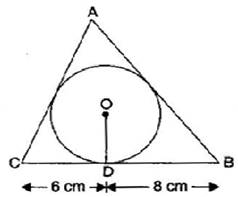
A triangle ABC is drawn to circumscribe a circle of radius 4 cm such that the segments BD and DC into which BC is divided by the point of contact D are of lengths 8 cm and 6 cm respectively (see figure). Find the sides AB and AC.
Two dice are thrown together. Find the probability that the product of the numbers on the top of the dice is:
  1. 6
  2. 12
  3. 7
A medicine capsule is in the shape of a cylinder with two hemipheres stuck to each of its ends. The length of the entire capsule is 14mm and the diameter of the capsule is 5mm. Fin its surface area.
The$ n^{th}$ term of an AP is (3n + 5). Find its common difference.
Find the median of the following data by making a 'less than ogive'.
Marks
0-10
10-20
20-30
30-40
40-50
50-60
60-70
70-80
80-90
90-100
Number of students
5
3
4
3
3
4
7
9
7
8
If the sum of the first $p$ terms of an $A.P.$ is $q$ and the sum of the first $q$ terms is $p$; then show that the sum of the first $(p+q)$ terms is $\{-(p+q)\}$.
A card is drawn at random from a well-shuffled deck of 52 cards. Find the probability of getting:
  1. A queen.
  2. A diamond.
  3. A king or an ace.
  4. A red ace.
If $a_n$ denotes the $n^{\text {th }}$ term of the AP $2,7,12,17, \ldots$, find the value of $\left(a_{30}-a_{20}\right)$.
Two cones with same base radius 8cm and height 15cm are joined together along their bases. Find the surface area of the shape formed.
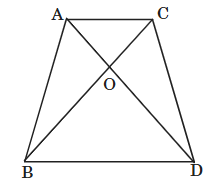
In the given figure, $A B C$ and $D B C$ are two triangles on the same base $B C$. If $A D$ intersects $B C$ at $O$, show that $\frac{\operatorname{ar}(\triangle A B C)}{\operatorname{ar}(\triangle D B C)}=\frac{A O}{D O}$
Image