Question
Solve the following quadratic equations by factorization:
$\frac{\text{x}-\text{a}}{\text{x}-\text{b}}+\frac{\text{x}-\text{b}}{\text{x}-\text{a}}=\frac{\text{a}}{\text{b}}+\frac{\text{b}}{\text{a}}$
Answer

$\frac{\text{x}-\text{a}}{\text{x}-\text{b}}+\frac{\text{x}-\text{b}}{\text{x}-\text{a}}=\frac{\text{a}}{\text{b}}+\frac{\text{b}}{\text{a}}$
$\Rightarrow\frac{\text{x}-\text{a}}{\text{x}-\text{b}}-\frac{\text{a}}{\text{b}}=\frac{\text{b}}{\text{a}}-\frac{\text{x}-\text{b}}{\text{x}-\text{a}}$
$\Rightarrow\frac{\text{bx}-\text{ab}-\text{ax}+\text{ab}}{\text{b}(\text{x}-\text{b})}=\frac{\text{bx}-\text{ab}-\text{ax}+\text{ab}}{\text{a}(\text{x}-\text{a})}$
$\Rightarrow\frac{\text{bx}-\text{ax}}{\text{b}(\text{x}-\text{b})}=\frac{\text{bx}-\text{ax}}{\text{a}(\text{x}-\text{a})}$
$\Rightarrow\frac{\text{bx}-\text{ax}}{\text{b}(\text{x}-\text{b})}-\frac{\text{bx}-\text{ax}}{\text{a}(\text{x}-\text{a})}=0$
$\Rightarrow(\text{bx}-\text{ax})\bigg(\frac{1}{\text{b}(\text{x}-\text{b})}-\frac{1}{\text{a}(\text{x}-\text{a})}\bigg)=0$
$\Rightarrow(\text{b}\text{x}-\text{ax})\bigg(\frac{\text{a}(\text{x}-\text{a})-\text{b}(\text{x}-\text{b})}{\text{a}\text{b}(\text{x}-\text{a})(\text{x}-\text{b})}\bigg)=0$
$\Rightarrow\frac{\text{x}(\text{b}-\text{a})(\text{ax}-\text{bx}-\text{a}^2+\text{b}^2)}{\text{ab}(\text{x}-\text{a})(\text{x}-\text{b})}=0$
$\because\text{x}\neq\text{a},\text{x}\neq\text{b}$
(Division by Zero is not possible)
$\therefore\text{x}(\text{ax}-\text{bx}-\text{a}^2+\text{b}^2)=0$
Either $\text{x}=0$
or $\text{ax}-\text{bx}=\text{a}^2-\text{b}^2$
$\Rightarrow(\text{a}-\text{b})\text{x}=(\text{a}+\text{b})(\text{a}-\text{b})$
$\Rightarrow\text{x}=\frac{(\text{a}+\text{b})(\text{a}-\text{b})}{\text{a}-\text{b}}=\text{a}+\text{b}$
Hence, $\text{x}=0,\text{a}+\text{b}$

Need a full question paper?

Generate a complete, print-ready paper with questions like this in minutes — across 16+ boards, with answer keys.

Start Generating Free

Similar questions

Show that $\triangle\text{ABC},$ with where A(22, 0), B(2, 0) and C(0, 2) and $\triangle\text{PQR}$ where P(-4, 0), Q(4, 0) and R(0, 4) are similar triangles.
A lending library has a fixed charge for the first three days and an additional charge for each day thereafter. Mona paid ₹ 27 for a book kept for 7 days, while Tanvy paid ₹ 21 for the book she kept for 5 days. Find the fixed charge and the charge for each extra day.
Find the roots of the following equations, if they exist, by applying the quadratic formula:$x^2 + x + 2 = 0$
Prove the following identities:
$\frac{\sin\theta}{(1+\cos\theta)}+\frac{(1+\cos^2\theta)}{\sin\theta}=2\text{cosec}\theta$
The radii of the circular ends of a bucket of height 15cm are 14cm and r cm (r < 14). If the volume of bucket is $5390cm^3,$ then find the value of r.
The sum of first seven terms of an A.P. is 182 . If its $4^{\text {th }}$ and the $17^{\text {th }}$ terms are in the ratio $1: 5$, find the A.P.
A well with inner radius 4m is dug 14m deep. Earth taken out of it has been spread evenly all around a width of 3m it to form an embankment. Find the height of the embankment.
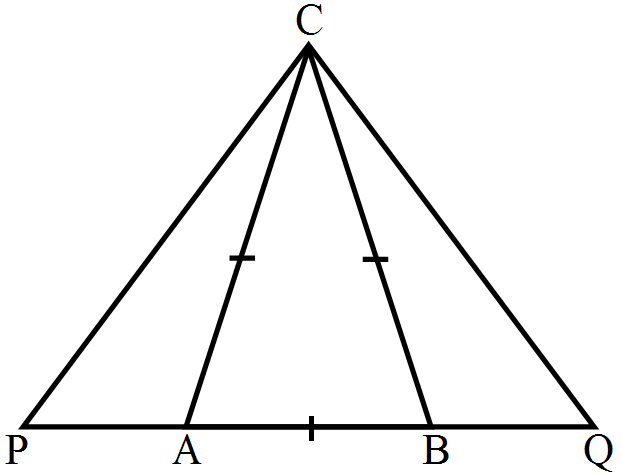
In an isosceles $\triangle\text{ABC},$ the base AB is produced both ways in P and Q such that $AP \times BQ = AC^2.$
Prove that $\triangle\text{ACP}\sim\triangle\text{BCQ}.$
A metallic solid right circular cone is of height 84cm and the radius of its base is 21cm. It is melted and recast into a solid sphere. Find the diameter of the sphere.
The sum of the digits of a two-digit number is 9. Also, nine times this number is twice the number obtained by reversing the order of the digits. Find the number.