Question
Solve the following quadratic equations by factorization:
$\text{x}^2-\big(\sqrt{2}+1\big)\text{x}+\sqrt{2}=0$

Answer

$\text{x}^2-\big(\sqrt{2}+1\big)\text{x}+\sqrt{2}=0$
$\Rightarrow(\text{x})^2-2\Big(\frac{\sqrt{2}+1}{2}\Big)\text{x}+\sqrt{2}=0$
$\Rightarrow(\text{x})^2-2\times\Big(\frac{\sqrt{2}+1}{2}\Big)\times\text{x}+\Big(\frac{\sqrt{2}+1}{2}\Big)^2-\frac{3-2\sqrt{2}}{4}=0$
$\begin{cases}\Big(\frac{\sqrt{2}+1}{2}\Big)^2-\frac{3-2\sqrt{2}}{4}\\=\frac{2+1+2\sqrt{2}}{4}-\frac{3-2\sqrt{2}}{4}=\sqrt{2}\end{cases}$
$\Rightarrow\Big(\text{x}-\frac{\sqrt{2}+1}{2}\Big)^2$
$=\frac{3-2\sqrt{2}}{4}$
$=\frac{2+1-2\sqrt{2}}{4}$
$=\Big(\pm\frac{\sqrt{2}-1}{2}\Big)^2$
$\therefore\text{x}-\frac{\sqrt{2}+1}{2}=\pm\frac{\sqrt{2}-1}{2}$
$\Rightarrow\text{x}=\frac{\sqrt{2}+1}{2}\pm\frac{\sqrt{2}-1}{2}$
$\therefore\text{x}=\frac{\sqrt{2}+1}{2}+\frac{\sqrt{2}-1}{2}$
$=\frac{2\sqrt{2}}{2}-\sqrt{2}$
and $\text{x}=\frac{\sqrt{2}+1}{2}-\frac{\sqrt{2}-1}{2}$
$=\frac{2}{2}=1$
Hence roots are $1,\sqrt{2}$

Need a full question paper?

Generate a complete, print-ready paper with questions like this in minutes — across 16+ boards, with answer keys.
Start Generating Free

Similar questions

Find the ratio in which the point P(x, 2) divides the line segment joining the points A(12, 5) and B(4, -3). Also, find the value of x.
All integers from $1$ to $500$ which are multiplies of $2$ or $5$.
Three measuring rods are $64\ cm,$ $80\ cm$ and $96\ cm$ in length. Find the least length of cloth that can be measured an exact number of times, using any of the rods.
In a morning walk three persons step off together, their steps measure $80\ cm, 85\ cm$ and $90\ cm$ respectively.
What is the minimum distance each should walk so that he can cover the distance in complete steps?
Diagonals of a quadrilateral $\mathrm{ABCD}$ intersect in point $\mathrm{Q}$. If $2 \mathrm{QA}=\mathrm{QC}$, $2 \mathrm{QB}=\mathrm{QD}$, then prove that $\mathrm{DC}=2 \mathrm{AB}$.
Given :
$ 2 Q A=Q C$
$2 Q B=Q D $
To prove : $\mathrm{CD}=2 \mathrm{AB}$
Let there be an A.P. with first term $'a'$, common difference $'d'$. If $a_n$​​​​​​​ denotes in $n^{th}​​​​​​​$​​​​​​​ term and $S_n​​​​​​​$​​​​​​​ the sum of first $n$ terms, find.
d, if $a = 3, n = 8$ and $S_n = 192$.
The sum of the squares of two consecutive natural numbers is 100 . Find the numbers.
If the sum of 7 terms of an A.P. is 49 and that of 17 terms is 289, find the sum of n terms.
A rectangular field is $16\ m$ long and $10\ m$ wide. There is a path of uniform width all around it, having an area of $120\ m^2$​​​​​​​. Find the width of the path.
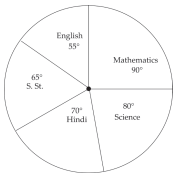
The following pie chart gives the marks scored in an examination by a student in various subjects. If the total marks obtained by the student were 360, answer the following questions
Image
(i) Find the marks obtained in each subject.
(ii) How many more marks he got in Mathematics than in Science?
(iii) Which subject he get the least marks?