Question
Solve the following simultaneous equation.
5m – 3n = 19; m – 6n = –7

Answer


$\begin{aligned}
& 5 m-3 n=19 \ldots (1) \\
& m-6 n=-7 \ldots (2)
\end{aligned}$
Multiply Eq. II by 5
$5 m-30 n=-35 \ldots (3)$
equating (I) and (III), change the sign of Eq. (III)
$\begin{aligned}
& 5 m -3 n =19 \\
& -5 m +30 n =35\text { Adding both we get } \\
& \Rightarrow 27 n =54
\end{aligned}$
$\begin{aligned}
\Rightarrow n=\frac{54}{27} \\
\Rightarrow n=2
\end{aligned}$
Substituting n = 2 in Eq 1
⇒ 5m - 3(2) = 19
⇒ 5m - 6 = 19
⇒ 5m = 25
⇒ m = 5
∴ Solution is (m , n) = (5, 2)

Need a full question paper?

Generate a complete, print-ready paper with questions like this in minutes — across 16+ boards, with answer keys.
Start Generating Free

Similar questions

Find the nature of the roots of the following quadratic equations:$\text{12x}^2-4\sqrt{15}\text{x}+5=0$
Solve the following quadratic equation by completing square method:
$6 m^2+m=2$
Which of the following are quadratic equations?
$\text{x}+\frac{1}{\text{x}}=\text{x}^2,\text{x}\neq0$
Write sample space ‘S’ and number of sample point n(S) for each of the following experiments. Also write events A, B, C in the set form and write n(A), n(B), n(C).
Two dice are rolled simultaneously,
Event A : The sum of the digits on upper faces is a multiple of 6.
Event B : The sum of the digits on the upper faces is minimum 10.
Event C : The same digit on both the upper faces.

In the equation 2𝑥 − 𝑦 = 2 if 𝑥 = 3 then find y=?
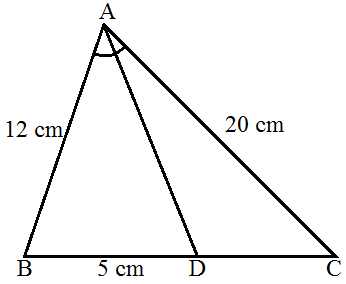
In figure, AD bisects $\angle\text{A},$ AB = 12cm, AC = 20cm, and BD = 5cm. Determine CD.
A card is drawn at random from a pack of 52 cards. Find the probability that the card drawn is:
Either a black card or a king.
In the following, determine whether the given quadratic equation have real root and if so, find the root:
$3x^2 - 2x + 2 = 0$
Given A(4,-3), B(8,5). Find the coordinates of the point that divides segmentAB in the ratio 3 : 1.
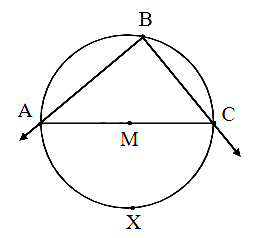
The angle inscribed in the semicircle is a right angle. Prove the result by completing the following activity.

Given: $\angle A B C$ is inscribed angle in a semicircle with center $M$
To prove: $\angle A B C$ is a right angle.
Proof: Segment AC is a diameter of the circle.
$
\therefore m(\operatorname{arc} A X C)=\square
$
Arc $A X C$ is intercepted by the inscribed angle $\angle A B C$
$\angle ABC =\square$ [Inscribed angle theorem]
$
=\frac{1}{2} \times \square
$
$\therefore m \angle ABC =\square$
$\therefore \angle ABC$ is a right angle.