Question
Solve the following simultaneous equations using Cramer’s rule.
4x + 3y – 4 = 0; 6x = 8 – 5y
Answer

$4 x+3 y=4 $
$6 x+5 y=8$
$D=\begin{bmatrix}4 & 3 \\6 & 5\end{bmatrix}$$=(4 \times 5)-(3 \times 6)=20-18=2 $
$D_x=\begin{bmatrix} 4 & 3 \\8 & 5 \end{bmatrix}=(4 \times 5)-(3 \times 8)=20-24=-4$
$D_y=\begin{bmatrix} 4 & 4 \\ 6 & 8 \end{bmatrix}=(4 \times 8)-(4 \times 6)=32-24=8$
$x=\frac{D_x}{D}=-\frac{4}{2}=-2 y=\frac{D_y}{D}=\frac{8}{2}=4$
$\therefore(x, y)=(-2,4)$ is the solution.

Need a full question paper?

Generate a complete, print-ready paper with questions like this in minutes — across 16+ boards, with answer keys.

Start Generating Free

Similar questions

The sum of two numbers is $18$. The sum of their reciprocals is $\frac{1}{4}$ Find the numbers.
If $3$ is a root of the quadratic equation $x^2 - x + k = 0$, find the value of p so that the roots of the equation $x^2+ k(2x + k + 2) + p = 0$ are equal.
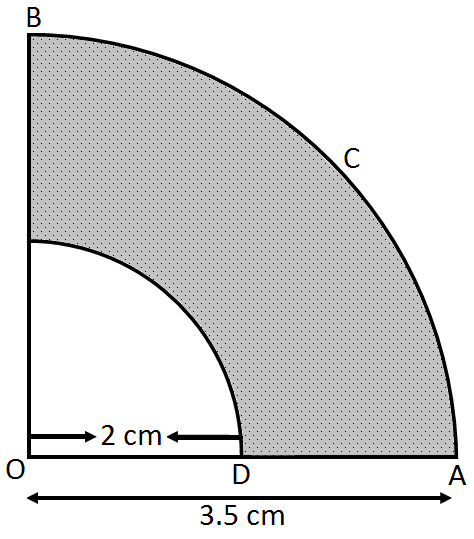
In the following figure, OACB is a quadrant of a circle with centre O and radius 3.5cm. If OD = 2cm, find the area of the: (i) Quadrant OACB (ii) Shaded region.
In a cylindrical vessel of diameter $24\ cm$, filled up with sufficient quantity of water, a solid spherical ball of radius $6\ cm$ is completely immersed. Find the increase in height of water level.
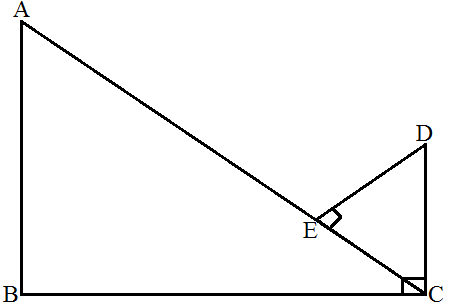
In the figure, if $\text{AB}\perp\text{BC,}$ $\text{DC}\perp\text{BC,}$ and $\text{DE}\perp\text{AC,}$ prove that $\triangle\text{CED}\sim\triangle\text{ABC.}$
Show that points $P(1,-2)$ $Q(5,2)$, $R(3,-1)$, $S(-1,-5)$ are the vertices of a parallelogram.
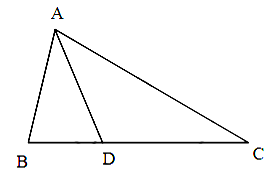
In ΔABC, B − D − C and BD = 7, BC = 20, then find the following ratio.


prove : Suppose two chords of a circle intersect each other in the interior of the circle, then the product of the lengths of the two segments of one chord is equal to the productof the lengths of the two segments of the other chord.
Water running in a cylindrical pipe of inneer diameter $7\ cm$, is collected in a container at the rate of $192.5$ litres per minute. Find the rate o flow of water in the pipe in km/hr.
The sum of the radii of two circles is $140\ cm$ and the difference of their circumferences is $88\ cm$. Find the diameters of the circles.