Question
Solve the following simultaneous equations using Cramer’s rule.
6x – 4y = –12; 8x – 3y = –2
Answer

$6 x-4 y=-12 $
$8 x-3 y=-2 $
$D=\begin{bmatrix} 6 & -4 \\ 8 & -3 \end{bmatrix}=(6 \times-3)-(-4 \times 8)=-18+32=14$
$D_x=\begin{bmatrix} -12 & -4 \\ -2 & -3 \end{bmatrix}=(-12 \times-3)-(-4 \times-2)=36-8=28 $
$D_y=\begin{bmatrix} 6 & -12 \\ 8 & -2 \end{bmatrix}=(6 \times-2)-12 \times 8=12+96=108 $
$x=\frac{D_x}{D}=\frac{28}{14}=2 y=\frac{D_y}{D}=\frac{108}{14}=6$
$\therefore(x, y)=(2,6)$ is solution.

Need a full question paper?

Generate a complete, print-ready paper with questions like this in minutes — across 16+ boards, with answer keys.

Start Generating Free

Similar questions

Solve the following simultaneous equations using Cramer’s rule.
4x + 3y – 4 = 0; 6x = 8 – 5y
The probability of selecting a green marble at random from a jar that contains only green, white and yellow marbles is $\frac{1}{4}$. The probability of selecting a white marble at random from the same jar is $\frac{1}{3}$. If this jar contains 10 yellow marbles. What is the total number of marbles in the jar?
If $\text{x}=\text{a}\sin\theta\text{ and y}=\text{b}\cos\theta,$ what is the value pf $b^2x^2 + a^2y^2$?
Mr. Chavan purchased 100 shares of ₹ 100 face value at ₹ 150 market value. He paid $0.2 \%$ brokerage and GST $18 \%$ on brokerage. Then, find his total investment on 100 shares.
Tiptop Electronics’ supplied an AC of 1.5 ton to a company. Cost of the AC supplied is Rs. 51,200 (with GST). Rate of CGST on AC is 14%. Then find the following amounts as shown in the tax invoice of Tiptop Electronics.
(1) Rate of SGST
(2) Rate of GST on AC
(3) Taxable value of AC
(4) Total amount of GST
(5) Amount of CGST
(6) Amount of SGST
A man goes $15$ meters due west and then $8$ meters due north. How far is he from the starting point$?$
Solve the following quadratic equation: $2x^2 + ax - a^2 = 0$
For the following arithmetic progressions write the first term a and the common difference d:
$\frac{1}{5},\frac{3}{5},\frac{5}{5},\frac{7}{5}.$
Prove the following.
sec6x – tan6x = 1 + 3 sec2x × tan2x

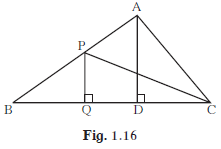
In adjoining figure PQ ⊥ BC, AD ⊥ BC then find following ratios.

(i) $\frac{ A (\Delta PQB )}{ A (\triangle PBC )}$
(ii) $\frac{ A (\Delta PBC )}{ A (\Delta ABC )}$
(iii) $\frac{ A (\Delta ABC )}{ A (\triangle ADC )}$
(iv) $\frac{ A (\Delta ADC )}{ A (\Delta PQC )}$