Question
Solve the following simultaneous equations.
$5 x-3 y=8 ; 3 x+y=2$

Answer

Get the step-by-step solution for this question inside the Vidyadip app.

Get the answer in the app

Need a full question paper?

Generate a complete, print-ready paper with questions like this in minutes — across 16+ boards, with answer keys.
Start Generating Free

Similar questions

If $\cot \theta=\frac{40}{9},$ find the values of cosecθ and sinθ.
A box contains 90 discs which are numbered from 1 to 90. If one discs is drawn at random from the box, find the probability that it bears:
  1. A two digit number.
  2. A perfect square number.
  3. A number divisible by 5.
The sum of first $q$ terms of an A.P. is $63 q-3 q^2$. If its $p^{\text {th }}$ term is -60 , find the value of $p$. Also, find the $11^{\text {th }}$ term of this A.P.
Disha purchased some beauty products and paid GST of ₹ 1500 . She sold all the beauty products to one customer and collected GST of ₹ 1700. Find the CGST and SGST to be paid.
Eliminate $\theta$ from given equations.
x=a $\cot$ $\theta$ -b cosec $\theta$
y=a $\cot$ $\theta$+b cosec $\theta$
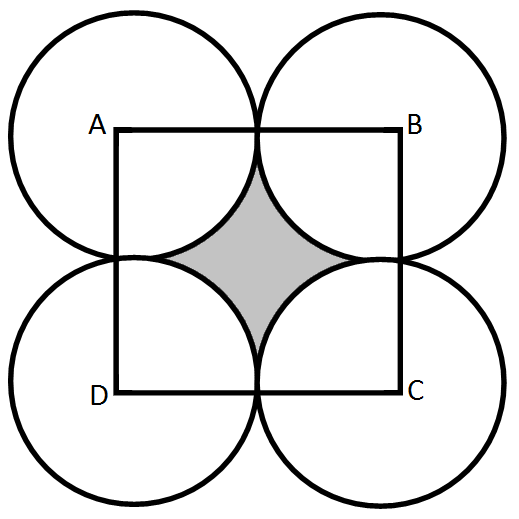
A child makes a poster on a chart paper drawing a square ABCD of side 14cm. She draws four circles with centre A, B, C and D in which she suggests different ways to save energy. The circles are drawn in such a way that each circle touches externally two of the three remaining circles (in the following figure). In the shaded region she write a message 'Save Energy'. Find the perimeter and area of the shaded region.$\Big(\text{Use }\pi=\frac{22}{7}\Big)$
In an A.P. $17^{\text {th }}$ term is $7$ more than its $10^{\text {th }}$ term. Find the common difference.
$ABCD$ is a parallelogram with vertices $A(x_1, y_1), B(x_2, y_2)$ and $C(x_3, y_3)$.
Find the coordinates of the fourth vertex $D$ in terms of $x_1, x_2, x_3, y_1, y_2$ and $y_3$.
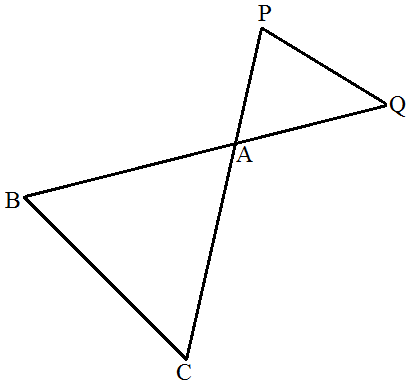
In the given figure, $\triangle\text{ACB}\sim\triangle\text{APQ}.$ If BC = 10cm, PQ = 5cm, BA = 6.5cm and AP = 2.8cm, find CA and AQ. Also, find the area$ (\triangle\text{ACB)}$ : area $ (\triangle\text{APQ)}.$