Question
Solve the following simultaneous equations.
$\frac{7 x-2 y}{x y}=5 ; \frac{8 x+7 y}{x y}=15$

Answer

$\frac{7 x-2 y}{x y}=5 \Rightarrow \frac{7 x}{x y}-\frac{2 y}{x y}=5 \Rightarrow \frac{7}{y}-\frac{2}{x}=5 \ldots \text { (I) } $
$\frac{8 x+7 y}{x y}=15 \Rightarrow \frac{8 x}{x y}+\frac{7 y}{x y}=15 \Rightarrow \frac{8}{y}+\frac{7}{x}=15 \ldots (II)$
$\frac{1}{x}=m \text { and } \frac{1}{y}=n $
$7 n-2 m=5 \ldots \text { (III) }$
$8 n+7 m=15 \ldots(\text { IV) }$
Multiply Eq. 1 by 7 and Eq.Il by 2
$49 n -14 m=35 \ldots( V ) 16 n +14 m=30 \ldots( VI ) $
$65 n =65 $
$n =\frac{65}{65} $
$n =1$
Substituting value in Eq.VI
$16 \times 1+14 m=30$
$14 m=30-16 $
$14 m=14$
$m=\frac{14}{14}$
$m=1$
$\therefore \frac{1}{x}= m \Rightarrow \frac{1}{x}=1 \Rightarrow x =1 $
$\frac{1}{ y }= n \Rightarrow \frac{1}{y}=1 \Rightarrow y =1$
Hence, $(x, y)=(1,1)$

Need a full question paper?

Generate a complete, print-ready paper with questions like this in minutes — across 16+ boards, with answer keys.

Start Generating Free

Similar questions

Shri Maniklal has purchased 300 shares of F.V. ₹ 100, for M.V. ₹ 120. Company has paid dividend at 7%. Complete the following activity to find the rate of return on his investment.
Activity :
F.V. = ₹ 100
Number of shares = 300
Market value = ₹ 120
(a) Sum invested = M.V. × No. of shares
$\therefore$ = ⬜ x ⬜
= ₹ 36,000
(b) Dividend per share $=$ F.V. × rate of dividend
= ⬜ x $\frac{⬜}{100} $
= ₹ 7
$\therefore \quad$ Total dividend received $=300 \times 7$
= ₹ ⬜
(c) Rate of return $=\frac{\text { Dividend income }}{\text { Sum invested }} \times 100$
$=\frac{2,100}{36,000} \times 100 $
= ⬜ %
Determine the set of values of $k$ for which the given following quadratic has real root:
$4x^2 - 3kx + 1 = 0$
The following data gives the information on the observed lifetimes (in hours) of $225$ electrical components:
Lifetimes (in hours)
0-20
20-40
40-60
60-80
80-100
100-120
No. of components
10
35
52
61
38
29
Determine the modal lifetimes of the components.
Find the centroids of the triangles whose vertices are given below.
(1) (-7, 6), (2, -2), (8, 5)
(2) (3, -5), (4, 3), (11, -4)
(3) (4, 7), (8, 4), (7, 11)

Draw a circle with centre P and radius 3.4 cm. Take point Q at a distance 5.5 cm from the centre. Construct tangents to the circle from point Q.
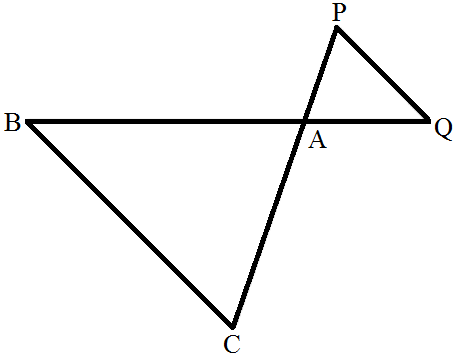
In the given figure, $\triangle\text{ACB}\sim\triangle\text{APQ}.$ If BC = 8cm, PQ = 4cm, BA = 6.5cm and AP = 2.8cm, find CA and AQ.
If 1 is added to the numerator of a certain fraction its value becomes $\frac{1}{2}$ and if 1 is added to its denometer $\frac{1}{3}$. Find the original fraction.
If $\sqrt{3} \tan \theta=3 \sin \theta$, find the value of $\sin ^2 \theta-\cos ^2 \theta$.
Is 184 a term of the AP 3, 7, 11, 15, ....?
The rain water from a roof of dimensions 22m × 20m drains into a cylindrical vessel having diameter of base 2m and height 3.5m. If the rain water collected from the roof just fills the cylindrical vessel, then find the rain in cm.