Question
Solve the following system of equations graphically:
3x + 2y = 4,
2x - 3y = 7

Answer

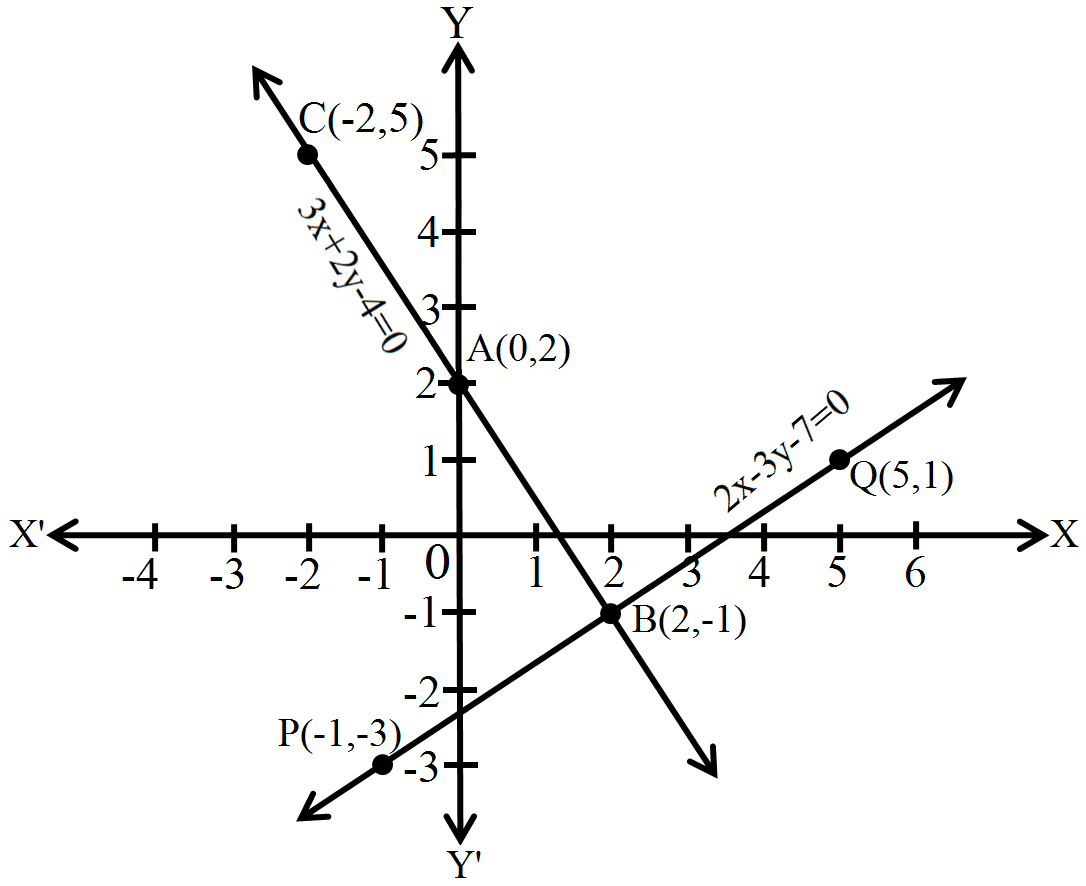
On a graph paper, draw a horizontal line X'OX and a vertical line YOY' representing the x-axis and y-axis, respectively. Graph of 3x + 2y = 4: 3x + 2y = 4 $\Rightarrow\text{y}=\frac{4-\text{3x}}{2}$ Thus we have the following table for 3x + 2y = 4
x:
0
2
-2
y:
2
-1
5
Plot the points A(0, 2), B(2, -1) and C(-2, 5) on the graph paper. Join AB and AC to get the graph line BC. Extend it on both ways. Thus, the line BC is the graph of 3x + 2y = 4. Graph of 2x - 3y = 7: $\Rightarrow\text{y}=\frac{\text{2x}-7}{3}$ Thus, we have the following table for 2x - 3y = 7 is
x:
2
-1
5
y:
-1
-3
1
Now, on the same graph paper plot the points P(-1, -3) and Q(5, 1). The point B(2, -1) has already been plotted. Join PB and QB and extend it on both ways. Thus, line PQ is the graph of 2x - 3y = 7.
The two graph lines intersect at B(2, -1). $\therefore$ x = 2, y = -1 is the solution of the given system of equations.

Need a full question paper?

Generate a complete, print-ready paper with questions like this in minutes — across 16+ boards, with answer keys.
Start Generating Free

Similar questions

Find the values of x and y in the following rectangle.
Find the mean from the following frequency distribution of marks at a test in statistics:
Marks$ (x):$ $5$ $10$ $15$ $20$ $25$ $30$ $35$ $40$ $45$ $50$
No. of students $(f):$ $15$ $50$ $80$ $76$ $72$ $45$ $39$ $9$ $8$ $6$
In an A.P., if the $5^{\text {th }}$ and $12^{\text {th }}$ terms are 30 and 65 respectively, what is the sum of first 20 terms?
A square ABCD is inscribed in a circle of radius r. Find the area of the square.
When 3 is added to the denominator and 2 is subtracted from the numerator a fraction becomes $\frac{1}{4}.$ And when 6 is added to numerator and the denominator is multiplied by 3, it becomes $\frac{2}{3}.$ Find the fraction.
A spiral is made up of successive semicircles, with centres alternately at A and B, starting with centre at A, of radii 0.5 cm, 1.0 cm, 1.5 cm, 2.0 cm, ... as shown in Figure. What is the total length of such a spiral made up of thirteen consecutive semicircles? $(Take\; \pi = \frac { 22 } { 7 } )$
[Hint: Length of successive semicircles is$ l_1, l_2, l_3, l_4, ...$ with centres at A, B, A, B, ... respectively.]
Image
If the centroid of $\triangle\text{ABC}$ having vertices A(a, b), B(b, c) and C(c, a) is the origin, then find the value of (a + b + c).
In the given figure, the side of square is 28 cm and radius of each circle is half of the length of the side of the square where $O$ and $O$ are centres of the circles. Find the area of shaded region.
Image
Short-Answer Question:
If $\alpha$ and $\beta$ are the zeroes of a polynomial $f(x) = x^2 - 5x + k$, such that $\alpha-\beta=1$ find the value of k.
Graphically, solve the following pair of equations:
$2x + y = 6$
$2x - y + 2 = 0$
Find the ratio of the areas of the two triangles formed by the lines representing these equations with the x axis and the lines with the y-axis.