Question
Solve the following system of linear equation graphically and shade the region between the two lines and x-axis:
2x + 3y = 12,
x - y = 1.

Answer

The system of given equations is,
2x + 3y = 12
x - y = 1
Now, 2x + 3y = 12
⇒ 2x = 12 - 3y
When y = 2, we have,
$\text{x}=\frac{12-3\times2}{2}=3$
When y = 4, we have,
$\text{x}=\frac{12-3\times4}{2}=0$
Thus, we have the following table,
x
0
3
y
4
2
We have, x - y = 1
⇒ x = 1 + y
When y = 0, we have,
x = 1
When y = 1, we have,
x = 1 + 1 = 2
Thus, we have the following table,
x
1
2
y
0
1
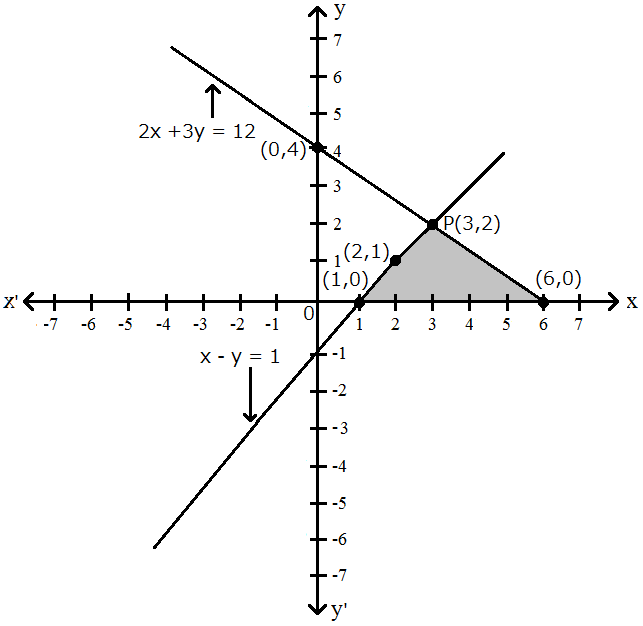
Graph of the given system of equations.

Clearly, the two lines intersect at P(3, 2).
Hence, x = 3, y = 2 is the solution of the given system of equations.

Need a full question paper?

Generate a complete, print-ready paper with questions like this in minutes — across 16+ boards, with answer keys.

Start Generating Free

Similar questions

A fish tank is in the form of a cuboid, external measures of that cuboid are 80 cm x 40 cm × 30 cm. The base, side faces and back face are to be covered with a coloured paper. Find the area of the paper needed.
If a square is inscribed in a circle, find the ratio of the area of the circle and the square.
Roshani saw an eagle on the top of a tree at an angle of elevation of 61°, while she was standing at the door of her
house. She went on the terrace of the house so that she could see it clearly. The terrace was at a height of 4m. While
observing the eagle from there the angle of elevation was 52°. At what height from the ground was the eagle ?
(Find the answer correct upto nearest integer)
(tan 61° = 1.80, tan 52° = 1.28, tan 29° = 0.55, tan 38° = 0.78)
Compute the mode from the following data:
Class interval
1-5
6-10
11-15
16-20
21-25
26-30
31-35
36-40
41-45
46-50
Frequency
3
8
13
18
28
20
13
8
6
4
A tent is of the shape of a right circular cylinder upto a height of 3m and then becomes a right circular cone with a maximum height of 13.5m above the ground. Calculate the cost of painting the inner side of the tent at the rate of Rs. 2 per square metre, if the radius of the base is 14m.
In $\triangle ABC , \angle ABC =90^{\circ} . \triangle PAB , \triangle QAC$ and $\triangle RBC$ are the equilateral triangles constructed on sides $A B, A C$ and $B C$ respectively. Prove that : $A (\triangle P A B)+ A (\triangle R B C)= A (\triangle Q A C)$.
Solve: $2^x+3^y=17,2^{x+2}-3^{y+1}=5$
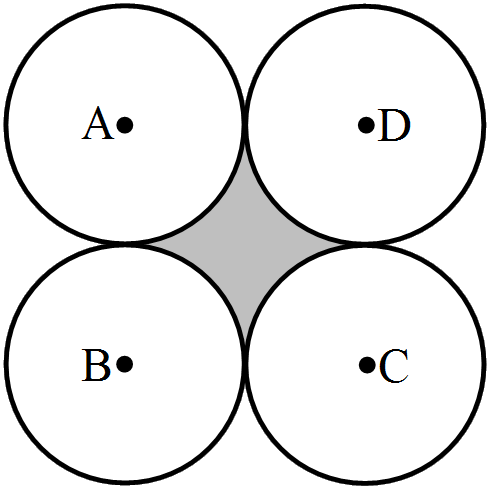
Four equal circles, each of radius 5cm, touch each other, as shown in the figure. Find the area included between them. $[\text{Take }\pi\ =3.14]$
The sum of first m term of an AP is $(4m^2 - m)$. If its $n^{th}$​​​​​​​ term is $107$, find the value of n. Also, find the $21^{st}​​​​​​​$​​​​​​​ term of this AP.
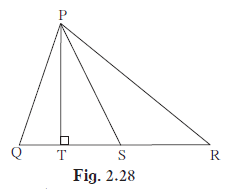
In the figure 2.28 seg PS is the median of ΔPQR and PT ⊥ QR. Prove that,
(1) $PR ^2= PS ^2+ QR \times ST +\left(\frac{ QR }{2}\right)^2$
(2) $PQ ^2= PS ^2- QR \times ST +\left(\frac{ QR }{2}\right)^2$