Question
Solve the following systems of equations by using the method of cross multiplication:
$\frac{\text{x}}{6}+\frac{\text{y}}{15}=4,$
$\frac{\text{x}}{3}-\frac{\text{y}}{15}=\frac{\text{19}}{4}$

Answer

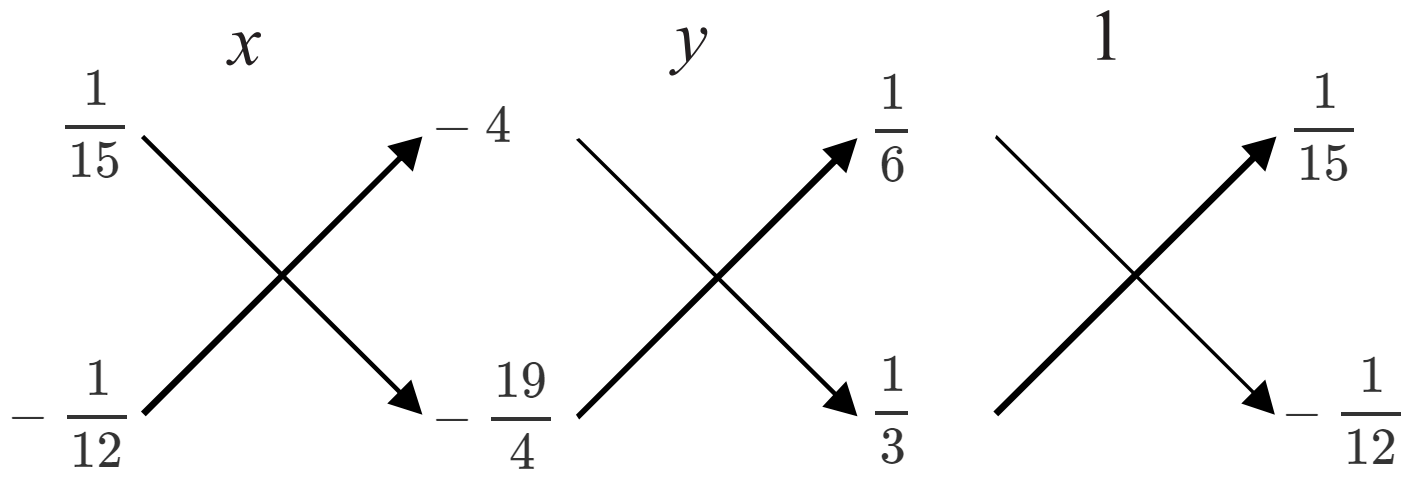
The given equations may be written as: $\frac{\text{x}}{6}+\frac{\text{y}}{15}-4=0\ \dots(\text{i})$ $\frac{\text{x}}{3}-\frac{\text{y}}{15}-\frac{\text{19}}{4}=0\ \dots(\text{ii})$ Here, $\text{a}_1=\frac{1}{6},\ \text{b}_1=\frac{1}{15},\ \text{c}_1=-4,$ $\text{a}_2=\frac{1}{3},\ \text{b}_2=-\frac{1}{12}$ and $\text{c}_2=-\frac{19}{4}$ By cross multiplication, we have:
$\therefore\frac{\text{x}}{\big[\frac{1}{15}\times\big(-\frac{19}{4}\big)-\big(-\frac{1}{12}\big)\times(-4)\big]}=\frac{{\text{y}}}{\big[(-4)\times\frac{1}{3}-\big(\frac{1}{6}\big)\times\big(-\frac{19}{4}\big)\big]}\\=\frac{1}{\big[\frac{1}{{6}}\times\big(\frac{-1}{12}\big)-\frac{1}{3}\times\frac{1}{15}\big]}$ $\Rightarrow\frac{\text{x}}{\big(-\frac{19}{60}-\frac{1}{3}\big)}=\frac{\text{y}}{\big(-\frac{4}{3}+\frac{19}{24}\big)}=\frac{1}{\big(-\frac{1}{72}-\frac{1}{45}\big)}$ $\Rightarrow\frac{\text{x}}{\big(-\frac{39}{60}\big)}=\frac{\text{y}}{\big(-\frac{13}{24}\big)}=\frac{1}{\big(\frac{13}{360}\big)}$ $\Rightarrow\text{x}=\Big[\Big(-\frac{39}{60}\Big)\times\Big(-\frac{360}{13}\Big)\Big]=18,$ $\text{y}=\Big[\Big(-\frac{13}{24}\Big)\times\Big(-\frac{360}{13}\Big)\Big]=15$ Hence, x = 18 and y = 15 is the required solution.

Need a full question paper?

Generate a complete, print-ready paper with questions like this in minutes — across 16+ boards, with answer keys.

Start Generating Free

Similar questions

The sum of the squares of two consecutive positive even numbers is 452. Find the numbers.
In a trapezium $\text{ABCD}, A B \| D C$ and $D C=2 A B$. $E F \| A B$, where $E$ and $F$ lie on $B C$ and $A D$ respectively such that $\frac{B E}{E C}=\frac{4}{3}$. Diagonal $DB$ intersects $EF$ at $G$ . Prove that, $7 EF =11 AB$.
Short-Answer Question:
If $\alpha$ and $\beta$ are the zeroes of a polynomial $f(x) = 6x^2 + x - 2$, find the value of $\Big(\frac{\alpha}{\beta}+\frac{\beta}{\alpha}\Big).$
Determine the ratio in which the point (-6, a) divides the join of A(-3, 1) and B(-8, 9). Also find the value of a.
A cylindrical tub of radius $12 \ cm$ contains water to a depth of $20 \ cm.$ A spherical ball is dropped into the tub and the level of the water is raised by $6.75 \ cm.$ Find the radius of the ball.
A medicine capsule is in the shape of a cylinder with two hemispheres stuck to each of its ends. The length of the entire capsule is $14 \ mm$ and the diameter of the capsule is $4 \ mm$ , find its surface area. Also, find its volume.
Image
The length of a rectangular park is twice its breadth, and its perimeter measures 840m. Find the area of the park.
A right circular cylinder and aright circular cone have equal bases and equal heights. If their curved surfaces are in the ratio 8 : 5, determine the ratio of the radius of the base to the height of either of them.
The diagonals of quadrilateral ABCD intersect at O. Prove that $\frac{\text{ar}(\triangle\text{ACB})}{\text{ar}(\triangle\text{ACD})}=\frac{\text{BO}}{\text{DO}}.$
Find the values of k for which the given quadratic equation has real and distinct roots:
$5x^2 - kx + 1 = 0$