Question
Solve the following systems of equations graphically:
$x - 2y = 5$
$2x + 3y = 10$

Answer

The given equations are:
$x - 2y = 5 ......(i)$
$2x + 3y = 10 .....(ii)$
Puting $x = 0$ in equation $(i)$, we get,
$⇒ 0 - 2y = 5$
$\Rightarrow\text{y}=\frac{-5}{2}$
$\Rightarrow\text{x}=0,\ \text{y}=\frac{-5}{2}$
Puting $y = 0$ in equation $(i)$, we get,
$⇒ x + 2 × 0 = 5$
$⇒ x = 5$
$⇒ x = 5, y = 0$
Use the following table to draw the graph.
$x$
$0$
$5$
$y$
$\frac{-5}{2}$
$0$
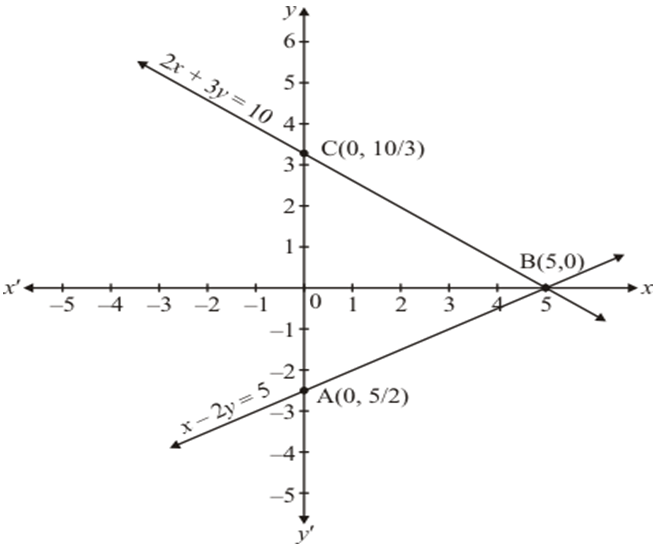
Draw the graph by plotting the two points $\text{A}\Big(0,\frac{-5}{2}\Big)$ and $B(5, 0)$ from table.

Graph the equation$ (ii),$
$⇒ 2x + 3y = 10 ......(ii)$
Putting $x = 0 $in equation $(ii)$, we get,
$⇒ 2 × 0 + 3y = 10$
$\Rightarrow\text{y}=\frac{10}{3}$
$\Rightarrow\text{x}=0,\ \text{y}=\frac{10}{3}$
Putting $y = 0$ in equation $(ii),$ we get,
$⇒ 2x + 3 × 0 = 10$
$⇒ x = 5$
$x = 5, y = 0$
use the following table to draw the graph.
$x$
$0$
$5$
$y$
$\frac{10}{3}$
$0$
Draw the graph by plotting the two points $\text{C}\Big(0,\frac{10}{3}\Big)$ and $B(5, 0)$ from table.
The two lines intersects at points $B(5, 0).$
Hence $x = 5, y = 0$ is the solution.

Need a full question paper?

Generate a complete, print-ready paper with questions like this in minutes — across 16+ boards, with answer keys.
Start Generating Free

Similar questions

Cards marked with numbers $13, 14, 15, ....., 60$ are placed in a box and mixed thoroughly. One card is drawn at random from the box. Find the probability that number on the card drawn is:
  1. Divisible by $5.$
  2. A number is a perfect square.
A toy is in the shape of a right circular cylinder with a hemisphere on one end and a cone on the other. The radius and height of the cylindrical part are $5\ cm$ and $13\ cm$ respectively. The radii of the hemispherical and conical parts are the same as that of the cylindrical part. Find the surface area of the toy if the total height of the toy is $30\ cm.$
A line intersects the $y$-axis and $x$-axis at the points $P$ and $Q$ respectively. If $(2, -5)$ is the midpoint Of $PQ$ then find the coordinates of $P$ and $Q.$
The sum of the squares of two consecutive positive integers is $365$. Find the integers.
If the point $C(-2,3)$ is equidistant from the points $A(3,-1)$ and $B(x, 8)$, find the values of $x$. Also find the distance $B C$.
The taxi charges in a city consist of a fixed charge together with the charge for the distance covered. For a distance of $10\ km,$ the charge paid is $₹\ 105$ and for a journey of $15\ km$ the charge paid is $₹\ 155$. What are the fixed charges and the charge per $km?$ How much does a person have to pay for travelling a distance of $25\ km?$ Find them by substitution method.
QUESIION $D$ and $E$ are points on the sides $A B$ and $A C$ respectively of a $\triangle A B C$ such that $D E \| B C$ : If $\frac{ AD }{ DB }=\frac{4}{7}$ and $AC =6.6 cm$, find $AE .$​​​​​​​
Construct an isosceles triangle whose base is $8\ cm$ and altitude $4\ cm$ and then another triangle whose sides are $1\frac12\text{times}$ the corresponding sides of the isosceles triangle.
If $\tan\theta=\frac{4}{3},$ show that $(\sin\theta+\cos\theta)=\frac75.$
Solve the following quadratic equation:
$\frac{\text{a}}{(\text{x}-\text{b})}+\frac{\text{b}}{(\text{x}-\text{a})}=2,$ $\text{x}\neq-\text{b},\ \text{a}$