Question
Solve the following systems of equations graphically:
x + y = 6
x - y = 2

Answer

The given equations are
x + y = 6 .......(i)
x - y = 2 ..........(ii)
Putting x = 0 in equation (i), we get,
⇒ 0 + y = 6
⇒ y = 6
x = 0, y = 6
Putting y = 0 in equation (i), we get,
⇒ x + 0 = 6
⇒ x = 6
x = 6, y= 0
Use the following table to draw the graph.
x
0
6
y
6
0
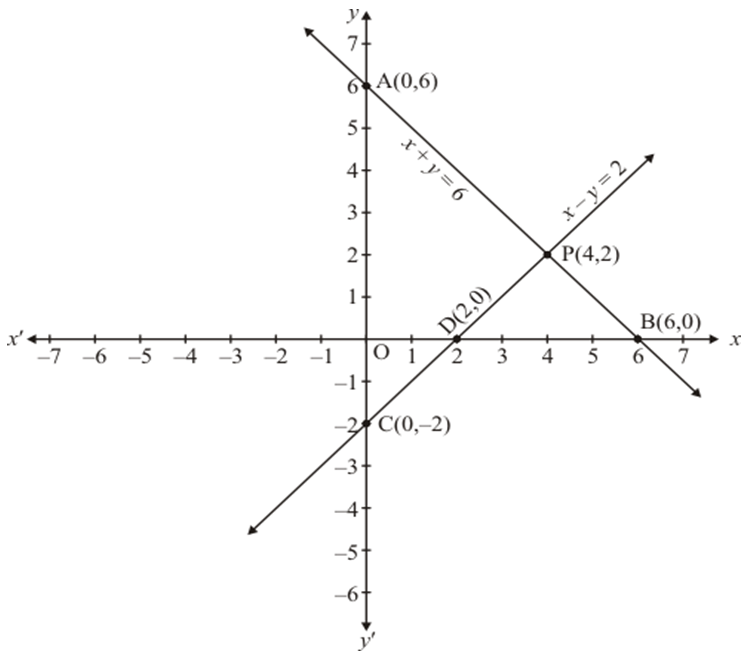
Draw the graph by plotting the two points A(0, 6) and B(6, 0) from table.

Graph of the equation,
x - y = 2 .......(ii)
Putting x = 0 in equation (ii) we get,
⇒ 0 - y = 2
⇒ y = -2
⇒ x = 0, y = -2
Putting y = 0 in equation (ii), we get,
⇒ x - 0 = 2
⇒ x = 2
⇒ x = 2, y = 0
Use the following table to draw the graph.
x
0
2
y
-2
0
Draw the graph by plotting the two points C(0, -2) and D(2, 0) from table.
The two lines intersect at points P(4, 2).
Hence x = 4, y = 2 is the solution.

Need a full question paper?

Generate a complete, print-ready paper with questions like this in minutes — across 16+ boards, with answer keys.

Start Generating Free

Similar questions

Two vertices of an isosceles triangle are $(2, 0)$ and $(2, 5)$. Find the third vertex if the length of the equal sides is 3.
A life insurance agent found the following data for distribution of ages of 100 policy holders. Calculate the median age, if policies are only given to persons having age 18 years onward but less than 60 years.
Age in years
Number of policy holders
Below 20
2
Below 25
6
Below 30
24
Below 35
45
Below 40
78
Below 45
89
Below 50
92
Below 55
98
Below 60
100
Show that $\square ABCD$ is a parallelogram, if $A (-1,2)$, $B(-5,-6)$, $C(3,-2)$ and $D(7,6)$
State the converse of Pythagpras' theorem.
Show that any number of the form $4^n, n \in N$ can never end with the digit $0$.
The following is the distribution of height of students of a certain class in a certain city:
Height (in cms)
160-162
163-165
166-168
16-171
172-174
No. of students
15
118
142
127
18
Find the median height.
Solve graphically the following system of linear equation. Also find the coordinates of the points where the lines meet axis of y.
3x + y - 5 = 0,
2x - y - 5 = 0.
Find a fraction which becomes $\Big(\frac{1}{2}\Big)$ when 1 is subtracted from the numerator and 2 is added to the denominator, and the fraction becomes $\Big(\frac{1}{3}\Big)$ when 7 is subtracted from the numerator and 2 is subtracted from the denominator.
Usha Joshi invested an equal amount in two companies by purchasing equity shares with MV ₹ 145 and ₹ 160 each. The FV is same and it is ₹ 100 for both the shares. At the end of the year, both companies declared the dividends at 20% and 30% each; In which company was her investment profitable?
Solve the following equations by using the method of completing the square:
$\text{x}^2-\big(\sqrt2+1\big)\text{x}+\sqrt2=0$