Question
Solve the following systems of equations:
${\text{x}}+\frac{\text{y}}{2}=4,$
$\frac{\text{x}}{3}+2\text{y}=5.$
Answer

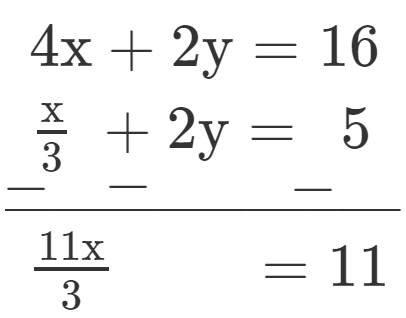
The given equations are, ${\text{x}}+\frac{\text{y}}{2}=4\ .....(\text{i})$ $\frac{\text{x}}{3}+2\text{y}=5\ ......(\text{ii})$ Multiply equation (i) by 4 and subtract equations (i) - (ii), we get 4x + 2y = 16
$\Rightarrow\text{x}=3$ Put the value of x in equation (i), we get $3+\frac{\text{y}}{2}=4$ $\Rightarrow\frac{\text{y}}{2}=1$ $\Rightarrow\text{y}=2$ Hence the value of x and y are x = 3 and y = 2.

Need a full question paper?

Generate a complete, print-ready paper with questions like this in minutes — across 16+ boards, with answer keys.

Start Generating Free

Similar questions

Two poles of height $p$ and $q$ metres are standing vertically on a level ground, a metres apart. Prove that the height of the point of intersection of the lines joining the top of each pole to the foot of the opposite pole is given by $\frac{p q}{p+q}$ metres.
A right angled triangle whose sides are 3cm, 4cm and 5cm is revolved about the sides containing the right angle in two ways. Find the difference in volumes of the two cones so formed. Also, find their curved surfaces.
Show that the following points are the vertices of a square:
P(0, -2), Q(3, 1), R(0, 4) and S(-3, 1)
Find the point on the y-axis which is equidistant from the points A(6, 5) and B(-4, 3).
The numerator of a fraction is 3 less than the denominator. If 2 is added to both the numerator and the denominator, then the sum of the new fraction and the original fraction is $\frac{29}{20}.$ Find the original fraction.
Each side of an equilateral triangle is 10cm.
Find:
  1. The area of the triangle.
  2. The height of the triangle.
The cost of 2kg of apples and 1kg of grapes on a day was found to be Rs. 160. After a month, the cost of 4kg of apples and 2kg of grapes is Rs. 300 Represent the situation algebraically and geometrically.
By the graphical method, find whether the following pair of equations are consistent or not. If consistent, solve them:
$x – 2y = 6, 3x – 6y = 0$
The perimeter of a rhombus is 60cm. If one of its diagonals is 18cm long.
Find:
  1. The length of the other diagonal.
  2. The area of the rhombus.
An electrician has to repair an electric fault on a pole of height 4 metres. He needs to reach a point 1 metre below the top of the pole to undertake the repair work. What should be the length of the ladder that he should use, which when inclined at an angle of 60° to the horizontal would enable him to reach the required position? $\big[\text{Use}\sqrt{3}=1.73\big]$