Question
Solve the following systems of linear equations has no solution:
$\text{x}+2\text{y}\leq3,3\text{x}+4\text{y}\geq12,\text{x}\geq0,\text{y}\geq1.$
Answer


Converting theinequations into equations, we get

$\text{x}+2\text{y}\leq3,3\text{x}+4\text{y}\geq12,\text{x}\geq0,\text{y}\geq1.$

Region represented by $\text{x}+2\text{y}\leq3:$

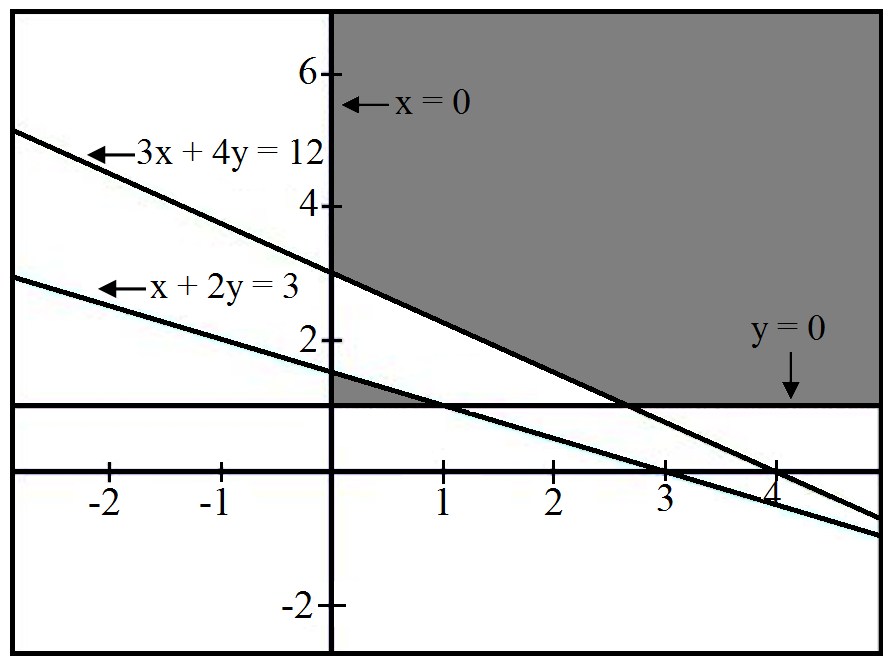
The line x + 2y = 3 meets the coordinate axes at $\Big(0,\frac{3}{2}\Big)$ and (3,0). We find that (0, 0) satisfies inequation $\text{x}+2\text{y}\leq3.$ So the portion containing origin represents the solution set of the inequation $\text{x}+2\text{y}\leq3.$

Region represented by $3\text{x}+4\text{y}\geq12:$

The line 3x + 4y = 12 meets the coordinate axes at (0, 3) and (4, 0). We find that (0, 0) does not satisfy inequation $3\text{x}+4\text{y}\geq12.$So the portion not containing the origin is represented by the inequation $3\text{x}+4\text{y}\geq12.$

Region represented by $\text{x}\geq0:$

Clearly, $\text{x}\geq0$ represents the region lying on the right side of y-axis.

Region represented by $\text{y}\geq1: $

The line y = 1 is parallel to x-axis. (0, 0) does not satisfy inequation $\text{y}\geq1.$ So the region lying above the line y = 1 is represented by $\text{y}\geq1.$

Need a full question paper?

Generate a complete, print-ready paper with questions like this in minutes — across 16+ boards, with answer keys.

Start Generating Free

Similar questions

Prove that the points $(2, -1), (0, 2), (2, 3)$ and $(4, 0)$ are the coordinates of the vertices of a parallelogram and find the angle between its diagonals.
Find the mean deviation from the mean for following data:
$x_i$
10
30
50
70
90
$f_i$
4
24
28
16
8
Prove that $\frac{1}{2}\tan\Big(\frac{\text{x}}{2}\Big)+\frac{1}{4}\tan\Big(\frac{\text{x}}{4}\Big)+...+\frac{1}{2^{\text{n}}}\tan\Big(\frac{\text{x}}{2^{\text{n}}}\Big)=\frac{1}{2^{\text{n}}}\cot\Big(\frac{\text{x}}{2^{\text{n}}}\Big)-\cot\text{x}$ for all $\text{n}\in\text{N}$ and $0<\text{x}<\frac{\pi}{2}$
Evaluate the following limit:
$\lim\limits_{\text{x}\rightarrow-\infty}\big(\sqrt{4\text{x}^2-7\text{x}}+2\text{x}\big)$
Find the equation of the straight line passing through the point of intersection of the lines 5x - 6y - 1 = 0 and 3x + 2y + 5 = 0 and perpendicular to the line 3x - 5y + 11 = 0
Two ships leave a port at the same time. One goes 24km/ hr in the direction N 38° E and other travels 32km/ hr in the direction S 52° E. Find the distance between the ships at the end of 3hrs.
Prove the following statement by principle of mathematical induction:
$2 + 4 + 6 + ..... + 2n = n^2 + n$ for all natural numbers $n.$
Evaluate:
$\lim\limits_{\text{x} \rightarrow \frac{1}{2}}\Big(\frac{8\text{x}-3}{2\text{x}-1}-\frac{4\text{x}^{2}+1}{4\text{x}^{2}-1}\Big)$
Prove the following by using the principle of mathematical induction for all n ∈ N:$\frac{1}{2}+\frac{1}{4}+\frac{1}{8}+...+\frac{1}{2^\text{n}}=1-\frac{1}{2^{\text{n}}}.$
Evaluate the following limit:
$\lim\limits_{\text{x}\rightarrow1}\frac{(2\text{x}-3)\big(\sqrt{\text{x}}-1\big)}{3\text{x}^2+3\text{x}-6}$