Question
Solve the following systems of linear inequations graphically:
$2\text{x}+3\text{y}\leq6,3\text{x}+2\text{y}\leq6,\text{x}\geq0,\text{y}\geq0$
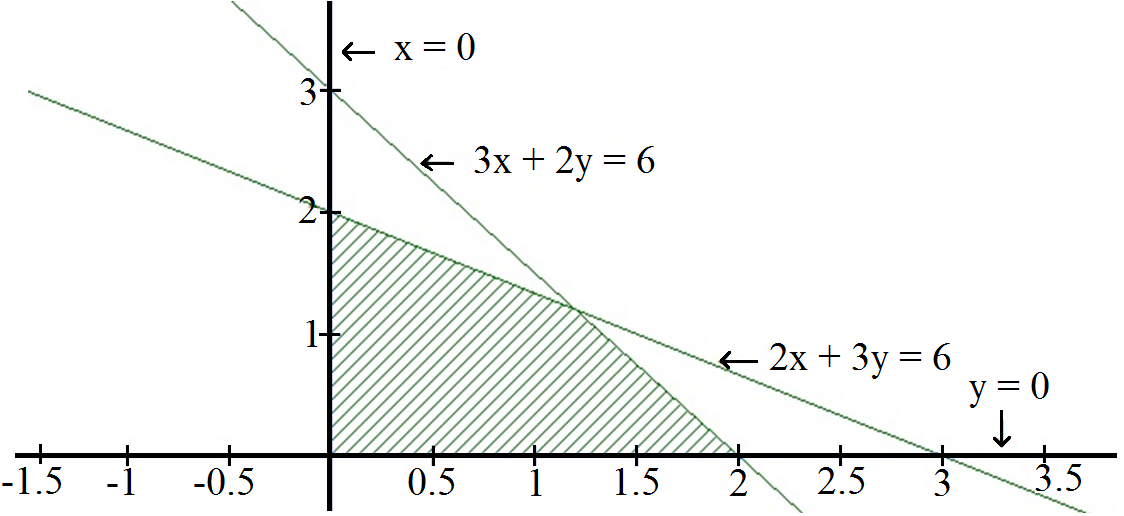
Answer


We have,

$2\text{x}+3\text{y}\leq6,3\text{x}+2\text{y}\leq6,\text{x}\geq0,\text{y}\geq0$

Converting the given inequation into equations, the inequations reduce to 2x + 3y = 6,

3x + 2y = 6, X = 0 and y = 0.

Region represented by $2\text{x}+3\text{y}\leq6$

Putting x = 0 inequation 2x + 3y = 6

we get $\text{y}=\frac{6}{3}=2$

Putting y = 0 in the equation 2x + 3y = 6,

we get $\text{x}=\frac{6}{3}=3.$

$\therefore$ This line 2x + 3y = 6 meets the coordinate axes at (0, 2) and (3, 0). Draw a thick line joining these points. We find that (0, 0) satisfies inequation 2x + 3y 36.

Region represented by 3x + 2y 56:

Putting x = 0 in the equation

3x + 2y = 6, we get $\text{y}=\frac{6}{2}=3$

Putting y = 0 in the equation

3x +2y = 6, we get $\text{x}=\frac{6}{2}=2$

$\therefore$ This line 3x + 2y = 6 meets the coordinate axes at (0, 3) and (2, 0). Draw a thick line joining these points. we find that (0, 0) satisfies inequation $2\text{x}+3\text{y}\leq6.$

Region represented by $​​\text{x}>0$ and $\text{y}\geq0$

Clearly $​​\text{x}>0$ and $\text{y}\geq0$ represent the first quadrant.

Need a full question paper?

Generate a complete, print-ready paper with questions like this in minutes — across 16+ boards, with answer keys.

Start Generating Free

Similar questions

Represent to solution set of each of the following inequations graphically in two dimensional plane:
$0\leq2\text{x}-5\text{y}+10$
Solve the following for $x$, where $|x|$ is modulus function, $[x]$ is the greatest integer function, $\{x\}$ is a fractional part function.$\left|x^2-9\right|+\left|x^2-4\right|=5$
Solve the following system of equations in R.
$2\text{x}+5\leq0,\text{x}-3\leq0$
20 cards are numbered form 1 to 20. card is drawn at random. what is the probability that trhe number on the card is:
  1. A multiple of 4?
  2. Not a multiple of 4?
  3. odd?
  4. Greather than 12?
  5. Divisible by 5?
  6. Not a multiple of 6?
show that the solution set of the following system of linear inequalities is an unbounded region $2\text{x}+\text{y}\geq8,\text{x}+2\text{y}\geq10,\text{x}\geq0,\text{y}\geq0.$
If a and b are the roots of $\text{x}^2-3\text{x}+\text{p}=0$ and c, d are roots $\text{x}^2-12\text{x}+\text{q}=0,$ where a, b, c, d from a G.P. Prove that (q + p) : (q - p) = 17 : 15.
Find the equation of the circle concentric with the circle $x^2 + y^2 - 6x + 12y + 15 = 0$ and double of its area.
Find the sum of the following series to $n$ terms:
$2^2 + 4^2 + 6^2 + 8^2 + ....$
focus is $(2, 2),$ directive is $x + y = 9$ and eccentricity $= 2.$
The mean and standard deviation of a group of 100 observations were found to be 20 and 3 respectively. Later on it was found that three observation were incorrect, which were recorded as 21, 21 and 18. Find the mean and standard deviation if the incorrect observation were omitted.