Question
Solve the following systems of linear inequations graphically:
$2\text{x}+3\text{y}\leq6,\text{x}+4\text{y}\leq4,\text{x}\geq0,\text{y}\geq0$
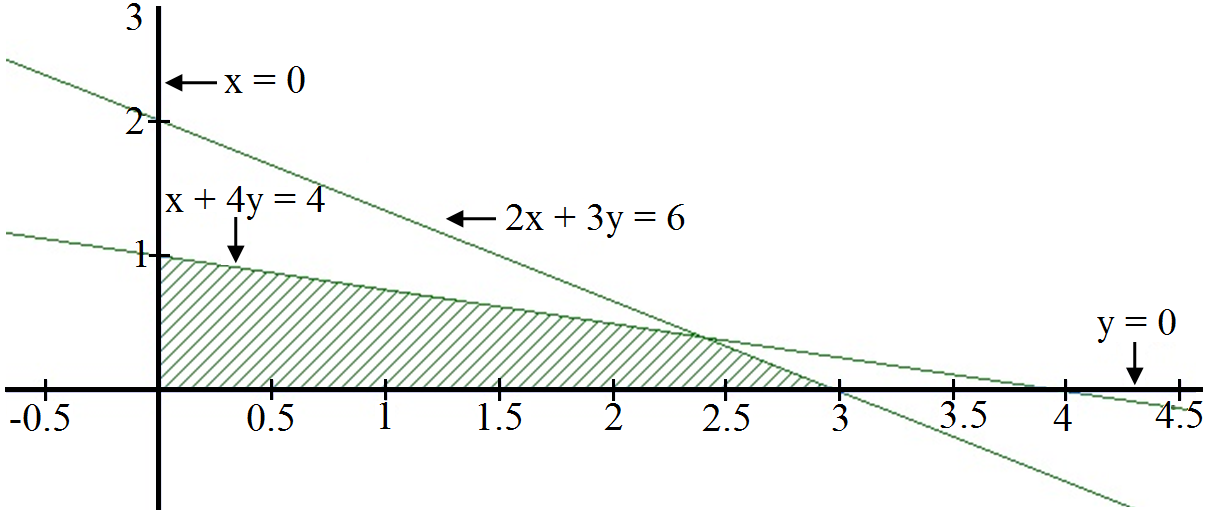
Answer


We have,

$2\text{x}+3\text{y}\leq6,\text{x}+4\text{y}\leq4,\text{x}\geq0,\text{y}\geq0$

Converting the given inequation into equations, the inequations reduce to 2x + 3y = 6,

x + 4y = 4, x = 0 and y = 0.

Region represented by $2\text{x}+3\text{y}\leq6$

Putting x = 0 inequation 2x + 3y = 6

we get $\text{y}=\frac{6}{3}=2$

Putting y = 0 in the equation 2x + 3y = 6,

we get $\text{x}=\frac{6}{2}=3.$

$\therefore$ This line 2x + 3y = 6 meets the coordinate axes at (0, 2) and (3, 0). Draw a thick line joining these points. We find that (0, 0) satisfies inequation 2x + 3y 36.

Region represented by $\text{x}+4\text{y}\leq4$

Putting x = 0 in x + 4y = 4

we get $\text{y}=\frac{4}{4}=1$

Putting y = 0 in x + 4y = 4

we get x = 4

$\therefore$ This line x + 4y = 4 meets the coordinate axes at (0, 1) and (4, 0). Draw a thick line joining these points.

Now putting x = 0, y = 0 in $\text{x}+4\text{y}\leq4$ we get $0\leq4$

Clearly, we find that (0, 0) satisfying in equation $\text{x}+4\text{y}\leq4$

Region represent by $\text{x}\geq0$ and $\text{y}\geq0$

Clearly $\text{x}\geq0$ and $\text{y}\geq0$ represent in first quadrant.

Need a full question paper?

Generate a complete, print-ready paper with questions like this in minutes — across 16+ boards, with answer keys.
Start Generating Free

Similar questions

Find the centre, the lengths of the axes, eccentricity, foci of the following ellipse:$\text{x}^2+2\text{y}^2-2\text{x}+12\text{y}+10=0$
If $ \tan\text{A}+\tan\text{B}=\text{a}$ and $\cot\text{A}+\cot\text{B}=\text{b},$ prove that $\cot\text{(A}+\text{B)}=\frac{1}{\text{a}}-\frac{1}{\text{b}}.$
Prove the following by the principle of mathematical induction:
$\frac{1}{2}+\frac{1}{4}+\frac{1}{8}+...+\frac{1}{2^\text{n}}=1-\frac{1}{2^\text{n}}$
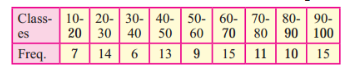
Find mean, variance and S.D. of the following data.

Image

Prove that $\frac{\text{n}^{11}}{11}+\frac{\text{n}^5}{5}+\frac{\text{n}^3}{3}+\frac{62}{165}$ n is a positive integer for all $\text{n}\in\text{N}.$
Find the coefficient of variation for the following data:
Size (in cms):
$10-15$
$15-20$
$20-25$
$25-30$ $30-35$ $35-40$
No. of items:
$2$
 
$8$
$20$
$35$ $20$ $15$
20 cards are numbered form 1 to 20. card is drawn at random. what is the probability that trhe number on the card is:
  1. A multiple of 4?
  2. Not a multiple of 4?
  3. odd?
  4. Greather than 12?
  5. Divisible by 5?
  6. Not a multiple of 6?
Find the coordinates of the foci, the vertices, the length of major axis, the eccentricity and the length of the latus rectum of the ellipse : $4 x^2+3 y^2=1$
Find the numberof observation lying between $\overline{\text{X}}-\text{M.D. }$and $\overline{\text{X}}-\text{M.D. }$ is the mean deviation from the mean.
$34, 66, 30, 38, 44, 50, 40, 60, 42, 51$
The first group has 100 items with mean 45 and variance 49. If the combined group has 250 items with mean 51 and variance 130, find the mean and standard deviation of second group.