Question
Solve the linear programming problem and determine the maximum profit to the manufacturer.
Answer

We have Maximise Z = 100x + 170y Subject to
$3\text{x}+2\text{y}\leq3600,\text{x}+4\text{y}\leq1800,\text{x}\geq0,\text{y}\geq0$
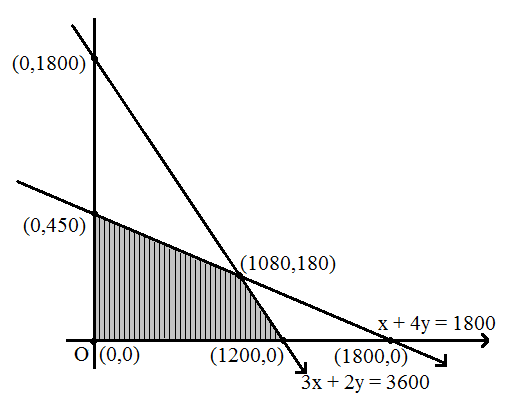
From the shaded feasible region it is clear that the coordinates of corner points are (0, 0), (1200, 0), (1080, 180) and (0, 450).
On solving x + 4y = 1800 and 3x + 2y = 3600, we get x = 1080 and y = 180.
Corner points
Corresponding value of Z = 100x + 170y
(0, 0)
(1200, 0)
(1080, 180)
(0, 450)
0
1200 ×100 = 12000
100 × 1080 + 170 × 180 = 138600 (maximum)
0 + 170 × 450 = 76500
Hence, the maximum profit to the manufacture is 138600.

Need a full question paper?

Generate a complete, print-ready paper with questions like this in minutes — across 16+ boards, with answer keys.

Start Generating Free

Similar questions

If $\text{y}=\tan^{-1}\Big(\frac{1-\text{x}}{1+\text{x}}\Big),$, find $\frac{\text{dy}}{\text{dx}}.$
Solve the following LPP graphically:
Minimise Z = 3x + 9y
subject to the constraints
x + 3y $\leq$ 60
x + y $\geq$ 10
x $\leq$ y
x $\geq$ 0, y $\geq$ 0.
Two sides of a triangle have lengths 'a' and 'b' and the angle between them is θ. What value of θ will maximize the area of the triangle? Find the maximum area of the triangle also.
Show that the height of the cylinder of maximum volume that can be inscribed a sphere of radius R is $\frac{2\text{R}}{\sqrt{3}}$ .
A bag contains 7 white, 5 black and 4 red balls. Four balls are drawn without replacement. Find the probability that at least three balls are black.
Prove that the given vectors are non-coplanar:
$3\hat{\text{i}}+\hat{\text{j}}-\hat{\text{k}},\ 2\hat{\text{i}}-\hat{\text{j}}+7\hat{\text{k}}$ and $7\hat{\text{i}}-\hat{\text{j}}+23\hat{\text{k}}$
Evaluate the following integrals:
$\int\text{x}\cos^3\text{x}^2\sin\text{x}^2\text{ dx}$
Solve the following differential equation:
$(1+\text{y}^2)+(\text{x}-\text{e}^{\tan^{-1}\text{y}})\frac{\text{dy}}{\text{dx}}=0$
A manufacturer has employed 5 skilled men and 10 semi-skilled men and makes two models A and B of an article. The making of one item of model A requires 2 hours work by a skilled man and 2 hours work by a semi-skilled man. One item of model B requires 1 hour by a skilled man and 3 hours by a semi-skilled man. No man is expected to work more than 8 hours per day. The manufacturer’s profit on an item of model A is Rs. 15 and on an item of model B is Rs. 10. How many of items of each model should be made per day in order to maximize daily profit? Formulate the above LPP and solve it graphically and find the maximum profit.
Find the distance of the point (2, 12, 5) from the point of intersection of the line $\vec{\text{r}}=2\hat{\text{i}}-4\hat{\text{j}}+2\hat{\text{k}}+\lambda(3\hat{\text{i}}+4\hat{\text{j}}+2\hat{\text{k}})$ and $\vec{\text{r}}\cdot(\hat{\text{i}}-2\hat{\text{j}}+\hat{\text{k}})=0.$