Question
Solve the pair of linear $($simultaneous$)$ equation by the method of elimination by substitution :$8x + 5y = 9,3x + 2y = 4$
Answer

$ 8 x+5 y=9$
$3 x+2 y=4 \ldots(1)$
$8 x+5 y=9$
$\therefore 5 y=9-8 x$
$\therefore y=\frac{9-8 x}{5} \ldots .(2) $
Putting this value of $y$ in $(2)$
$ 3 x+2\left[\frac{9-8 x}{5}\right]=4 $
Multiplying by $5 ,$
$ 15 x+18-16 x=20$
$15 x-16 x=20-18$
$-x=2$
$x=-2 $
From $(3)$
$\ y=\frac{9-8 x}{5}$
$=\frac{9-8(-2)}{5}$
$=\frac{25}{5}$
$=5$
$ y=5 $

Need a full question paper?

Generate a complete, print-ready paper with questions like this in minutes — across 16+ boards, with answer keys.

Start Generating Free

Similar questions

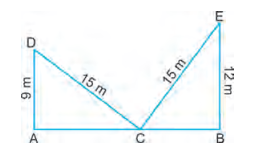
A ladder 15 m long reaches a window which is 9 m above the ground on one side of the street. Keeping its foot at the same point, the ladder is turned to the other side of the street to reach a window 12 m high. Find the width of the street.
Image
Solve the following simultaneous equations:$41x + 53y = 135;53x + 41y = 147$
Solve the following systems of equations by using the method of cross multiplication:
x + 2y + 1 = 0, 2x - 3y = 12
Solve the following systems of equations by using the method of cross multiplication:
$\frac{5}{x+1}-\frac{2}{y-1}=\frac{1}{2}, \frac{10}{x+1}+\frac{2}{y-1}=\frac{5}{2}$, where $x \neq-1$ and $x \neq 1$
$\left[\right.$ Hint. Put $\frac{1}{x+1}=u$ and $\left.\frac{1}{y-1}=v\right]$
Find the number of bricks, each measuring 25 cm $ \times$ 12.5 cm $ \times$ 7.5 cm, required to construct a wall 6 m long, 5 m high and 50 cm thick, while the cement and the sand 1 mixture occupies $\frac{1}{20}$th of the volume of the wall.
How much will ₹ 12000 amount to in 2 years at compound interest, the rates of interest for the successive years being 10% and 11% respectively?
If the equal sides of an isosceles triangle are produced, prove that the exterior angles so formed are obtuse and equal.
Evaluate the following:$\left(\frac{8}{27}\right)^{\frac{-2}{3}}-\left(\frac{1}{3}\right)^{-2}-7^0$
If $\triangle ABC, D$ and $E$ are points on $AB$ and $AC.$ Show that $DE \| BC$ for each of the following case or not:$AD = 5.7\ cm, BD = 9.5\ cm, AE = 3.3\ cm,$ and $EC = 5.5\ cm$
Using a scale of $1 \ cm$ to $1$ unit for both the axes, draw the graphs of the following equations$: 6y = 5x + 10, y = 5x - 15.$From the graph find :$(i)$ the coordinates of the point where the two lines intersect;$(ii)$ the area of the triangle between the lines and the $x-$ axis.