Question
Solve the system of inequality graphically: x + y $\le$ 6, x + y $\ge$ 4

Answer

The given in equality is $x + y \leqslant 6$
Draw the graph of the line x + y = 6.
Table of values satisfying the equation x + y = 6

X 3 4
Y 3 2

Putting (0, 0) in the given inequation, we have
$0 + 0 \leqslant 6 \Rightarrow 0 \leqslant 6$, which is true.
$\therefore $ Half plane of $x + y \leqslant 6$ is towards origin.
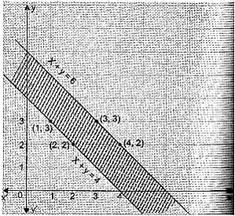
Also the given inequality is $x + y \geqslant 4$
Draw the graph of the line x + y = 4
Table of values satisfying the equation x + y = 4

X 2 1
Y 2 3

Putting (0, 0) in the given inequation, we have
$0 + 0 \geqslant 4 \Rightarrow 0 \geqslant 4$, which is false
$\therefore $ Half plane of $x + y \geqslant 4$ is away from origin.

Need a full question paper?

Generate a complete, print-ready paper with questions like this in minutes — across 16+ boards, with answer keys.

Start Generating Free

Similar questions

If a, b, c, are in G.P., prove that: $(\text{a}^2+\text{b}^2),(\text{b}^2+\text{c}^2),(\text{c}^2+\text{d}^2)\text{ are in G.P.}$
Prove that the coefficient of $x^n$ in the expansion of $(1+x)^{2 n}$ is twice the coefficient of $x^n$ in the expansion of $(1+x)^{2 n-1}$.
The weight of coffee in $70$ jars is shown in the following table:
Weight (in grams): 200-201 201-202 202-203 203-204 204-205 205-206
Frequency: 13 27 18 10 1 1
Determine the variance and standard deviation of the above distribution.
Prove that: $\sin\text{A}+\sin2\text{A}+\sin4\text{A}+\sin5\text{A}=4\cos\frac{\text{A}}{2}\cos\frac{2\text{A}}{2}\cos4\text{A}$
Find $\sin\frac{\text{x}}{2},\cos\frac{\text{x}}{2}$ and $\tan\frac{\text{x}}{2}$ in each of the following : $\tan\text{x}=-\frac{4}{3},$ x in quadrant II
$\frac{\text{a}^2\sin(\text{B}-\text{C})}{\sin\text{A}}+\frac{\text{b}^2\sin(\text{C}-\text{A})}{\sin\text{B}}+\frac{\text{c}^2\sin(\text{A}-\text{B})}{\sin\text{C}}=0$
A line is such that its segment between the straight lines 5x - y - 4 = 0 and 3x + 4y - 4 = 0 is bisected at the point (1, 5). Obtain its equation.
Find the equations of the straight lines which pass through the origin and trisect the portion of the straight line 2x + 3y = 6 which is intercepted between the axes.
A point moves as so that the difference its distances from (ae, 0) and (-ae, 0) is 2 a, prove that the equation to its locus is $\frac{\text{x}^2}{\text{a}^2}-\frac{\text{y}^2}{\text{b}^2}=1 $, where $\text{b}^2=\text{a}^2(\text{e}^2-1).$
If angle $\theta$ is divided into two parts such that the tangents of one part is $\lambda$ times the tangent of other,and $\phi$ is their difference,the show that $\sin\theta=\frac{\lambda+1}{\lambda-1}\sin\phi$