Question
Solve, using cross-multiplication$ :x - y + 2 = 0,7x + 9y = 130$

Answer

Given equation are $x-y+2=0$ and $7 x+9 y=130$
Comparing with $\mathrm{a}_1 \mathrm{x}+\mathrm{b}_1 \mathrm{y}+\mathrm{c}_1=0$ and $\mathrm{a}_2 \mathrm{x}+\mathrm{b}_2 \mathrm{y}+\mathrm{c}_2=0$,
We have
$a_1=1, b_1=-1, c_1=2$ and $a_2=7, b_2=9, c_2=-130$
Now, $x=\frac{b_1 c_2-b_2 c_1}{a_1 b_2-a_2 b_1}$ and $y=\frac{c_1 a_2-c_2 a_1}{a_1 b_2-a_2 b_1}$
$\Rightarrow x= \frac{-1 \times(-130)-9 \times 2}{1 \times 9-7 \times(-1)}$ and $y=\frac{2 \times 7-(-130) \times 1}{1 \times 9-7 \times(-1)}$
$\Rightarrow x=\frac{130-18}{9+7}$ and $y=\frac{14+130}{9+7}$
$\Rightarrow \mathrm{x}=\frac{112}{16} \quad$ and $y=\frac{144}{16}$
$\Rightarrow x=7$ and $y=9.$

Need a full question paper?

Generate a complete, print-ready paper with questions like this in minutes — across 16+ boards, with answer keys.
Start Generating Free

Similar questions

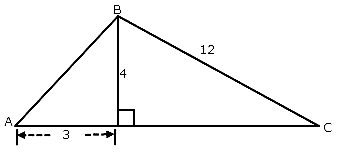
From the following figure, find the values of $(i)\cos A;(ii)\operatorname{cosec}A;(iii)\tan^2A - \sec^2A;(iv)\sin C;(v)\sec C;(vi)\cot^2 C - \frac{1}{\sin ^2 c}$
The diagonals of a quadrilateral intersect each other at right angle. Prove that the figure obtained by joining the mid$-$points of the adjacent sides of the quadrilateral is a rectangle.
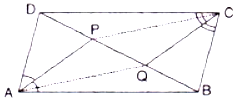
In the given figure, $A P$ is the bisector of $\angle A$ and $C Q$ is the bisector of $\angle C$ of parallelogram $\text{ABCD}$.
Prove that $\text{APCQ}$ is a parallelogram.
Calculate $x$ :
Use graph paper for this question. Take $2 \ cm = 1$ unit on both the axes.$(i)$ Draw the graphs of $x + y + 3 = 0$ and $3x - 2y + 4 = 0.$ Plot only three points per line.$(ii)$ Write down the coordinates of the point of intersection of the lines.$(iii)$ Measure and record the distance of the point of intersection of the lines from the origin in $\ cm.$
A man borrows $Rs.10,000$ at $10\%$ compound interest compounded yearly. At the end of each year, he pays back $20\%$ of the amount for that year. How much money is left unpaid just after the second year ?
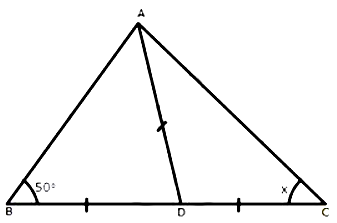
$AD$ is a median of a $\triangle ABC.P$ is any point on $AD$. Show that the area of $\triangle ABP$ is equal to the area of $\triangle ACP.$
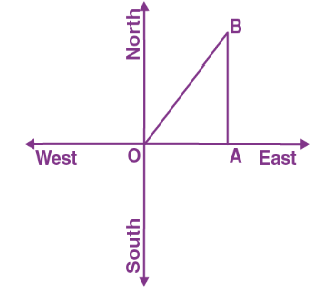
A man goes $10\ m$ due east and then $24\ m$ due north. Find the distance from the straight point.
Image
Prove that the straight line joining the vertex of an isosceles triangle to any point in the base is smaller than either of the equal sides of the triangle.
The base of an isosceles triangle is $24 \ cm$ and its area is $192 sq. \ cm$. Find its perimeter.