Question
Solve $: \left(x^2+5 x+4\right)\left(x^2+5 x+6\right)=120$

Answer

$\left(x^2+5 x+4\right)\left(x^2+5 x+6\right)=120$
Let $x^2+5 x=y$
then $(y + 4)(y + 6) = 120$
$\Rightarrow y^2+6 y+4 y+24-120=0$
$\Rightarrow y^2+10 y-96=0$
$\Rightarrow y^2+16 y-6 y-96=0$
$\Rightarrow y(y+16)-6(y+16)=0$
$\Rightarrow (y+16)(y-16)=0$
then $y = -16$ or $y = 6$
$\Rightarrow x^2+5 x+16=0 \text { or } x^2+5 x-6=0$
$\Rightarrow x=\frac{-5 \pm \sqrt{(5)^2-4(1)(16)}}{2(1)} \text { or } x^2+6 x-x-6=0$
$\Rightarrow x=\frac{-5 \pm \sqrt{-39}}{2} \text { or } x ( x +6)-1( x +6)=0$
(reject) or $(x + 6)(x - 1) = 0$
then $x = -6$ and $x = 1$

Need a full question paper?

Generate a complete, print-ready paper with questions like this in minutes — across 16+ boards, with answer keys.
Start Generating Free

Similar questions

If $(x-2)$ is a factor of the expression $2 x^3+a x^2+b x-14$ and when the expression is divided by $(x-3)$, it leaves a remainder 52 , find the values of $a$ and $b$.
Using the Remainder Theorem, factorise the expression $3x^3 + 10x^2 + x – 6$. Hence, solve the equation $3x^3 + 10x^2 + x – 6 = 0$.
 
An aeroplane travelled a distance of 400 km at an average speed of x km/hr. On the return journey, the speed was increased by 40 km/hr. Write down an expression for the time taken for
(i)the onward journey,
(ii) the return journey.
If the return journey took 30 minutes less than the onward journey, write down an equation in x and find its value.
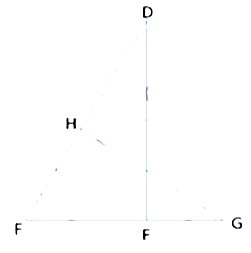
In figure $, \text{DEF}$ is a right $-$ angled triangle with $\angle E =90^{\circ}$. $FE$ is produced to $G$ and $GH$ is drawn perpendicular to $DE =8 \ cm , DH =8 \ cm , DH =6 \ cm$ and $HF =4 \ cm$, find $\frac{\operatorname{Ar} \triangle DEF }{\operatorname{Ar} \triangle GHF }$
On a map drawn to a scale of $1 : 25000,$ a rectangular plot of land$, \text{ABCD}$ is measured as $AB= 12 \ cm$ and $BC = 16\ cm$. calculate the diagonal distance of the plot in $km$ and the plot area in $km^2.$
Points $(3, 0)$ and $(-1, 0)$ are invariant points under reflection in the line $L1$;points $(0, -3)$ and $(0, 1)$ are invariant points on reflection in line $L2$.
(i) Name or write equations for the lines $L1$ and $L2$.
(ii) Write down the images of the points $P (3, 4)$ and $Q (-5, -2)$ on reflection in line $L1$. Name the images as $P’$ and $Q’$ respectively.
(iii) Write down the images of $P$ and $Q$ on reflection in $L2$. Name the images as $P”$ and $Q”$ respectively. (iv) State or describe a single transformation that maps $P’$ onto $p''$
Calculate the amount and the compound interest for the following:
Rs. 30,000 at $8 \%$ p.a. in $2 \frac{1}{2}$ years
A certain number of metallic cones, each of radius $2 \ cm$ and height $3\ cm,$ are melted and recast into a solid sphere of radius $6 \ cm.$ Find the number of cones used.
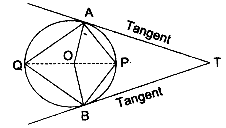
In the adjoining diagram TA and TB are tangents, O is the centre. If ∠ PAT = 35° and ∠ PBT = 40°.
Calculate:
(i) ∠ AQP, (ii) ∠ BQP
(iii) ∠ AQB, (iv) ∠ APB
(v) ∠ AOB, (vi) ∠ ATB
Find the coordinate of $O ,$ the centre of a circle passing through $A (8 , 12) , B (11 , 3),$ and $C (0 , 14).$ Also , find its radius.