MCQ
Solve $x^2 + 1 = 0$.
  • A
    $x = 1, -1$
  • $x = i, -i$
  • C
    $x = -1$
  • D
    $x = i$

Answer

Correct option: B.
$x = i, -i$
$\text{x}^2 + 1 = 0$
$\Rightarrow\text{x}^2=-1$
$\Rightarrow\text{x}$
$=\pm\sqrt{-1}=\pm\text{i}$

Need a full question paper?

Generate a complete, print-ready paper with questions like this in minutes — across 16+ boards, with answer keys.
Start Generating Free

Similar questions

Let $\frac{x^2}{a^2}+\frac{y^2}{b^2}=1, a>b$ be an ellipse with foci $F_1$ and $F_2$. Let $AO$ be its semi-minor axis, where $O$ is the centre of the ellipse. The lines $A F_1$ and $A F_2$, when extended, cut the ellipse again at points $B$ and $C$ respectively. Suppose that the $\triangle A B C$ is equilateral. Then, the eccentricity of the ellipse is
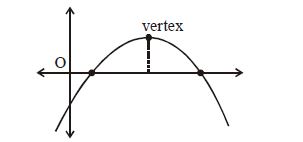
If graph of $y = ax^2 -bx + c$ is following, then sign of $a$, $b$, $c$ are
Let $a_1, a_2, a_3, \ldots, a_{11}$ be real numbers satisfying $a_1=15,27-2 a_2>0$ and $a_k=2 a_{k-1}-a_{k-2}$ for $k=3,4, \ldots$,

$11$. If $\frac{a_1^2+a_2^2+\ldots+a_{11}^2}{11}=90$, then the value of $\frac{a_1+a_2+\ldots+a_{11}}{11}$ is equal to

Let $A=\sum_{i=1}^{10} \sum_{j=1}^{10} \min \{i, j\}$ and $B=\sum_{i=1}^{10} \sum_{j=1}^{10}\max \{i, j\}$. Then $A+B$ is equal to
The number of terms that are integers in the binomial expansion of $\big(\sqrt{7}+\sqrt[3]{5}\big)^{35}$ is:
Sum of $n$ terms of the series $\sqrt{2}+\sqrt{8}+\sqrt{18}+\sqrt{32}+\ ...\text{ is}$
Six boys and six girls sit in a row at random. The probability that the boys and girls sit alternatively is:
In what direction a line be drawn through the point $(1, 2)$ so that its points of intersection with the line $x + y = 4$ is at a distance $\frac{{\sqrt 6 }}{3}$ from the given point
If equation of line is $y = 5x + 10$ then find the value of $x-$intercept made by the line:
Let $P$ be a point in the first octant, whose image $Q$ in the plane $x+y=3$ (that is, the line segment $P Q$ is perpendicular to the plane $x+y=3$ and the mid-point of $P Q$ lies in the plane $x+y=3$ ) lies on the $z$-axis. Let the distance of $P$ from the $x$-axis be $5$ . If $R$ is the image of $P$ in the xy-plane, then the length of $P R$ is. . . . . .