MCQ
Some charge is being given to a conductor. Then its potential:
- Ais maximum somewhere between surface and centre.
- Bis maximum at surface.
- Cis maximum at centre.
- Dremains same throughout the conductor.
Explanation:
Given that some charge is given to a conductor then the whole charge is distributed over its surface only. Inside of conductor, electric field is zero whereas potential is same as on the surface. Hence, throughout the conductor, potential is same i.e, the whole conductor is equipotential.
Generate a complete, print-ready paper with questions like this in minutes — across 16+ boards, with answer keys.
In the given figure, when galvanometer shows no deflection, the current (in ampere) flowing through 5Ω resistance will be

|
(a) 0.5 |
(b) 0.6 |
(c) 0.9 |
(d) 1.5 |
A metallic block carrying current I is subjected to a uniform magnetic induction  as shown in the figure. The moving charges experience a force
  given by ........... which results in the lowering of the potential of the face ........ Assume the speed of the carriers to be v

|
(a) eVB |
(b) eVB |
(c) -eVB |
(d) -eVB |
What is the effective capacitance between A and B in the following figure
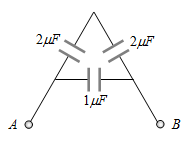
|
(a) 1 μF |
(b) 2 μF |
(c) 1.5 μF |
(d) 2.5 μF |
The ratio of charge to potential of a body is known as
|
(a) Capacitance |
(b) Conductance |
(c) Inductance |
(d) Resistance |
If the atom  follows the Bohr model and the radius of is n times the Bohr radius, then find n
|
(a) 100 |
(b) 200 |
(c) 4 |
(d) |
Material A has critical angle  and material B has critical angle
  . Then which of the following is true
(i) Light can be totally internally reflected when it passes from B to A
(ii) Light can be totally internally reflected when it passes from A to B
(iii) Critical angle for total internal reflection is 
(iv) Critical angle between A and B is 
|
(a) (i) and (iii) |
(b) (i) and (iv) |
(c) (ii) and (iii) |
(d) (ii) and (iv) |
Which statement is correct for a zone plate and a lens
|
(a) Zone plate has multi focii whereas lens has one |
|
(b) Zone plate has one focus whereas lens has multiple focii |
|
(c) Both are correct |
|
(d) Zone plate has one focus whereas a lens has infinite |
The mass of an a-particle is
|
(a) Less than the sum of masses of two protons and two neutrons |
|
(b) Equal to mass of four protons |
|
(c) Equal to mass of four neutrons |
|
(d) Equal to sum of masses of two protons and two neutrons |

