Question
Some questions and their alternative answers are given. Select the correct alternative.
Find perimeter of a square if its diagonal is 10 2 cm.
A. 10 cm
B. $40\sqrt 2$ cm
C. 20 cm
D. 40 cm
Answer

We know that,
Diagonal of a square = √2 a
Where 'a' is the side of the triangle.
⇒ √2 a = 10√2
⇒ a = 10 cm
Also, we know
Perimeter of square = 4a
Where 'a' is the side of the triangle
∴ Perimeter of given square = 4(10) = 40 cm

Need a full question paper?

Generate a complete, print-ready paper with questions like this in minutes — across 16+ boards, with answer keys.

Start Generating Free

Similar questions

Mark the correct alternative in the following:
The common difference of the $A.P.$ is $\frac{1}{2\text{q}},\frac{1-2\text{q}}{2\text{q}},\frac{1-4\text{q}}{2\text{q}}, .....$ is
Water flows at the rate of $10$ metre per minute from a cylindrical pipe $5\ mm$ in diameter. How long will it take to fill up a conical vessel whose diameter at the base is $40\ cm$ and depth $24\ cm?$
Assertion and Reason Type
Each question consists of two statements, namely, Assertion $(A)$ and Reason $(R)$. For selecting the correct answer, use the following code:
Assertion $(A)$
Reason $(R)$
The curved surface area of a cone of base radius $3\ cm$ and height $4\ cm$ is $15\pi\text{cm}^2$
Volume of a cone $\pi\text{r}^2\text{h}$
The perimeter of the triangle formed by the points $(0, 0), (0, 1)$ and $(0, 1)$ is:
A cubical ice$-$cream brick of edge $22\ cm$ is to be distributed among some children by filling ice$-$cream cones of radius $2\ cm$ and height $7\ cm$ up to the brim. How many children will get the ice$-$cream cones?
For an given A.P. a = 3.5, d = 0, n = 101, then tn = . . .
In the given fraction, if $1$ is subtracted from the numerator and $2$ is added to the denominator, it become $\frac{1}{2}.$ If $7$ is subtracted from the numerator and $2$ is subtracted from the denominator, it become $\frac{1}{3}.$ The fraction is:
The area of circle is equal to the sum of the areas of two circles of radii $24\ cm$ and $7\ cm.$ The diameter of
the new circle is:
$\triangle\text{ABC}\sim\triangle\text{DEF}$ and their perimeters are $32\ cm$ and $24\ cm$ respectively. If $AB = 10\ cm$ then $DE =?$
Image
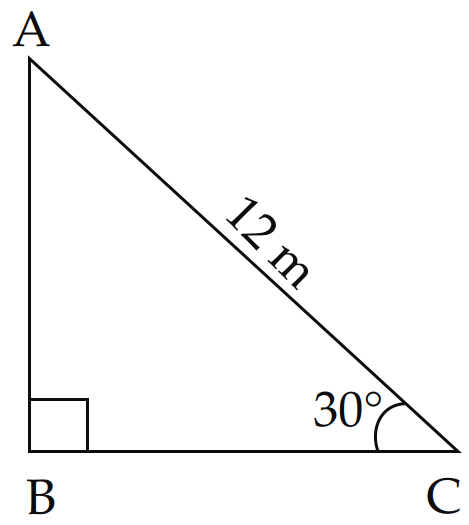
In the adjoining figure, if $\angle B=90^{\circ}, \angle C=30^{\circ}$, $A C=12 m$. then $A B=$ _______