Question
Sometimes a radioactive nucleus decays into a nucleus which itself is radioactive. An example is:
$^{38}\text{Sulphur}\xrightarrow[=2.48\text{h}]{\text{half-life}}\ \ ^{38}\text{Cl}\ \xrightarrow[=0.62\text{h}]{\text{half-life}}\ ^{38}\text{Ar}(\text{stable})$
Assume that we start with 1000 38S nuclei at time t = 0. The number of 38Cl is of count zero at t = 0 and will again be zero at t = ∞. At what value of t, would the number of counts be a maximum?
Answer

Suppose decay is given as shown below:
$^{38}\text{S}\xrightarrow[=2.48]{}\ \ ^{38}\text{Cl}\ \xrightarrow[0.62\text{h}]{}\ ^{38}\text{Ar}$
At any time t, let 38S have N1(t) active nuclei and 38Cl have N2 (t) active nuclei.
$\frac{\text{dN}_1}{\text{dt}}=-\lambda_1\text{N}_1=$ rate of formation of Cl38.
Also, $\frac{\text{dN}_2}{\text{dt}}=-\lambda_\text{1}\text{N}_2=\lambda_1\text{N}_1$
But $\text{N}_1=\text{N}_0\text{e}^{-\frac{\lambda}{\text{t}}}$
$\frac{\text{dN}_2}{\text{dt}}=-\lambda_1\text{N}_0\text{e}^{-\frac{\lambda}{\text{t}}}-\lambda_2\text{N}_2\ .....(\text{i})$
Multiplying by $\text{e}^{\lambda2\text{t}}\text{ dt}$ and rearranging
$\text{e}^{\lambda_2\text{t}}\text{dN}_2+\lambda_2\text{N}_2\text{e}^{\lambda_2\text{t}}\text{dt}=\lambda_1\text{N}_0\text{e}^{(\lambda_2-\lambda_1)\text{t}}\text{dt}$
Integrating both sides
$\text{N}_2\text{e}^{\lambda_2\text{t}}=\frac{\text{N}_0\lambda_1}{\lambda_0-\lambda_1}\text{e}^{(\lambda_1-\lambda_1)\text{t}}+\text{C}$
Since, at t = 0, N2 = 0, $\text{C}=-\frac{\text{N}_0\lambda_1}{\lambda_2-\lambda_1}$
$\therefore\ \text{N}_2\text{e}^{\lambda_2\text{t}}=\frac{\text{N}_0\lambda_1}{\lambda_2-\lambda_1}\big(\text{e}^{(\lambda_2-\lambda_1)\text{t}}-1\big)$
$\text{N}_2=\frac{\text{N}_0\lambda_1}{\lambda_2-\lambda_1}{(\text{e}^{\lambda_1\text{t}}-\text{e}^{\lambda_2\text{t}})}$
For maximum count, $\frac{\text{dN}_2}{\text{dt}}=0$
By using concepts of calculus and solving, we will get,
$\text{t}=\frac{\Big(\text{In}\frac{\lambda_1}{\lambda_2}\Big)}{(\lambda_1-\lambda_2)}$
$=\frac{\text{In}\Big(\frac{2.48}{0.62}\Big)}{(2.48-0.62)}$
$=\frac{\text{In}4}{1.86}=\frac{2.303\log4}{1.86}\ \ \bigg(\because\ \lambda=\frac{0.696}{\text{T}_{\frac{1}{2}}}\bigg)$
$=0.745\text{s}.$

Need a full question paper?

Generate a complete, print-ready paper with questions like this in minutes — across 16+ boards, with answer keys.

Start Generating Free

Similar questions

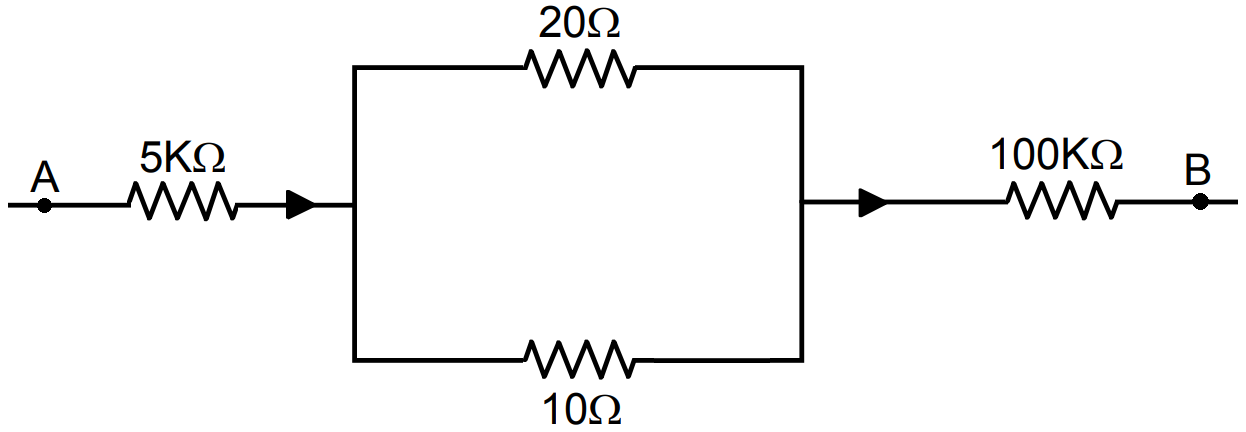
Figure. shows a part of a circuit. If a current of 12mA exists in the $5\text{k}\Omega$ resistor, find the currents in the other three resistors. What is the potential difference between the points A and B?

In beta decay, an electron (or a positron) is emitted by a nucleus. Does the remaining atom get oppositely charged?
In en experiment on photoelectric effect, light of wavelength 400 run is incident on a cesium plate at the rate of 5.0W. The potential of the collector plate is made sufficiently positive with respect to the emitter so that the current reaches its saturation value. Assuming that on the average one out of every 10° photons is able to eject a photoelectron, find the photocurrent in the circuit.
An aluminium vessel of mass 0.5kg contains 0.2kg of water at 20°C. A block of iron of mass 0.2kg at 100°C is gently put into the water. Find the equilibrium temperature of the mixture. Specific heat capacities of aluminium, iron and water are 910Jkg-1-K-1, 470Jkg-1-K-1 and 4200Jkg-1-K-1 respectively.
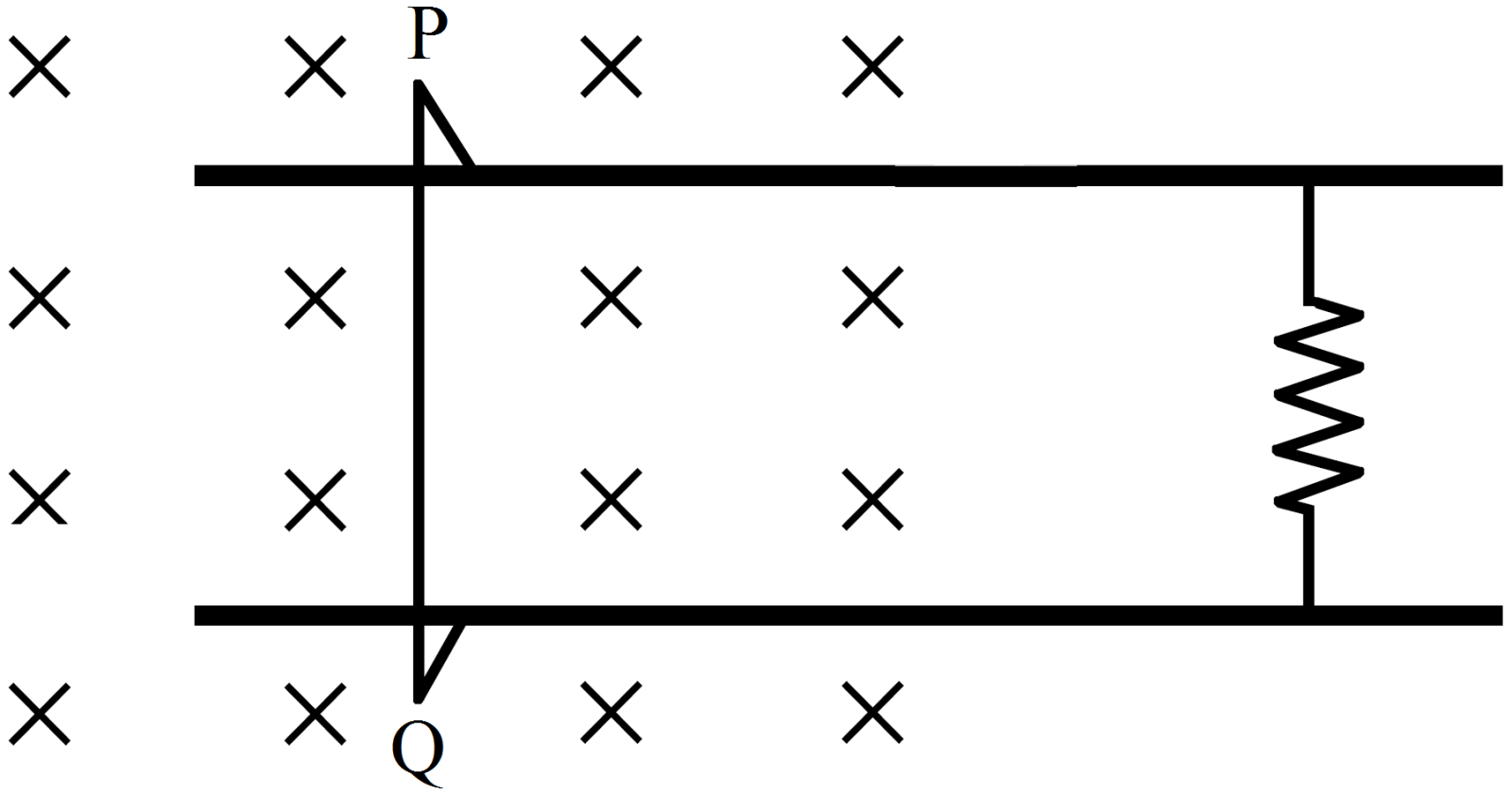
Consider the situation shown in figure. The wire PQ has mass m, resistance r and can slide on the smooth, horizontal parallel rails separated by a distance l. The resistance of the rails is negligible. A uniform magnetic field B exists in the rectangular region and a resistance R connects the rails outside the field region. At t = 0, the wire PQ is pushed towards right with a speed v0. Find

  1. The current in the loop at an instant when the speed of the wire PQ is v.
  2. The acceleration of the wire at this instant.
  3. The velocity vas a functions of x.
  4. The maximum distance the wire will move.

Two point charges of magnitude +q and -q are placed at $\Big(-\frac{\text{d}}{2},0,0\Big)$ and $\Big(\frac{\text{d}}{2},0,0\Big)$, respectively. Find the equation of the equipoential surface where the potential is zero.
A long solenoid of radius 2cm has 100 turns/cm and carries a current of 5A. A coil of radius 1cm having 100 turns and a total resistance of $2\Omega$ is placed inside the solenoid coaxially. The coil is connected to a galvanometer. If the current in the solenoid is reversed in direction, find the charge flown through the galvanometer.
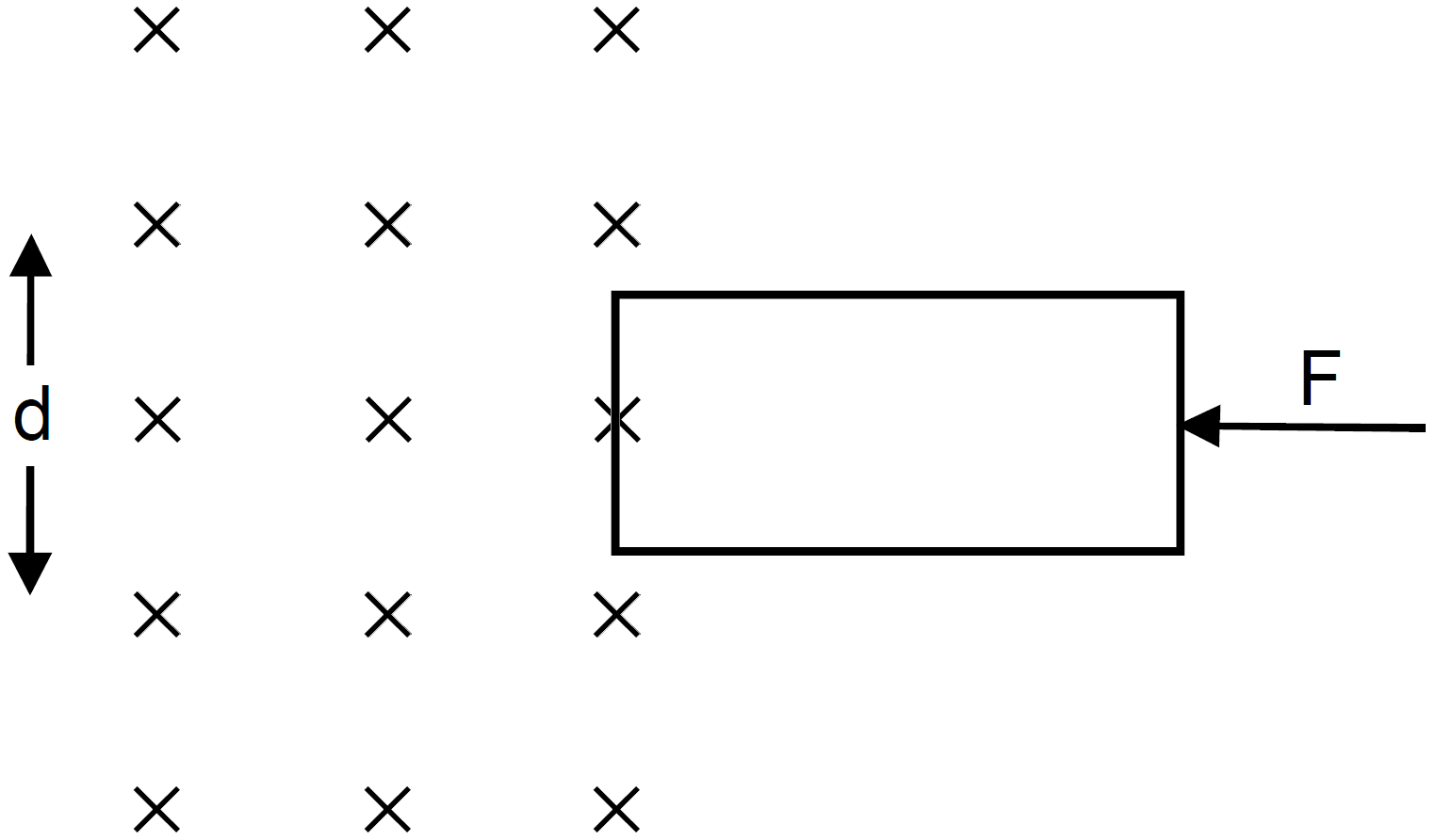
The rectangular wire-frame, shown in figure, has a width d, mass m, resistance R and a large length. A uniform magnetic field B exists to the left of the frame. A constant force F starts pushing the frame into the magnetic field at t = 0.
  1. Find the acceleration of the frame when its speed has increased to v.
  2. Show that after some time the frame will move with a constant velocity till the whole frame enters into the magnetic field. Find this velocity v0.
  3. Show that the velocity at time t is given by $\text{v}=\text{v}_0\Big(1-\text{e}^{-\frac{\text{ft}}{\text{mv}_0}}\Big)$

i. There are two sets of apparatus of Young's double-slit experiment. Inset A, the phase difference between the two waves emanating from the slits does not change with time, whereas in set B, the phase difference between the two waves from the slits changes rapidly with time. What difference will be observed in the pattern obtained on the screen in the two setups?
ii. Deduce the expression for the resultant intensity in both the above-mentioned setups ( A and B ), assuming that the waves emanating from the two slits have the same amplitude a and same wavelength $\lambda$.
A thin paper of thickness 0.02mm having a refractive index 1.45 is pasted across one of the slits in a Young's double slit experiment. The paper transmits $\frac{4}{9}$ of the light energy falling on it.
  1. Find the ratio of the maximum intensity to the minimum intensity in the fringe pattern.
  2. How many fringes will cross through the centre if an identical paper piece is pasted on the other slit also? The wavelength of the light used is 600nm.