MCQ
$‘SONAR’$ emits which of the following waves
  • A
    Radio waves
  • Ultrasonic waves
  • C
    Light waves
  • D
    Magnetic waves

Answer

Correct option: B.
Ultrasonic waves
b
$SONAR$ emits ultrasonic waves.

Need a full question paper?

Generate a complete, print-ready paper with questions like this in minutes — across 16+ boards, with answer keys.

Start Generating Free

Similar questions

What should be the velocity of earth due to rotation about its own axis so that the weight at equator become $3/5$ of initial value. Radius of earth on equator is $ 6400\, km$
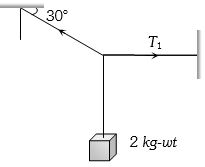
A body of weight $2\, kg$ is suspended as shown in the figure. The tension ${T_1}$ in the horizontal string (in kg wt) is
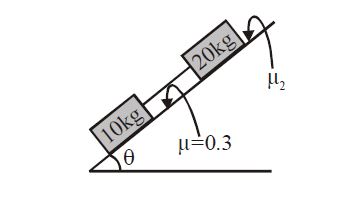
Value of $\theta$  is increased gradually from $\theta  = 0$ At $\theta=tan^{-1}(\frac{1}{2})$ both the block just start slipping. Then value of $\mu_2$ is : $(g = 10 m/s^2)$
A parallel plate capacitor of plate area $A$ and plate seperation $d$ is charged to potential difference $V$ and then the battery is disconnected. Aslab of dielectric constant $K$ is then inserted between the plates of the capacitor so as to fill the space between the plates. If $Q, E$ and $W$ denote respectively, the magnitude of charge on each plate, the electric field between the plates (after the slab is inserted) and the work done on the system, in question, in the process of inserting the slab, then 
Two rods of same length and material transfer a given amount of heat in $12$ seconds, when they are joined end to end. But when they are joined lengthwise, then they will transfer same heat in same conditions in ....... $\sec$
The phase difference between the flux linked with a coil rotating in a uniform magnetic field and induced $e.m.f.$ produce in it is
A body of mass $4 \ kg$ experiences two forces $\overrightarrow{ F }_1=5 \hat{ i }+8 \hat{ j }+7 \hat{ k }$ and $\overrightarrow{ F }_2=3 \hat{ i }-4 \hat{ j }-3 \hat{ k }$. The acceleration acting on the body is $:$
For photoelectric emission, tungsten requires light of $ 2300 Å$. If light of $1800 Å $ wavelength is incident then emission
A beam of unpolarised light of intensity $I_0$ is passed through a polaroid $A$ and then through another polaroid $B$ which is oriented so that its principal plane makes an angle of $45^o $ relative to that of $A$. The intensity of the emergent light is
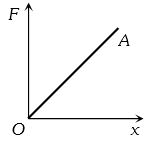
The force required to stretch a spring varies with the distance as shown in the figure. If the experiment is performed with the above spring of half length, the line $OA$ will