MCQ
Sound waves of wavelength $\pi$ travelling in a medium with a speed of $v\ m/ s$ enter into another medium where its speed is $2v\ m/ s$. Wavelength of sound waves in the second medium is:
  • A
    $\pi$
  • B
    $\frac{\pi}{2}$
  • $2\pi$
  • D
    $4\pi$

Answer

Correct option: C.
$2\pi$
When wave passes from one medium to another its frequency $(v)$ does not chang but its velocity and wavelength changs.
$\text{v}=\text{v}\lambda$ or $\text{v}=\frac{\text{v}}{\lambda}$
$\frac{\text{v}}{\lambda}=\frac{2\text{v}}{\lambda_2}\Rightarrow\lambda_2=2\lambda.$
Hence verifies the correct option $(c)$

Need a full question paper?

Generate a complete, print-ready paper with questions like this in minutes — across 16+ boards, with answer keys.
Start Generating Free

Similar questions

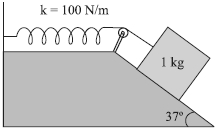
A $1\; kg$ block situated on a rough incline is connected to a spring of spring constant $100\;N m ^{-1}$ as shown in Figure. The block is released from rest with the spring in the unstretched position. The block moves $10 \;cm$ down the incline before coming to rest. Find the coefficient of friction between the block and the incline. Assume that the spring has a negligible mass and the pulley is frictionless.
A gas kept in a container of finite conductivity is suddenly compressed. The process:
  1. Must be very nearly adiabatic.
  2. Must be very nearly isothermal.
  3. May be very nearly adiabatic.
  4. May be very nearly isothermal.
Match List$-I$ with List$-II$

      List $-I$       List $-II$
$(A)$ Moment of inertia of solid sphere of radius $(R)$ about any tangent  $(I)$  $\frac{5}{3} MR ^{2}$
$(B)$ Moment of inertia of hollow sphere of radius $(R)$ about any tangent $(II)$ $\frac{7}{5} MR ^{2}$
$(C)$ Moment of inertia of circular ring of radius $(R)$ about its diameter. $(III)$ $\frac{1}{4} MR ^{2}$
$(D)$ Moment of inertia of circular disc of radius $(R)$ about any diameter. $(IV)$ $\frac{1}{2} MR ^{2}$

Question: Choose the correct answer from the options given below

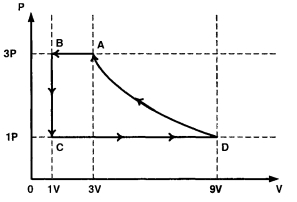
One mole of a monatomic ideal gas is taken through a cycle $ABCDA$ as shown in the $P-V$ diagram. Column $II$ gives the characteristics involved in the cycle. Match them with each of the processes qiven in Column $I$
Column $I$ Column $II$
$(A)$ Process $A \rightarrow B$ $(p)$ Internal energy decreases.
$(B)$ Process $B \rightarrow C$ $(q)$ Internal energy increases.
$(C)$ Process $C \rightarrow D$ $(r)$ Heat is lost.
$(D)$ Process $D \rightarrow A$ $(s)$ Heat is gained.
  $(t)$ Work is done on the gas.

If $V_m$ is the velocity of sound in moist air, $V_d$ is the velocity of sound in dry air, under identical conditions of pressure and temperature
The mass of the earth is $81$ times that of the moon and the radius of the earth is $3.5$ times that of the moon. The ratio of the escape velocity on the surface of earth to that on the surface of moon will be
The quantity having the same unit in all system of unit is:
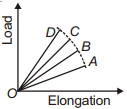
The load versus elongation graph for four wires of same length and the same material is shown in figure. The thinnest wire is represented by line
Two waves executing simple harmonic motion travelling in the same direction with same amplitude and frequency are superimposed. The resultant amplitude is equal to the $\sqrt{3}$ times of amplitude of individual motions. The phase difference between the two motions is $.....(degree)$
A billiard ball moving with a speed of $5 \,m/s$ collides with an identical ball originally at rest. If the first ball stops after collision, then the second ball will move forward with a speed of ...........  $m{s^{ - 1}}$