MCQ
Speed of electromagnetic waves in vacuum is:
- ✓$3 \times 10^8 m / s$
- B$3 \times 10^7 m / s$
- C$3 \times 10^6 m / s$
- D$3 \times 10^10 m / s$
Generate a complete, print-ready paper with questions like this in minutes — across 16+ boards, with answer keys.
Effective capacitance between A and B in the figure shown is (all capacitance are in mF)
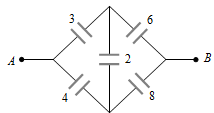
|
(a) 21 mF |
(b) 23 mF |
(c) |
(d) |
Temperature above which a ferromagnetic substance becomes paramagnetic is called
| (a) Critical temperature | (b) Boyle's temperature |
| (c) Debye's temperature | (d) Curie temperature |
The capacity of a parallel plate capacitor increases with the
|
(a) Decrease of its area |
(b) Increase of its distance |
|
(c) Increase of its area |
(d) None of the above |
The patient is asked to drink  for examining the stomach by X-rays because X-rays are
|
(a) Reflected by heavy atoms |
(b) Refracted by heavy atoms |
|
(c) Less absorbed by heavy atoms |
(d) More absorbed by heavy atoms |
Voltmeters V1 and V2 are connected in series across a D.C. line. V1 reads 80 volts and has a per volt resistance of 200 ohms. V2 has a total resistance of 32 kilo ohms. The line voltage is
|
(a) 120 volts |
(b) 160 volts |
(c) 220 volts |
(d) 240 volts |
Two heater wires of equal length are first connected in series and then in parallel. The ratio of heat produced in the two cases is
|
(a) 2 : 1 |
(b) 1 : 2 |
(c) 4 : 1 |
(d) 1 : 4 |
By a monochromatic wave, we mean
|
(a) A single ray |
(b) A single ray of a single colour |
|
(c) Wave having a single wavelength |
(d) Many rays of a single colour |

