Question
Spherical aberration in a lens

Answer

Spherical aberration is a type of aberration found in optical system that use elements with spherical surfaces. Lenses and curved mirrors are often made with surfaces that are spherical, because this shape is easier to form than non-spherical curved surfaces. Light ray that strike a spherical surface aff-centre are refracted or reflected more or less than those that strikes close to the centre. This deviation reduces the quality of images produced by optical systems In lens systems, aberrations can be minimized using combinations of convex and concave lenses, or by using aspheric lenses or aplanatic lenses.
Need a full question paper?

Generate a complete, print-ready paper with questions like this in minutes — across 16+ boards, with answer keys.

Start Generating Free

Similar questions

A steady current $I$ flows through a wire of radius $r$, length $L$ and resistivity $\rho$. The current produces heat in the wire. The rate of heat loss in a wire is proportional to its surface area. The steady temperature of the wire is independent of
A charge of $4\,\mu C$ is to be divided into two. The distance between the two divided charges is constant. The magnitude of the divided charges so that the force between them is maximum, will be.
The magnification produced by the objective lens and the eye lens of a compound microscope are $25$ and $6$ respectively. The magnifying power of this microscope is
Eddy currents are used in
In the following sequence of reactions :

Toluene $\xrightarrow{{KMn{O_4}}}A\xrightarrow{{SOC{l_2}}}$ $B\xrightarrow[{BaS{O_4}}]{{{H_2}/Pd}}C$

the product $C$ is :

A stone is shot straight upward with a speed of $20\, m/sec$ from a tower $200\, m$ high. The speed with which it strikes the ground is approximately........$m/sec$
An alpha-particle of mass $m$ suffers $1-$ dimensional elastic collision with a nucleus at rest of unknown mass. It is scattered directly backwards losing, $64\%$ of its initial kinetic energy. The mass of the nucleus is $.......... \mathrm{m}$
The weight of a body at the surface of earth is $18\,N$. The weight of the body at an altitude of $3200\,km$ above the earth's surface is $........\,N$ (given, radius of earth $R _{ e }=6400\,km$ )
Three vessels of equal volume contain gases at the same temperature and pressure. The first vessel contains neon (monoatomic), the second contains chlorine (diatomic) and third contains uranium hexafloride (polyatomic). Arrange these on the basis of their root mean square speed $\left(v_{ ms }\right)$ and choose the correct answer from the options given below:
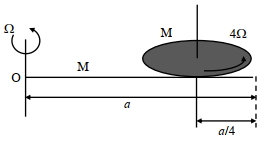
A thin rod of mass $M$ and length $a$ is free to rotate in horizontal plane about a fixed vertical axis passing through point $O$. A thin circular disc of mass $M$ and of radius $a / 4$ is pivoted on this rod with its center at a distance $a / 4$ from the free end so that it can rotate freely about its vertical axis, as shown in the figure. Assume that both the rod and the disc have uniform density and they remain horizontal during the motion. An outside stationary observer finds the rod rotating with an angular velocity $\Omega$ and the disc rotating about its vertical axis with angular velocity $4 \Omega$. The total angular momentum of the system about the point $O$ is $\left(\frac{ M a^2 \Omega}{48}\right) n$. The value of $n$ is.$ . . . .$