MCQ
$\sqrt[3]{{(61 - 46\sqrt 5 )}} = $
  • $1 - 2\sqrt 5 $
  • B
    $1 - \sqrt 5 $
  • C
    $2 - \sqrt 5 $
  • D
    None of these

Answer

Correct option: A.
$1 - 2\sqrt 5 $
a
(a) $\sqrt[3]{{61 - 46\sqrt 5 }} = a - \sqrt b $

==> $61 - 46\sqrt 5 = {(a - \sqrt b )^3} = {a^3} + 3ab - (3{a^2} + b)\sqrt b $

==> $61 = {a^3} + 3ab,\,46\sqrt 5 = (3{a^2} + b)\,\sqrt b $

==> $61 = ({a^2} + 3b)\,a$, $23\sqrt {20} = (3{a^2} + b)\sqrt b $

So,$a = 1,\,\,b = 20$.

Therefore, $\sqrt[3]{{61 - 46\sqrt 5 }} = 1 - \sqrt {20} = 1 - 2\sqrt 5 $.

Need a full question paper?

Generate a complete, print-ready paper with questions like this in minutes — across 16+ boards, with answer keys.
Start Generating Free

Similar questions

$\sin 15^\circ + \cos 105^\circ = $
The vector $2\,i + a\,j + k$ is perpendicular to the vector $2\,i - j - k,$ if $a = $
$\int\limits_0^{\frac{\pi }{2}} {\,\,\sqrt {\sin \,2\theta } } \sin\, \theta \,d\theta$ is equal to :
Let $\overrightarrow{ a }=\hat{ i }+2 \hat{ j }+ k , \overrightarrow{ b }=3(\hat{ i }-\hat{ j }+ k )$. Let $\overrightarrow{ c }$ be the vector such that $\overrightarrow{ a } \times \overrightarrow{ c }=\overrightarrow{ b }$ and $\overrightarrow{ a } \cdot \overrightarrow{ c }=3$. Then $\overrightarrow{ a } \cdot((\overrightarrow{ c } \times \overrightarrow{ b })-\overrightarrow{ b }-\overrightarrow{ c })$ is equal to :
If $y = {x^n}\log x + x{(\log x)^n}$, then ${{dy} \over {dx}} = $
The equation of motion of a particle is given by $s = 2{t^3} - 9{t^2} + 12t + 1$, where $s$ and $t$ are measured in $cm$ and $sec$. The time when the particle stops momentarily is
If the system of linear equations $2 x-3 y=\gamma+5$ ; $\alpha x+5 y=\beta+1$, where $\alpha, \beta, \gamma \in R$ has infinitely many solutions, then the value of $|9 \alpha+3 \beta+5 \gamma|$ is equal to
An $A.P.$, a $G.P.$ and a $H.P.$ have the same first and last terms and the same odd number of terms. The middle terms of the three series are in
Suppose that $20$ pillars of the same height have been crected along the boundary of a circular stadium. If the top of each pillar has been connected by beams with the top of all its non-adjacent pillars, then the total number of beams is
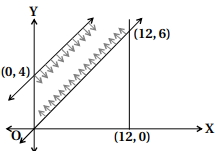
The feasible region for an $LPP$ is shown in the Figure. Let $z=3 x-4 y$ be the objective function.Minimum value of $Z$ is $....$