Question
Srikanth has made a project on real numbers, where he finely explained the applicability of exponential laws and divisibility conditions on real numbers. He also included some assessment questions at the end of his project as listed below. Answer them.
1. The statement 'One of every three consecutive positive integers is divisible by 3 ' is?
2. For what value of $n, 4^n$ ends in 0 ?
3. If $a$ is a positive rational number and $n$ is a positive integer greater than $I$, then for what value of $n, 4^n$ is a rational number?
Or
If n is any odd integer, then $n ^2-1$ is divisible by?

Answer

1. Let three consecutive positive integers be $n , n +1$ and $n +2$.
We know that when a number is divided by 3, the remainder obtained is either 0 or 1 or 2 .
So, $n=3 p$ or $3 p+1$ or $3 p+2$, where pis some integer.
If $n=3 p$, then 2 is divisible by 3 .
If $n=3 p+1$, then $n+2=3 p+1+2=3 p+3=3(p+1)$ is divisible by 3 .
If $n=3 p+2$, then $n+1=3 p+2+1=3 p+3=3(p+1)$ is divisible by 3 .
So, we can say that one of the numbers among $n, n+1$ and $n+2$ is always divisible by 3.2 . For a number to end in zero it must be divisible by 5 , but $4^n=2^{2 n}$ is never divisible by 5 . So, $4^n$ never ends in zero for any value of $n$.
3. We know that product of two rational numbers is also a rational number.
So, $a^2=a \times a=$ rational number.
$a^3=a^2 \times a=$ rational number.
$a^4=a^3 \times a=$ rational number.
$a^n=a^{n-1} \times a=$ rational number.
or
Any odd number is of the form of $(2 k+1)$, where $k$ is any integer.
So, $n ^2-1=(2 k +1)^2-1=4 k ^2+4 k$
For $k=1,4 k^2+4 k=8$, which is divisible by 8 .
Similarly, for $k=2,4 k^2+4 k=24$, which is divisible by 8 .
And fork $=3,4 k^2+4 k=48$, which is also divisible by 8 .
So, $4 k^2+4 k$ is divisible by 8 for all integers $k$, i.e., $n^2-1$ is divisible by 8 for all odd values of $n$.

Need a full question paper?

Generate a complete, print-ready paper with questions like this in minutes — across 16+ boards, with answer keys.

Start Generating Free

Similar questions

Read the following text carefully and answer the questions that follow:
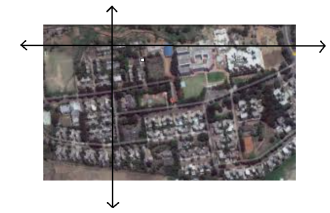
A satellite image of a colony is shown below. In this view, a particular house is pointed out by a flag, which is situated at the point of intersection of $x$ and $y-$ axes. If we go $2 \ c$m east and $3 \ cm$ north from the house, then we reach to a Grocery store. If we go $4 \ c$m west and $6 \ cm$ south from the house, then we reach to an Electricians's shop. If we go $6 \ cm$ east and $8 \ c$m south from the house, then we reach to a food cart. If we go $6 \ cm$ west and $8 \ cm$ north from the house, then we reach a bus stand.
Scale:
$x-$ axis: $1 \ cm = 1$ unit
$y -$ axis: $1 \ cm = 1$ unit
Image
$i.$ What is the distance between the grocery store and food cart?
$ii$. What is the distance of the bus stand from the house?
$iii$. If the grocery store and electricians shop lie on a line, then what will be the ratio of distance of house from grocery store to that from electrician's shop?
OR
What are the ratio of distances of the house from bus stand to food cart?
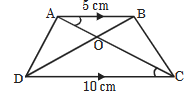
A farmer has a field in the shape of trapezium, whose map with scale 1 cm = 20 m, is given below:
The field is divided into four parts by joining the opposite vertices.
Image
Based on the above information, answer any four of the following questions:
1. The two triangular regions AOB and COD are
(a) Similar by AA criterion (b) Similar by SAS criterion
(c) Similar by RHS criterion (d) Not similar
2. The ratio of the area of the $\triangle A O B$ to be area of $\triangle COD$, is
(a) $4: 1$ (b) $1: 4$
(c) $1: 2$ (d) $2: 1$
3. If the ratio of the perimeter of $\triangle A O B$ to the perimeter of $\triangle C O D$ would have been $1: 4$, then
(a) $AB =2 CD$ (b) $AB =4 CD$
(c) $CD =2 AB$ (d) $CD =4 AB$
4. If in $\triangle s A O D$ and $B O C, \frac{A O}{B C}=\frac{A D}{B O}=\frac{O D}{O C}$, then
(a) $\triangle AOD \sim \triangle BOC$ (b) $\triangle AOD \sim \triangle BCO$
(c) $\triangle ADO \sim \triangle BCO$ (d) $\triangle ODA \sim \triangle OBC$
5. If the ratio of areas of two similar triangles $A O B$ and COD is $1: 4$, then which of the following statements is true?
(a) The ratio of their perimeters is $3: 4$ (b) The corresponding altitudes have a ratio $1: 2$
(c) The medians have a ratio $1: 4$ (d) The angle bisectors have a ratio $1: 16$
Read the text carefully and answer the questions:
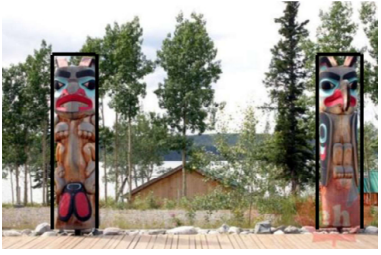
Totem poles are made from large trees. These poles are carved with symbols or figures and mostly found in western Canada and northwestern United States.
In the given picture, two such poles of equal heights are standing $28 m$ apart. From a point somewhere between them in the same line, the angles of elevation of the top of the two poles are $60^{\circ}$ and $30^{\circ}$ respectively.

Image

$(a)$ Draw a neat labelled diagram.
$(b)$ Find the height of the poles.
OR
Find the location of the point of observation.
$(c)$ If the distances of the top of the poles from the point of observation are taken as $p$ and $q,$ then find a relation between $p$ and $q$ .
Activities like running or cycling reduce stress and the risk of ental disorder like depression. Running helps build endurance. Children develop stronger bones and uscles and are less prone to gain weight. The physical education teacher of a school has decided to conduct an inter school running tournaent in his school preises. The tie taken by a group of students to run 100 , was noted as follows:
Iage
Tie (in seconds)0-2020-4040-6060-8080-100
Nuber of students8101363

Based on the above, answer the following questions:
(i) What is the edian class of the above given data?
(ii) (a) Find the ean tie taken by the students to finish the race.
OR
(b) Find the ode of the above given data.
(iii) How any students took tie less than 60 seconds?
Read the following text carefully and answer the questions that follow:
India meteorological department observes seasonal and annual rainfall every year in different sub$-$divisions of our country
ImageI
t helps them to compare and analyse the results. The table given below shows sub$-$division wise seasonal $($monsoon$)$ rainfall $($mm$)$ in $2018:$
Rainfall (mm) Number of Sub-divisions
$200-400$ $2$
$400-600$ $4$
$600-800$ $7$
$800-1000$ $4$
$1000-1200$ $2$
$1200-1400$ $3$
$1400-1600$ $1$
$1600-1800$ $1$
$i.$ Write the modal class.
$ii.$ Find the median of the given data. 
$iii.$ If sub$-$division having at least $1000$ mm rainfall during monsoon season$,$ is considered good rainfall sub$-$ division, then how many subdivisions had good rainfall?
$OR$
Find the mean rainfall in this season.

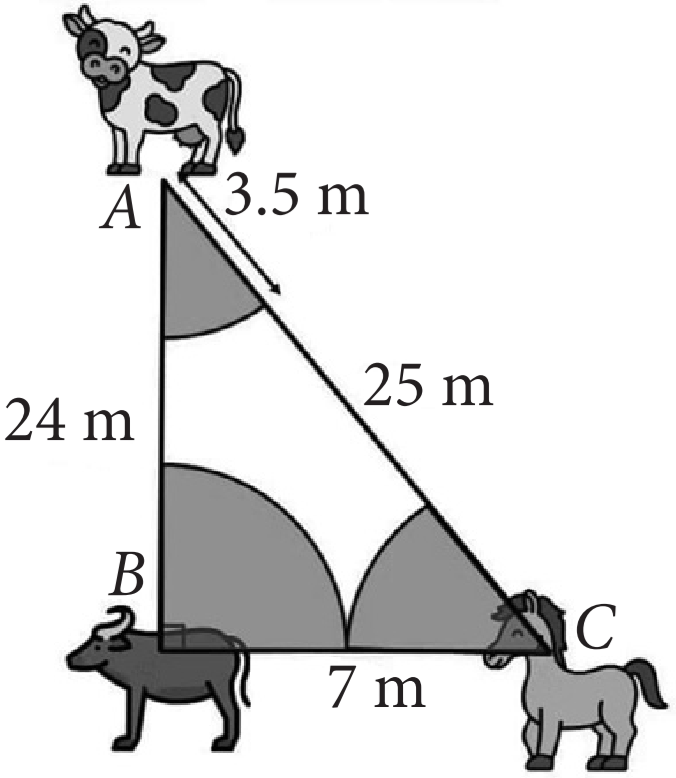
Gayatri have a triangular shaped grass field. At the three corners of the field, a cow, a buffalo, and a horse are tied separately to the pegs by means of ropes of 3.5m each to graze in the field, as shown in the figure. Sides of the triangular field are 25m, 24m and 7m. Based on the above information, answer the following questions.
  1. Area of the region grazed by the cow is ?
  2. Area of region grazed by the buffalo and the horse is:
  3. Total area grazed by the cow, the buffalo and the horse is:
    Or
    Find the area of the field that cannot be grazed.
Read the following text carefully and answer the questions that follow:
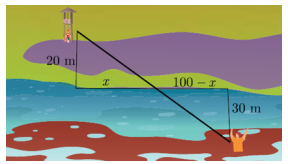
Swimmer in Distress: A lifeguard located $20$ metre from the water spots a swimmer in distress. The swimmer is $30$ metre from shore and $100$ metre east of the lifeguard. Suppose the lifeguard runs and then swims to the swimmer in a direct line, as shown in the figure.
Image
$i$. How far east from his original position will he enter the water? $($Hint: Find the value of $x$ in the sketch$)$.
$ii$. Which similarity criterion of triangle is used?
$iii$. What is the distance of swimmer from the shore?
OR
What is the length of $AD$?
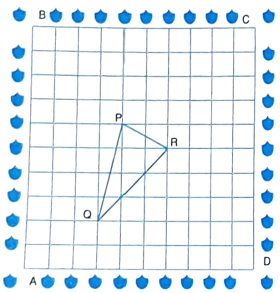
A garden is in the shape of a square. The gardener grew saplings of Ashoka tree on the boundary of the garden at the distance of 1 m from each other. He wants to decorate the garden with rose plants. He chose a triangular region inside the garden to grow rose plants. In the above situation, the gardener took help from the students of class 10. They made a chart for it which looks like the Fig.
Image
(i) If $A$ is taken as origin, what are the coordinates of the vertices of $\triangle P Q R$ ?
(ii) (a) Find the distances $P Q$ and $Q R$.
OR
(b) Find the coordinates of the point which divides the line segment joining points $P$ and $R$ in the ratio 2:1 internally.
(iii) Find out if $\triangle P Q R$ is an isoscales triangle.