Standing waves are generated on a sonometer string loaded with a cylindrical body. If the cylinder is completely immersed in water, the length of the loops changes by a factor of $2.2$ . The specific gravity of the material of the cylinder is
Diffcult
Download our app for free and get started
$f=\frac{V}{\lambda_{1}}=\frac{1}{\lambda_{1}} \sqrt{\frac{T_{1}}{\mu}}$
$\mathrm{f}=\frac{\mathrm{V}}{\lambda_{1}}=\frac{1}{\lambda_{1}} \sqrt{\frac{\mathrm{T}_{2}}{\mu}}$
$\frac{1}{\lambda_{1}} \sqrt{\frac{T_{1}}{\mu}}=\frac{1}{\lambda_{2}} \sqrt{\frac{T_{2}}{\mu}}$
$\sqrt{\frac{\mathrm{T}_{1}}{\mu}}=\left(\frac{\lambda_{1}}{\lambda_{2}}\right) \sqrt{\frac{\mathrm{T}_{2}}{\mu}}$
$\mathrm{T}_{1}=(2.2)^{2} \cdot \mathrm{T}_{2}$
$\mathrm{Mg}=4.84\left[\mathrm{Mg}-\frac{\mathrm{M}}{(\mathrm{S} \cdot \mathrm{G})} \cdot \mathrm{g}\right]$
$1=4.84-\frac{4.84}{\mathrm{S.G}}$
$\frac{4.84}{\mathrm{S.G}}=3.84 \Rightarrow \mathrm{S.G}=\frac{4.84}{3.84}$
$\Rightarrow \mathrm{S.G}=1.26$

Download our appand get started for free
Experience the future of education. Simply download our apps or reach out to us for more information. Let's shape the future of learning together!No signup needed.*
Similar Questions
- 1Consider ten identical sources of sound all giving the same frequency but having phase angles which are random. If the average intensity of each source is ${I_0}$, the average of resultant intensity $I$ due to all these ten sources will beView Solution
- 2View SolutionIn a stretched string,
- 3A train, standing in a station-yard, blows a whistle of frequency $400\,Hz$ in still air. The wind starts blowing in the direction from the yard to the station with a speed of $10\,ms^{-1}$ then value of frequency and speed of sound for observer will be (the speed of sound in still is $340\, ms^{-1}$ )View Solution
- 4View SolutionA tuning fork produces waves in a medium. If the temperature of the medium changes, then which of the following will change
- 5There are three sources of sound of equal intensity with frequencies $400, 401$ and $402\, vib/sec.$ The number of beats heard per second isView Solution
- 6At $23^{\circ} C$, a pipe open at both ends resonates at a frequency of $450 \,Hz$. At what frequency does the same pipe resonate on a hot day when the speed of sound is $4 \%$ higher than it would be at $23^{\circ} C$ ?View Solution
- 7View SolutionApparatus used to find out the velocity of sound in gas is
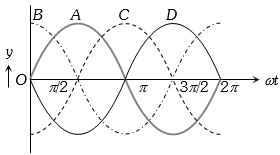
- 8The figure shows four progressive waves $A, B, C$ and $D $ with their phases expressed with respect to the wave $A$. It can be concluded from the figure thatView Solution
- 9Consider the three wavesView Solution
${z_1},{z_2}$ and ${z_3}$ as${z_1} = A\sin (kx - \omega \,t)$, ${z_2} = A\sin (kx + \omega \,t)$ and ${z_3} = A\sin (ky - \omega \,t)$.
Which of the following represents a standing wave
- 10Two persons $A$ and $B$, each carrying a source of sound of frequency $n$, are standing a few metres apart in a quiet field. $A$ starts moving towards $B$ with a speed $u$. If $v$ is the speed of sound, the number of beats heard per second by $A$ will beView Solution