MCQ
Standing waves are produced in $10 \,m$ long stretched string fixed at both ends. If the string vibrates in $5$ segments and wave velocity is $20 \,m / s$, the frequency is ....... $Hz$
  • $5$
  • B
    $10$
  • C
    $2$
  • D
    $4$

Answer

Correct option: A.
$5$
a
(a)

The question refers to the $5^{\text {th }}$ harmonic of a vibrating wave.

Frequency of $5^{\text {th }}$ harmonic is $=\frac{n v}{21}=\frac{5 \times 20}{2 \times 10}=5 \,Hz$

Need a full question paper?

Generate a complete, print-ready paper with questions like this in minutes — across 16+ boards, with answer keys.
Start Generating Free

Similar questions

What is the number of significant figures in $11.118 \times 10^{ - 6}\,V$ 
The cross sectional area of a horizontal tube increases along its length linearly, as we move in the direction of flow. The variation of pressure, as we move along its length in the direction of flow ($x-$ direction), is best depicted by which of the following graphs
Temperature is a measurement of coldness or hotness of an object. This definition is based on
Two stones of masses $m$ and $2\,m$ are whirled in horizontal circles, the heavier one in a radius $\frac{r}{2}$ and the lighter one in radius $r.$ The tangential speed of lighter stone is $n$ times that of the value of heavier stone when they experience same centripetal forces. The value of $n$ is
A particle has initial velocity $(2\hat i + 3\hat j ) $ and has acceleration $(0.3\,\hat i + 0.2\,\hat j)$ . Its speed after $10\,s$ is
Two moles of ideal helium gas are in a rubber balloon at $30^{\circ} C$. The balloon is fully expandable and can be assumed to require no energy in its expansion. The temperature of the gas in the balloon is slowly changed to $35^{\circ} C$. The amount of heat required in raising the temperature is nearly (take $R =8.31 J / mol$. $K$)
We are able to squeeze snow and make balls out of it because of
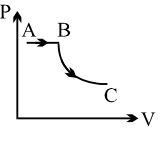
A process is shown in the diagram. Which of the following curves may represent the same process ?
A uniform cable of mass $‘M’$ and length $‘L’$ is placed on a horizontal surface such that its ${\left( {\frac{1}{n}} \right)^{th}}$  part is hanging below the edge of the surface. To lift the hanging part of the cable upto the surface, the work done should be
If $\vec A = 2\hat i + \hat j - \hat k,\,\vec B = \hat i + 2\hat j + 3\hat k$ and $\vec C = 6\hat i - 2j - 6\hat k$ then the angle between $(\vec A + \vec B)$ and $\vec C$ wil be ....... $^o$