MCQ
Standing waves are produced in $10 \,m$ long stretched string fixed at both ends. If the string vibrates in $5$ segments and wave velocity is $20 \,m / s$, the frequency is ....... $Hz$
  • $5$
  • B
    $10$
  • C
    $2$
  • D
    $4$

Answer

Correct option: A.
$5$
a
(a)

The question refers to the $5^{\text {th }}$ harmonic of a vibrating wave.

Frequency of $5^{\text {th }}$ harmonic is $=\frac{n v}{21}=\frac{5 \times 20}{2 \times 10}=5 \,Hz$

Need a full question paper?

Generate a complete, print-ready paper with questions like this in minutes — across 16+ boards, with answer keys.

Start Generating Free

Similar questions

The nature of damped oscillation is:
The property utilized in the manufacture of lead shots is
One end of a copper rod of uniform cross-section and of length $3.1$ m is kept in contact with ice and the other end with water at $100°C $ . At what point along it's length should a temperature of $200°C$ be maintained so that in steady state, the mass of ice melting be equal to that of the steam produced in the same interval of time. Assume that the whole system is insulated from the surroundings. Latent heat of fusion of ice and vaporisation of water are $80 cal/gm$ and $540$ cal/gm respectively
In damped oscillation graph between velocity and position will be
A thin hollow cylinder open at both ends:

$(i)$ Slides without rotating

$(ii)$ Rolls without slipping, with the same speed
Two forces of 10 N each are acting at an angle $\theta^{\circ}$ at a point. Their resultant force is 10 N . The value of $\theta$ will be.
A balloon with mass $m$ is descending down with an acceleration $a ($ where $a< g).$ How much mass should be removed from it so that it starts moving up with an acceleration $a\,?$
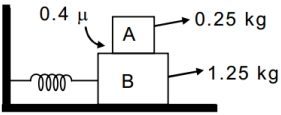
Maximum amplitude(in $cm$) of $SHM$ so block A will not slip on block $B , K =100 N / m$
A projectile is fired at $30^{\circ}$ to the horizontal, The vertical component of its velocity is $80 \;ms ^{-1}$, Its time flight is $T$. What will be the velocity of projectile at $t =\frac{ T }{2}$?
A tube of length $L$ is filled completely with an incompressible liquid of mass $M$ and closed at both the ends. The tube is then rotated in a horizontal plane about one of its ends with a uniform angular velocity $\omega $. The force exerted by the liquid at the other end is