MCQ
Stars are not visible in the day time because
  • A
    Stars hide behind the sun
  • B
    Stars do not reflect sun rays during day
  • C
    Stars vanish during the day
  • Atmosphere scatters sunlight into a blanket of extreme brightness through which faint stars cannot be visible
Answer

Correct option: D.
Atmosphere scatters sunlight into a blanket of extreme brightness through which faint stars cannot be visible
d
During the night time the sunlight doesn't complete reach the part of earth we are residing in. Hence, the sky is darker compared to day time. So, the visibility of the stars increases and we can see them properly.

During the day time, the sunlight reaches the part of earth we are residing in directly. The particles present in the atmosphere causes the phenomenon of atmospheric scattering which causes the sunlight to scatter brightly across the sky. This brightness are so high that the light emitted by the stars are completely covered by the sunlight. Hence, we cannot see the stars in daytime.

Need a full question paper?

Generate a complete, print-ready paper with questions like this in minutes — across 16+ boards, with answer keys.

Start Generating Free

Similar questions

An electron revolves around nucleus with rotational frequency $'f'$ in circular orbit, due to this magnetic induction produced at nucleus position is $'B'$ then radius of circular orbit is directly proportional to
There is a current of 1.344 amp in a copper wire whose area of cross-section normal to the length of the wire is 1$mm^2$ . If the number of free electrons per $cm^3$ is $8.4\times 10^{22}$ , then the drift velocity would be
The mass of a photo electron is
A common transistor radio set requires $12\,V (D.C.)$ for its operation. The $D.C.$ source is constructed by using a transformer and a rectifier circuit, which are operated at $220\, V$ $(A.C.)$ on standard domestic $A.C.$ supply. The number of turns of secondary coil are $24,$ then the number of turns of primary are
A diamagnetic material in a magnetic field moves
Basically, the product modulator is
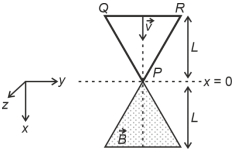
A region in the form of an equilateral triangle (in $x-y$ plane) of height $L$ has a uniform magnetic field $\vec{B}$ pointing in the $+z$-direction. A conducting loop $P Q R$, in the form of an equilateral triangle of the same height $L$, is placed in the $x-y$ plane with its vertex $P$ at $x=0$ in the orientation shown in the figure. At $t=0$, the loop starts entering the region of the magnetic field with a uniform velocity $\vec{v}$ along the $+x$-direction. The plane of the loop and its orientation remain unchanged throughout its motion.

Which of the following graph best depicts the variation of the induced emf $(E)$ in the loop as a function of the distance $(x)$ starting from $x=0$ ?

Ionisation energy of 10 times ionised sodium atom will be :
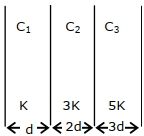
In the reported figure, a capacitor is formed by placing a compound dielectric between the plates of parallel plate capacitor. The expression for the capacity of the said capacitor will be (Given area of plate $=A$ )
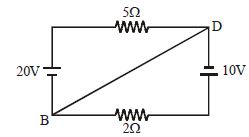
Calculate the current in wire $BD$ ................ $A$