Question
Starting from an initial situation of consumer's equilibrium state, how does increase in marginal utility of one rupee affect the quantity demanded of a product?
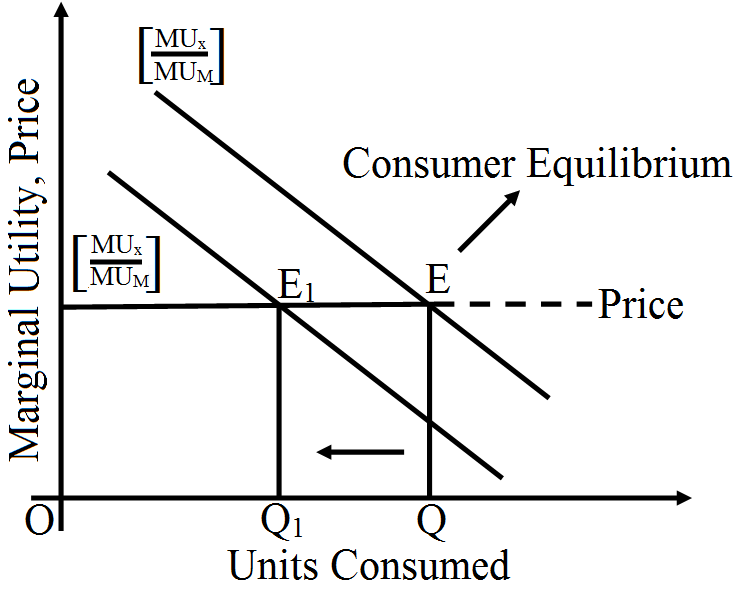
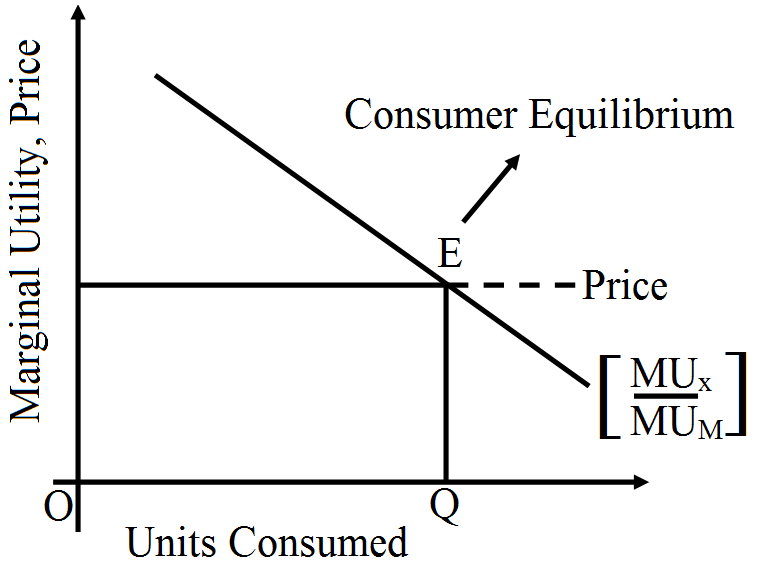 It can be explained with the help of the following schedule and dia-gram and assuming price of quantity X to be 1 and for consumer MU of a rupee is 20 utils.
 | Units of Commodity consumed | Marginal Utility ( utilds) | MU in term in term of money (₹) (MU of commodity ÷ MU of ₹ ) | Price of commodity (₹) |
| 1 | 50 | 2.5 (=50 ÷ 20 ) | 1 |
| 2 | 40 | 2 | 1 |
| 3 | 30 | 1.5 | 1 |
| 4 | 20 | 1 | 1 |
| 5 | 10 | 0.5 | 1 |
| Units of Commodity consumed | Marginal Utility ( utilds) | MU in term in term of money (₹) (MU of commodity ÷ MU of ₹ ) | Price of commodity (₹) |
| 1 | 50 | 1.6 (=50 ÷ 30 ) | 1 |
| 2 | 40 | 1.33 | 1 |
| 3 | 30 | 1 | 1 |
| 4 | 20 | 0.66 | 1 |
| 5 | 10 | 0.33 | 1 |
Generate a complete, print-ready paper with questions like this in minutes — across 16+ boards, with answer keys.
| S.No. | Contents | ₹ (in crore) |
| (i) | Value of Output in Economic Territory | 4,100 |
| (ii) | Net Exports | (-)50 |
| (iii) | Intermediate Purchase by Primary Sector | 600 |
| (iv) | Private Final Consumption Expenditure | 1,450 |
| (v) | Intermediate Purchases by Secondary Sector | 700 |
| (vi) | Government Final Consumption Expenditure | 400 |
| (vii) | Net Domestic Fixed Capital Formation | 200 |
| (viii) | Intermediate Purchases by Tertiary Sector | 700 |
| (ix) | Net Change in Stock | (-)50 |
| (x) | Net Indirect Taxes | 100 |
| (xi) | Consumption of Fixed Capital | 50 |
| Output (in units) | TR (₹) | TC (₹) |
| 1 | 50 | 60 |
| 2 | 60 | 65 |
| 3 | 68 | 68 |
| 4 | 70 | 60 |
| 5 | 75 | 75 |
| 6 | 80 | 95 |
Calculate:
OR
Explain ‘large number of buyers and sellers' feature of perfect competition.