Question
Starting with the thermodynamic relationship G = H - TS, derive the following relationship: $\Delta\text{G}=-\text{T}\Delta\text{S}_\text{Total}$

Answer

$\text{G}=\text{H}-\text{TS},$ $\text{G}_1=\text{H}_1-\text{TS}_1,$ $\text{G}_2=\text{H}_2-\text{TS}_2$$\text{G}_2-\text{G}_1=\text{H}_2-\text{H}_1-\text{T}(\text{S}_2-\text{S}_1)$
$\Delta\text{G}=\text{H}_2-\text{H}_1-\text{T}(\text{S}_2-\text{S}_1)$
$\Delta\text{G}=\Delta\text{H}-\text{T}\Delta\text{S}$
$\Delta\text{S}_\text{Total}=\Delta\text{S}_\text{sys}+\Delta\text{S}_\text{surr}$
$\Rightarrow\Delta\text{S}_\text{Total}=\Delta\text{S}_\text{sys}-\frac{\text{q}}{\text{T}}$
$\Delta\text{S}_\text{sys}=\frac{+\text{q}}{\text{T}},\Delta\text{S}_\text{surr}=\frac{-\text{q}}{\text{T}}$
$\Rightarrow\text{T}\Delta\text{S}_\text{Total}=\text{T}\Delta\text{S}_\text{sys}-\text{q}=\text{T}\Delta\text{S}_\text{sys}-\Delta\text{H}$
$\text{T}\Delta\text{S}_\text{Total}=-\Delta\text{G}$
$\Rightarrow\Delta\text{G}=-\text{T}\Delta\text{S}_\text{Total}$

Need a full question paper?

Generate a complete, print-ready paper with questions like this in minutes — across 16+ boards, with answer keys.
Start Generating Free

Similar questions

Calculate the total number of electrons present in 1.4g of dinitrogen gas.
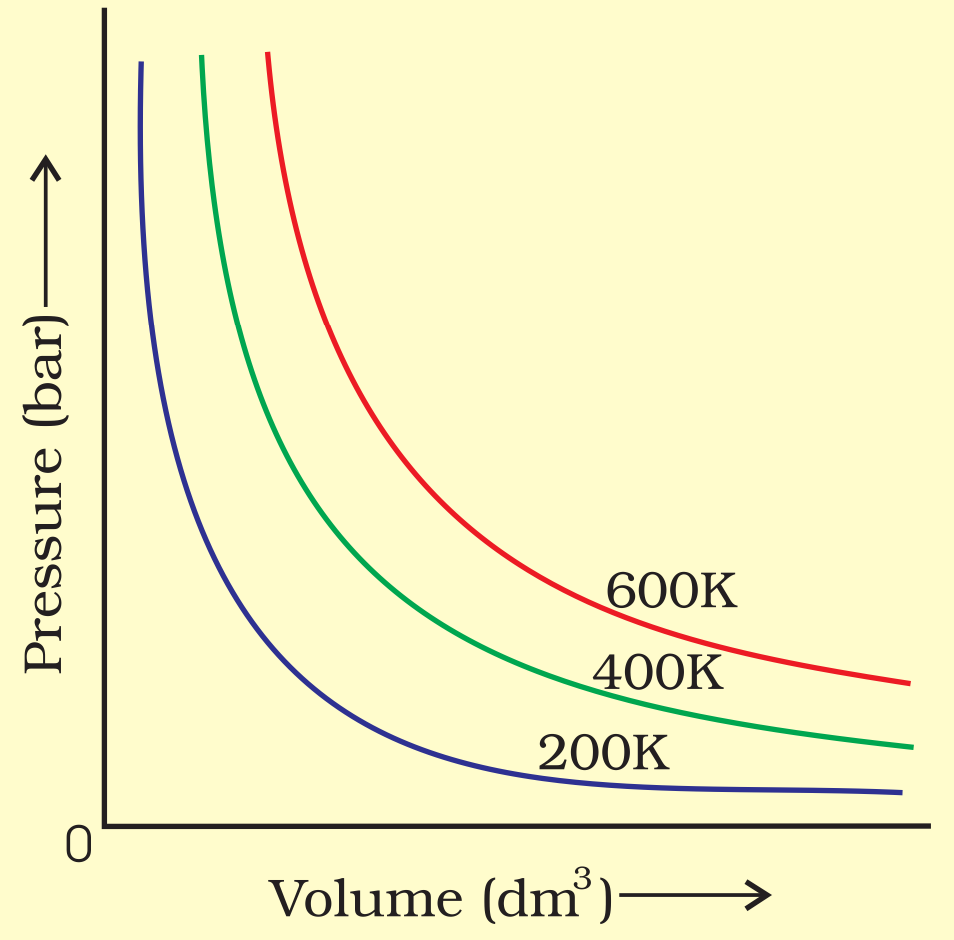
The variation of pressure with volume of the gas at different temperatures can be graphically represented as shown in Fig. On the basis of this graph answer the following questions.
  1. How will the volume of a gas change if its pressure is increased at constant temperature?
  2. At a constant pressure, how will the volume of a gas change if the temperature is increased from 200K to 400K?
Basic principle of hydrogen economy is transportation and storage of energy in the form of liquid or gaseous hydrogen. Which property of hydrogen may be useful for this purpose? Support your answer with the chemical equation if required.
Is demineralised or distilled water useful for drinking purposes? If not, how can it be made useful?
a. Name the group of the elements in which electrons are progressively filled in 4 f -orbital and 5 f orbitals.
b. Which of the following is the correct order of size of the given species: $I, I^{+}, I^{-}$?
c. Which of the following elements can show covalency greater than 4 ?
Be, P, S, B
  1. Draw the shape of $B_2H_6$ molecule.
  2. Give suitable reasons for the following:
  1. $[\text{SiF}_6]^{2-}$ is known whereas $[\text{SiCl}_6]^{2-}$ not
  2. Diamond is covalent, yet it has high melting point.
  1. Complete the reactions:
  1. $\text{Na}_2\text{B}_4\text{O}_7+7\text{H}_2\text{O}\xrightarrow{\ \ \ \ \ \ \ }$
  2. $\text{B}_2\text{H}_6+3\text{O}_2\xrightarrow{\ \ \ \ \ \ \ \ }$
What is meant by hydrogen bond? What is bond energy of hydrogen bond? Why is $\mathrm{HF}, \mathrm{H}_2 \mathrm{O}$ are liquids whereas $\mathrm{HCl}, \mathrm{HBr}, \mathrm{HI}$ and $\mathrm{H}_2 \mathrm{~S}$ are gases?
For the reaction, $\mathrm{N}_2(\mathrm{g})+3 \mathrm{H}_2(\mathrm{g}) \rightleftharpoons 2 \mathrm{NH}_3(\mathrm{g})$, the partial pressures of $\mathrm{N}_2$ and $\mathrm{H}_2$ are 0.80 and 0.40 atmosphere respectively at equilibrium. The total pressure of the system is 2.80 atmosphere. What is $\mathrm{K}_{\mathrm{p}}$ for the above reaction?
What would be the SI unit for the quantity $\text{pV}^2\text{T}^2/\text{n}$?
Complete the following reactions:
  1. $8\text{LiH}+\text{AlCl}_6\xrightarrow{\ \ \ \ \ \ \ \ \ }$
  2. $2\text{LiH}+\text{B}_2\text{H}_6\xrightarrow{\ \ \ \ \ \ \ \ \ }$
  3. $2\text{NaH}+\text{B}_2\text{H}_6\xrightarrow{\ \ \ \ \ \ \ \ \ }$