Magnetic Fields due to Electric Current — Physics STD 12 Science — Question
Maharashtra BoardEnglish MediumSTD 12 SciencePhysicsMagnetic Fields due to Electric Current4 Marks
Question
State Ampere’s law. Explain how is it useful in different situations.
✓
Answer
Ampere’s circuital law : In free space, the line integral of magnetic induction around a closed path in a magnetic field is equal to p0 times the net steady current enclosed by the path.
In mathematical form,$\oint \vec{B} \cdot \overrightarrow{d l}=\mu_0 \mid$
where $\vec{B}$ is the magnetic induction at any point on the path in vacuum, $\overrightarrow{d l}$ is the length element of the path, $I$ is the net steady current enclosed and $\mu_0$ is the permeability of free space.
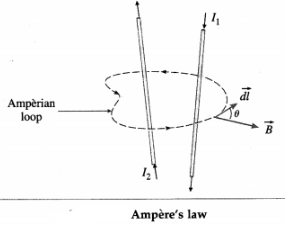
Explanation : Figure shows two wires carrying currents $I_1$ and $I_2$ in vacuum. The magnetic induction $\vec{B}$ at any point is the net effect of these currents.
To find the magnitude $B$ of the magnetic induction :
We construct an imaginary closed curve around the conductors, called an Amperian loop, and imagine it divided into small elements of length $\overrightarrow{d l}$. The direction of dl is the direction along which the loop is traced.
(ii) We assign signs to the currents using the right hand rule : If the fingers of the right hand are curled in the direction in which the loop is traced, then a current in the direction of the outstretched thumb is taken to be positive while a current in the opposite direction is taken to be negative.
For each length element of the Amperian loop, $\vec{B} \cdot \overrightarrow{d l}$ gives the product of the length $dl$ of the element and the component of $\vec{B}$ parallel to $\overrightarrow{d l}$. If $\theta r$ is the angle between $\overrightarrow{d l}$ and $\vec{B}$
$\vec{B} \cdot \overrightarrow{d l}=(B \cos \theta) d l$
Then, the line integral,
$\oint \vec{B} \cdot \overrightarrow{d l}=\oint B \cos \theta d l$
For the case shown in Fig., the net current I through the surface bounded by the loop is
$ I = I _2- I _1$
$\therefore \oint B \cos \theta d l=\mu_0 I$
$=\mu_0\left( I _2- I _1\right) \ldots \ldots \ldots \ldots . \text { (3) } $
Equation (3) can be solved only when B is uniform and hence can be taken out of the integral.
[Note: Ampere's law in magnetostatics plays the part of Gauss's law of electrostatics. In particular, for currents with appropriate symmetry, Ampere's law in integral form offers an efficient way of calculating the magnetic field. Like Gauss's law, Ampere's law is always true (for steady currents), but it is useful only when the symmetry of the problem enables B to be taken out of the integral $\oint \vec{B} \cdot \overrightarrow{d l}$. The current configurations that can be handled by Ampere's law are infinite straight conductor, infinite plane, infinite solenoid and toroid.]
Need a full question paper?
Generate a complete, print-ready paper with questions like this in minutes — across 16+ boards, with answer keys.