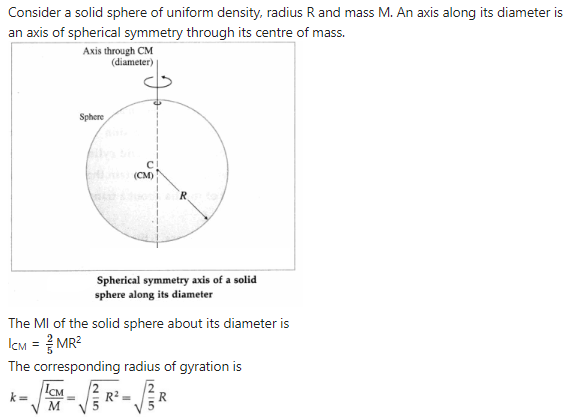
State an expression for the moment of inertia of a solid sphere about its diameter. Write the expression for the corresponding radius of gyration.
Q 85
Download our app for free and get started

Download our appand get started for free
Experience the future of education. Simply download our apps or reach out to us for more information. Let's shape the future of learning together!No signup needed.*
Similar Questions
- 1View SolutionDo we need a banked road for a two wheeler? Explain.
- 2View SolutionState an expression for the moment of inertia of a thin ring about its transverse symmetry axis.
- 3View SolutionWhat is vertical circular motion? Comment on its two types.
- 4Two discs of moments of inertia $\mathrm{I}_1$ and $\mathrm{I}_2$ about their transverse symmetry axes, respectively rotating with angular velocities to $\omega_1$ and $\omega_2$, are brought into contact with their rotation axes coincident. Find the angular velocity of the composite disc.View Solution
- 5View SolutionDefine the angular momentum of a particle.
- 6View SolutionAbout which axis of rotation is the radius of gyration of a body the least ?
- 7A solid sphere of mass $1 \mathrm{~kg}$ rolls on a table with linear speed $2 \mathrm{~m} / \mathrm{s}$, find its total kinetic energy.View Solution
- 8View SolutionExpress the kinetic energy of a rotating body in terms of its angular momentum.
- 9A stone of mass $100 \mathrm{~g}$ attached to a string of length $50 \mathrm{~cm}$ is whirled in a vertical circle by giving it a velocity of $7 \mathrm{~m} / \mathrm{s}$ at the lowest point. Find the velocity at the highest point.View Solution
- 10A coin is placed on a stationary disc at a distance of $1 \mathrm{~m}$ from the disc's centre. At time $t=0$ $\mathrm{s}$, the disc begins to rotate with a constant angular acceleration of $2 \mathrm{rad} / \mathrm{s}^2$ around a fixed vertical axis through its centre and perpendicular to its plane.View Solution
Find the magnitude of the linear acceleration of the coin at $t=1.5 \mathrm{~s}$. Assume the coin does not slip.