Chemical Thermodynamics — Chemistry STD 12 Science — Question
Maharashtra BoardEnglish MediumSTD 12 ScienceChemistryChemical Thermodynamics2 Marks
Question
State and explain Hess‘s law of constant heat summation.
✓
Answer
$1.$ Hess's law of constant heat summation states that," The change in enthalpy for a reaction is the same whether the reaction takes place in one or a series of steps".
$2.$ The Hess's law is a direct consequence of fact that the enthalpy is a state function and so enthalpy change depends only on the initial and final states of the system and not on the path by which the reaction takes place.
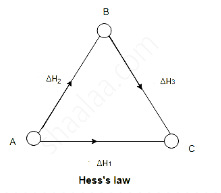
eg. The conversion of $A$ to $C$ can take place directly
in a single step.
$A \rightarrow C, \triangle H^\circ = \triangle H_1$
$3.$ The reaction can also take place in two steps for which $\triangle H^\circ$
values are known.
Step $(1) A \rightarrow B, \triangle H^\circ = \triangle H_2$
Step $(2) B \rightarrow C, \triangle H^\circ = \triangle H_3$
$...........................$
Overall $A \rightarrow C, \triangle H^\circ = \triangle H_{2 +}\triangle H_3$
$4.$ According to Hess's law, $\triangle H_1 = \triangle H_{2 +}\triangle H_{3.}$
The sequence of steps is represented in the figure.
Need a full question paper?
Generate a complete, print-ready paper with questions like this in minutes — across 16+ boards, with answer keys.