Question
State and explain Maxwell’s right-hand thumb rule.
Answer

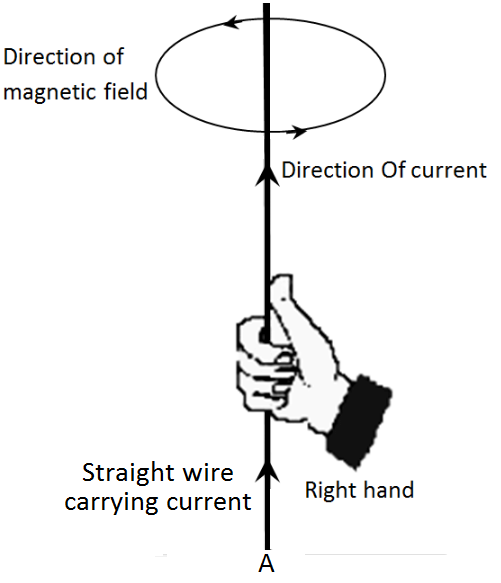
According to Maxwell’s right hand thumb rule: Imagine that you are grasping the currentcarrying wire in your right hand so that your thumb points in the direction of current, then the direction in which your fingers encircle the wire will give the direction of magnetic field lines around the wire.

Let AB be the straight wire carrying current in the vertically upward direction from A to B. To find out the direction of the magnetic field lines produced by this current, we imagine that we are grasping the current carrying wire in our right hand as shown in fig. so that our thumb points in the direction of current towards B. Now, the direction in which our fingers are folded gives the direction of magnetic field lines. In this case, the direction of magnetic field lines is in the anticlockwise direction.

Need a full question paper?

Generate a complete, print-ready paper with questions like this in minutes — across 16+ boards, with answer keys.

Start Generating Free

Similar questions

What is meant by power of a lens? Define its S.I. unit.

You have two lenses A and B of focal lengths +10 cm and –10 cm respectively. State the nature and power of each lens. Which of the two lenses will form a virtual and magnified image of an object placed 8 cm from the lens? Draw a ray diagram to justify your answer.
  1. State the laws of refraction of light. Explain the term absolute refractive index of a medium and write an expression to relate it with the speed of light in vacuum.
  2. The absolute refractive indices of two media 'A' and 'B' are 2.0 and 1.5 respectively. If the speed of light in medium 'B' is 2 × 108 m/ s, calculate the speed of light in:
  1. Vacuum,
  2. Medium 'A'.
Three incandescent bulbs of 100W each are connected in series in an electric circuit. In another circuit another set of three bulbs of the same wattage are connected in parallel to the same source.
  1. Will the bulb in the two circuits glow with the same brightness? Justify your answer.
  2. Now let one bulb in both the circuits get fused. Will the rest of the bulbs continue to glow in each circuit? Give reason.
The image of a candle flame placed at a distance of 30cm from a spherical lens is formed on a screen placed on the other side of the lens at a distance of 60cm from the optical centre of the lens. Identify the type of lens and calculate its focal length. If the height of the flame is 3cm, find the height of its image.
Two lamps, one rated 40W at 220V and the other 60W at 220V, are connected in parallel to the electric supply at 220V.
  1. 10 Draw a circuit diagram to show the connections.
  2. Calculate the current drawn from the electric supply.
  3. Calculate the total energy consumed by the two lamps together when they operate for one hour.
Explain with diagrams what is meant by the “series combination” and “parallel combination” of resistances. In which case the resultant resistance is:
  1. Less, and
  2. More, than either of the individual resistances?
A concave lens of focal length 60 cm is used to form an image of an object of length 9 cm kept at a distance of 30 cm from it. Use lens formula to determine the nature, position and length of the image formed. Also draw labelled ray diagram to show the image formation in the above case.
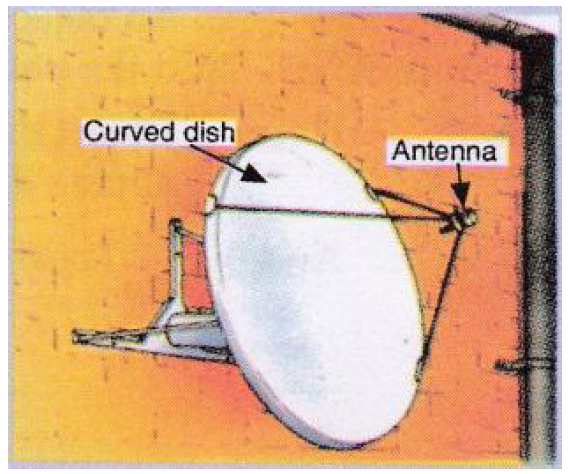
The diagram shows a dish antenna which is used to receive television signals from a satellite. The antenna (signal detector) is fixed in front of the curved dish.

  1. What is the purpose of the dish?
  2. Should it be concave or convex?
  3. Where should the antenna be positioned to receive the strongest possible signals?
  4. Explain what change you would expect in the signals if a larger dish was used.
An object is kept at a distance of 100 cm from each of the above lenses. Calculate the
  1. Image distance and
  2. Magnification in each of two cases.
With the help of a circuit diagram, deduce the equivalent resistance of two resistances connected in series.

Two resistances are connected in series as shown in the diagram:


  1. What is the current through the 5 ohm resistance?
  2. What is the current through R?
  3. What is the value of R?
  4. What is the value of V?