Question
State and explain three properties of indifference curves.
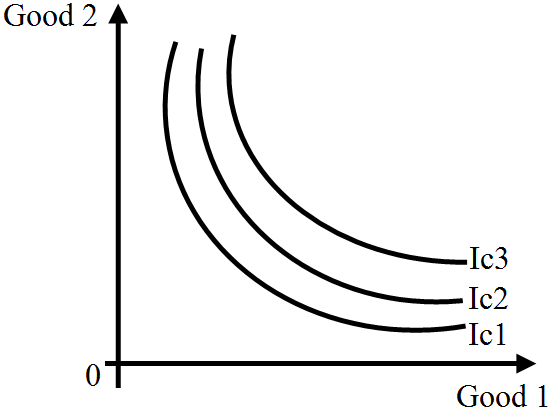
Answer

Properties of indifference curves (ICs):
  1. Indifference curves slope downwards or negative slope:
The indifference curves slope downwards, left to right, because an increase in the amount of Good X along the indifference curve is associated with a decrease in the amount of Good Y, as the preferences are monotonic.
  1. Slope of indifference curves represents marginal rate of substitution:
Marginal rate of substitution (MRS) is the rate at which a consumer is willing to substitute one commodity for another commodity.
Slope of indifference curve between A and B $=\frac{\Delta\text{Y}}{\Delta\text{X}}=\text{MRS}$
MRS is the rate at which the output of Good Y is sacrificed for every additional unit of Good X.
  1. In an indifference map, higher IC represents higher level of satisfaction:
An indifference map refers to a set of indifference curves. An indifference curve which is to the right and above another shows a higher level of satisfaction to the consumer. Here, $IC_3$ shows higher level of satisfaction than $IC_2$. Thus, the indifference curve relates to a higher level of income of the consumer.

Need a full question paper?

Generate a complete, print-ready paper with questions like this in minutes — across 16+ boards, with answer keys.

Start Generating Free

Similar questions

A firm's average fixed cost, when it produces 2 units, is ₹ 30. Its average total cost schedule is given below. Calculate its marginal cost and average variable cost at each level of output.
Output (Units) 1 2 3
Average Total Cost (₹) 80 48 40
If duopoly behaviour is one that is described by Cournot, the market demand curve is given by the equation q = 200 – 4p, and both the firms have zero costs, find the quantity supplied by each firm in equilibrium and the equilibrium market price.
A consumer consumes only two goods $X$ and $Y$ whose prices are $₹ 4$ and $₹ 5$ per unit respectively. If the consumer chooses a combination of the two goods with marginal utility of $X$ equal to 5 and that of $Y$ equal to $4$ , is the consumer in equilibrium? Give reasons. What will a rational consumer do in this situation? Use utility analysis.
Explain the relationship between Marginal product and Average product.
OR
State the relation between Marginal product and average product. Use diagram.
Market for a good is in equilibrium. There is an 'increase' in demand for this good. Explain the chain of effects of this change. Use diagram.
Explain the conditions of consumer’s equilibrium using indifference curve analysis.
A consumer consumes only two goods X and Y both priced at Rs. 3 per unit. If the consumer chooses a combination of these two goods with Marginal Rate of Substitution equal to 3, is the consumer in equilibrium? Give reasons. What will a rational consumer do in this situation? Explain.
From the following table, calculate price at each level of output.
Output(Units) 1 2 3 4
Marginal Revenue(₹) 6 4 2 0
Examine the effect of (a) fall in the own price of good X and (b) rise in tax rate on good X, on the supply curve. Use diagrams.
What do you mean by excess supply? Explain with the help of a diagram the effect of excess supply on the price of the commodity.