Question
State any six users of accounting information Why do they need accounting information?

Answer

  1. The owners/shareholders: use them to see if they are getting satisfactory returns on their investment and also to assess the financial health of their enterprise.
  2. The managers/directors: use them to ascertain the strengths and weaknesses of the enterprise.
  3. The creditors: use them to know whether the firm will be able to pay the interest regularly and will be able to pay their debts as they become due.
  4. The prospective investors: use them to assess whether or not to invest their money in this firm.
  5. Employees: They need accounting information to claim increase in wages, bonus and other benefits.
  6. The government agencies: use them for the payment of various taxes such as Goods and Service Tax (GST), Income Tax etc.

Need a full question paper?

Generate a complete, print-ready paper with questions like this in minutes — across 16+ boards, with answer keys.

Start Generating Free

Similar questions

Rectify the following errors found in the books of Bheem. Trial Balance had ₹ 930 excess credit. The difference has been posted to a Suspense Account:
  1. The total of Returns Inward Book has been cast ₹ 1,000 short.
  2. The purchase of an office table costing ₹ 3,000 has been passed through the Purchases Book.
  3. ₹ 3,750 paid for wages to workmen for making showcases had been charged to the Wages Account.
  4. A purchase of ₹ 670 had been posted to the Creditors' Account as ₹ 600.
  5. A cheque for ₹ 2,000 received from Nakul had been dishonoured and was passed to the debit of the Allowances Account.
  6. An amount of ₹ 15,720 due from Prasad written off as had in a previous year, was recovered and credited to the Personal Account of Prasad.
After rectification reflect the transactions in the Suspense Account.
Prepare Simple Cash Book from the following transactions of Simran, Delhi:
2019
 
March 1
Simran commenced business with cash
65,000
March 3
Bought goods for cash, CGST and SGST paid @ 6% each
6,850
March 4
Paid cash to Mr. Mohan
950
March 6
Deposited in Bank
40,000
March 6
Paid for office furniture in cash, CGST and SGST paid @ 6% each
4,650
March 9
Sold goods for cash charged CGST and SGST @ 6% each
30,000
March 12
Paid wages in cash
1,200
March 13
Paid for Stationery, CGST and SGST paid @ 6% each
400
March 15
Sold goods for cash, charged CGST and SGST @ 6% each
25,000
March 17 Paid for miscellaneous expenses 450
March 19 Received cash from Mr. Trilok Chand 4,850
March 22 Purchased goods, CGST and SGST paid @ 6% each 2,500
March 22 Paid Salary 4,000
March 25 Paid rent, CGST and SGST paid @ 6% each 900
March 28 Paid electricity bill 350
March 29 Paid for advertising, CGST and SGST paid @ 6% each 400
March 31 Paid into bank 25,000
Use Accounting Equation to show the effect of the following transactions of M/s Royal Traders:
 
 
(₹)
(a)
Started Business with Cash
1,20,000
(b)
Purchased goods for cash
10,000
(c)
Rent received
5,000
(d)
Salary outstanding
2,000
(e)
Received interest
700
(f)
Sold goods for cash (costing ₹ 5,000)
7,000
(g)
Goods destroyed by fire
500
Enter the following transactions in the Two Column Cash Book of Mr. Mohan:
2018
 
Jan. 1
Cash in Hand
2,200
Cash at Bank
50,000
Jan. 3
Purchased goods for ₹ 75,000; Trade Discount 20%; CGST 6%, SGST 6%; Payment made by Cheque
 
Jan. 4
Sold goods for ₹ 40,000; Trade Discount 15%; IGST 12%; Payment received by Cheque
 
Jan. 5
Received a cheque from Naresh
1,000
Jan. 8
Cheque received from Naresh endorsed to Suresh in full settlement of his account of ₹ 1,050
 
Jan. 10
Paid Life Insurance premium of Mr. Mohan
100
Jan. 13
Received a cheque from Pawan in full settlement of his account of ₹ 750
700
Jan. 16
Pawan's cheque returned dishonoured by bank
 
Jan. 20
Deposited into Bank, balance of Cash in excess of ₹ 250
 
The accountant of X prepared the Trial Balance at the end of the year on 31st March, 2015. But there was a difference and the accountant put the difference in a Suspense Account. Rectify the following errors found and prepare the Suspense Account:
  1. The total of the returns outward book ₹ 420 has not been posted in the ledger.
  2. A purchase of ₹ 350 from Y has been entered in the sales book. However Y's Account has been correctly entered.
  3. A sale of ₹ 390 to Z has been credited to his account ₹ 290.
  4. Old furniture sold for ₹ 5,400 had been posted as ₹ 4,500 in Sales Account.
  5. Goods taken by the proprietor ₹ 500 have not been entered in the books at all.
Journalise the following transactions in the books of Prakash:
  1. Opened a current account with Punjab National Bank ₹ 1,00,000.
  2. Received a cheque of ₹ 12,900 from Chandradev and allowed discount ₹ 300 to him. The cheque was deposited into Bank on the same day.
  3. Purchased machinery for ₹ 1,00,000, payment made by cheque. Installation charge of machinery ₹ 6,000 paid in cash.
  4. Purchased a horse for business for ₹ 20,000.
  5. Sold goods to Gokul at a list price of ₹ 4,000. Trade discount 10% and cash discount 5%. He paid the amount on the same day and availed the cash discount.
  6. Purchased goods for ₹ 10,000 and paid ₹ 400 for carriage on these goods.
  7. Additional cash introduced by the proprietor ₹ 40,000.
  8. Purchased stationery ₹ 800 and postal stamps ₹ 100.
  9. Withdrawn from bank ₹ 20,000.
  10. Received an order to supply goods of ₹ 40,000 from Manu and received ₹ 10,000 as an advance together with the order.
  11. Cash ₹ 10,000 and goods worth ₹ 4,000 were stolen.
  12. Purchased goods from Devendra for ₹ 40,000 and the payment was made by cheque.
  13. Sold $\frac{1}{4}\text{th}$ of the above goods at a profit of 25% on cash.
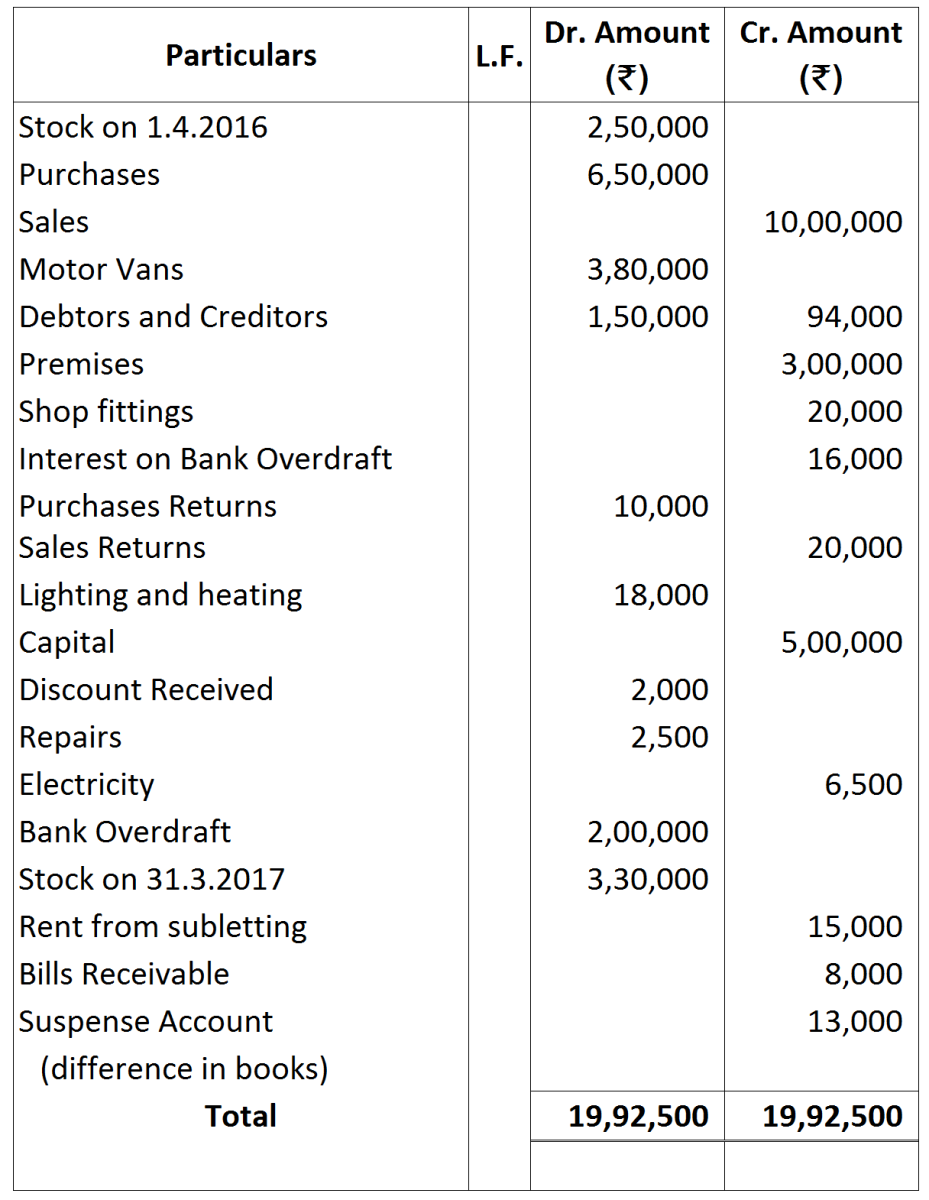
A book-keeper extracted the following Trial Balance as at 31st March, 2017:
On Checking Ram's Cash Book with the bank statement of his overdraft current account for the month of November 2014, you find the following:
  1. Cash Book showed an overdraft of ₹ 16,200.
  2. The payment side of the Cash Book had been undercast by ₹ 500.
  3. A cheque for ₹ 13,600 drawn on his saving deposit account has been wrongly recorded as drawn on current account in the Cash Book.
  4. Cheques amounting to ₹ 18,800 drawn and entered in the Cash Book had not been presented.
  5. Cheques amounting to ₹ 7,500 sent to the bank for collection though entered in the Cash Book, had not been credited by the bank.
  6. Bank charge of ₹ 150 as per bank statement of account had not been taken in the Cash Book.
  7. Dividend of the amount of ₹ 420 had been paid direct to the bank and not entered in the Cash Book.
You are requested to arrive at the balance as it would appear in the bank statement as on 30th November 2014.
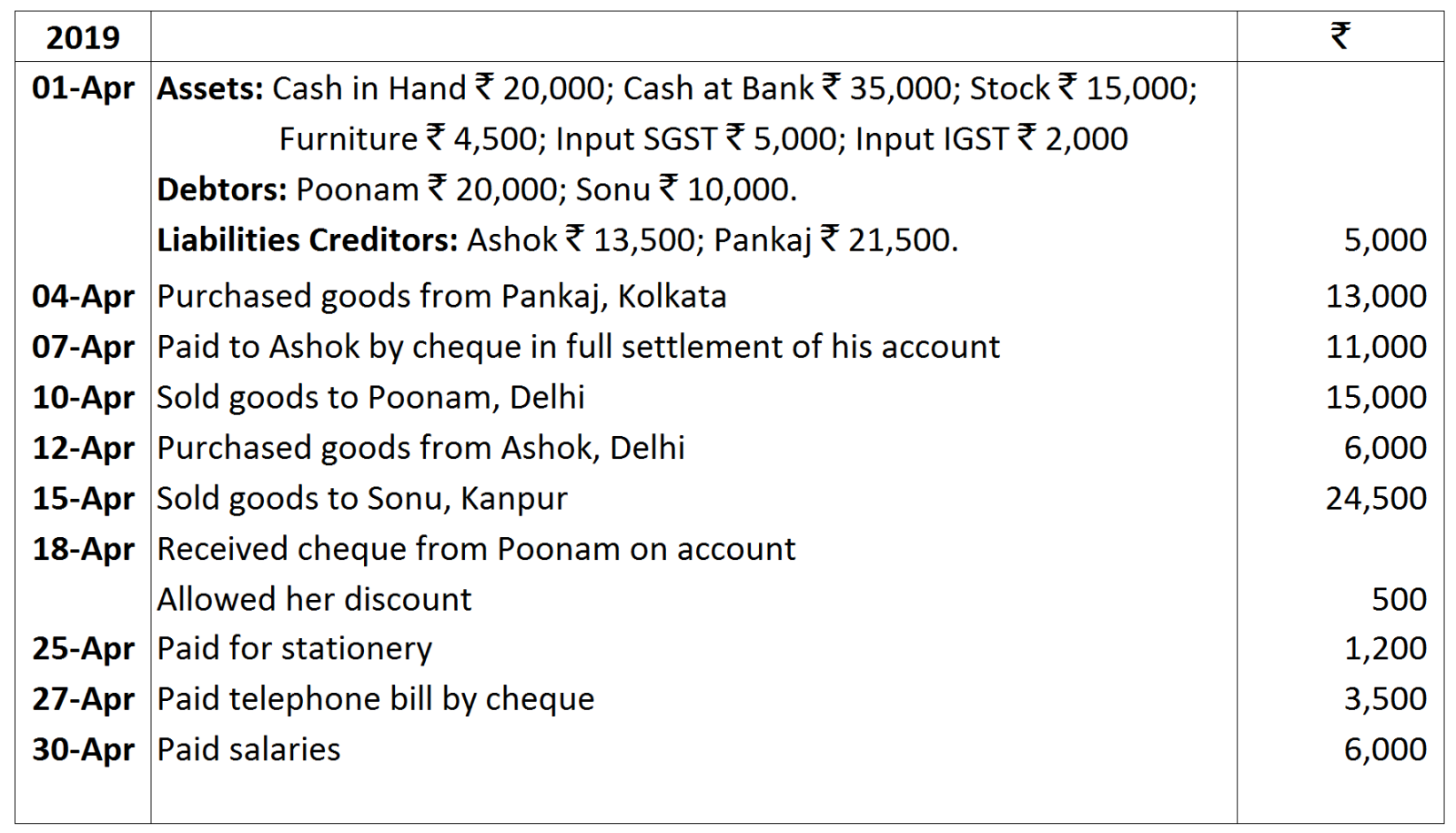
Enter the following transactions in the Journal of M/s. Karim Bros., Prop. Shri Karim Khan, Kolkata, post to the Ledger:
Inter-state transactions are subject to levy of IGST @ 12% and Intra-state transactions are subject to levy of CGST and SGST @ 6% each. GST is not levied on transactions marked with (*).
Following transactions of Ramesh for April, 2019 are given below. Journalise them.
2019
 
April 1
Ramesh started business with cash
1,00,000
April 2
Paid into bank
20,000
April 3
Bought goods for cash
50,000
April 4
Drew cash from bank for office use
10,000
April 13
Sold goods to Krishna
15,000
April 20
Bought goods from Shyam
22,500
April 22
Krishna returned goods
2,000
April 24
Received from Krishna
12,500
 
Allowed him discount
500
April 28
Paid cash to Shyam
21,500
 
Discount received
1,000
April 30
Cash sales for the month
80,000
April 30
Paid rent
5,000
April 30
Paid salary
10,000