Question
State any two limitations of analysis of financial statements?

Answer

  1. Limitations of Financial Statements: Financial analysis is based on financial statements. But financial statements themselves suffer from certain limitations, hence the limitations of financial statements are also the limitations of their analysis.
For example:
  1. Sometimes the informations given in financial statements are incomplete and unauthentic.
  2. Financial Statements are based on accounting concepts and conventions.
As such, the utility of financial analysis is decreased due to the shortcomings of financial statements.
  1. Affected by Window-dressing: Some firms resort to window-dressing their financial statements to cover up bad financial position on the eve of accounting date. For example, they may not record the purchases made at the end of the year or they may overvalue their closing stock. In such cases, the results obtained by analysis of financial statements will be misleading.

Need a full question paper?

Generate a complete, print-ready paper with questions like this in minutes — across 16+ boards, with answer keys.

Start Generating Free

Similar questions

The Current Ratio of a Company is 3 : 1. State giving reasons which of the following suggestions would (i) Improve; (ii) Reduce; (iii) Not change; the Current Ratio:-
  1. Payment of Trade Payables.
  2. Sale of goods costing ₹ 20,000 for ₹ 20,000 for Cash.
  3. Sale of goods costing ₹ 20,000 for ₹ 18,000 on Credit.
  4. Sale of goods costing ₹ 20,000 at a profit of ₹ 1,000.
  5. Purchase of goods on Credit.
  6. Purchase of goods for Cash.
  7. Purchase of machinery against long-term loan.
Z Ltd. was registered with an authorised capital of ₹ 10,00,000 divided into 10,000 shares of ₹ 100 each. The Company offered 5,000 of these shares to the public, which were payable ₹ 25 per share on application, ₹ 50 per share on allotment and the balance three months later. Applications for 7,100 shares were received on which the directors allotted as follows:
Applications for 4,000 Shares
Full
Applications for 3,000 Shares
1,000
Applications for 100 Shares
Nil
₹ 1,85,000 was realised on account of allotment money (excluding the amount carried from application money) and ₹ 1,15,000 on account of call. The Directors decided to forfeit those shares on which allotment money was overdue.
Show the entries in the company’s books.
Describe the provisions of law relating to ‘Calls-in-Arrears’ and ‘Calls-in-Advance’.
Calculate current assets of a company from the following information:
  1. Inventory turnover 4 times.
  2. Inventory in the end is ₹ 20,000 more than inventory in the beginning.
  3. Revenue from Operations ₹ 3,00,000.
  4. Gross profit ratio 20%.
  5. Current liabilities ₹ 40,000.
  6. Quick ratio 0.75.
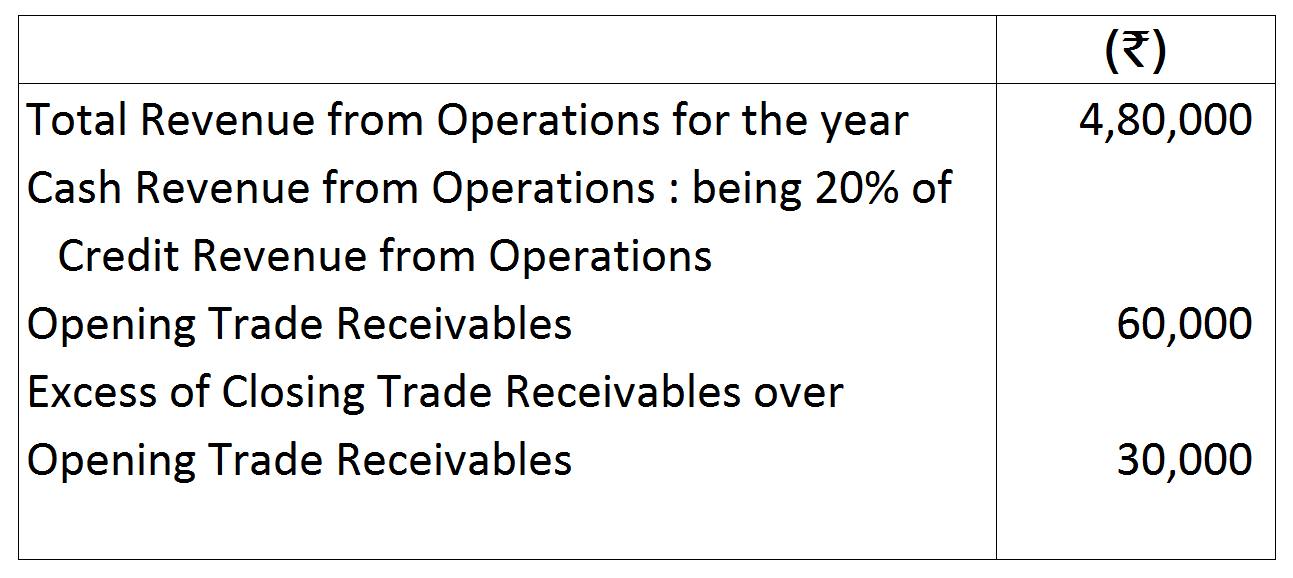
Calculate Trade Receivables Turnover Ratio and Average Collection Period from the following:
X Limited offered to the public 10,000 equity shares of ₹ 10 each at a premium of ₹ 2 per share payable as follows:
On application ₹ 3; On allotment (including premium) ₹ 4; On first call ₹ 3 and on second and final call ₹ 2.
Applications were received for 15,000 shares.
All applications were placed under four categories and allotment was made as follows:
Category A
to applicants of 4,000 shares
in full
Category B
to applicants of 6,000 shares
4,000 shares
Category C
to applicants of 3,000 shares
2,000 shares
Category D
to applicants of 2,000 shares
Nil
Except in the cases where applications were wholly rejected, excess application money was not to be refunded but to be adjusted against moneys due on allotment and calls.
A, an applicant under category B to whom 400-shares were allotted failed to pay the allotment money and on his failure to pay the first call his shares were forfeited.
B, an applicant under category C to whom 300 shares were allotted failed to pay both the calls and his shares were also forfeited.
500 of the shares thus forfeited were re-issued to C as fullypaid for ₹ 8 per share.
Show Cash Book, Journal entries and prepare the Balance Sheet in the: books of the company; you are to assume that the whole of the A's shares were issued to C.
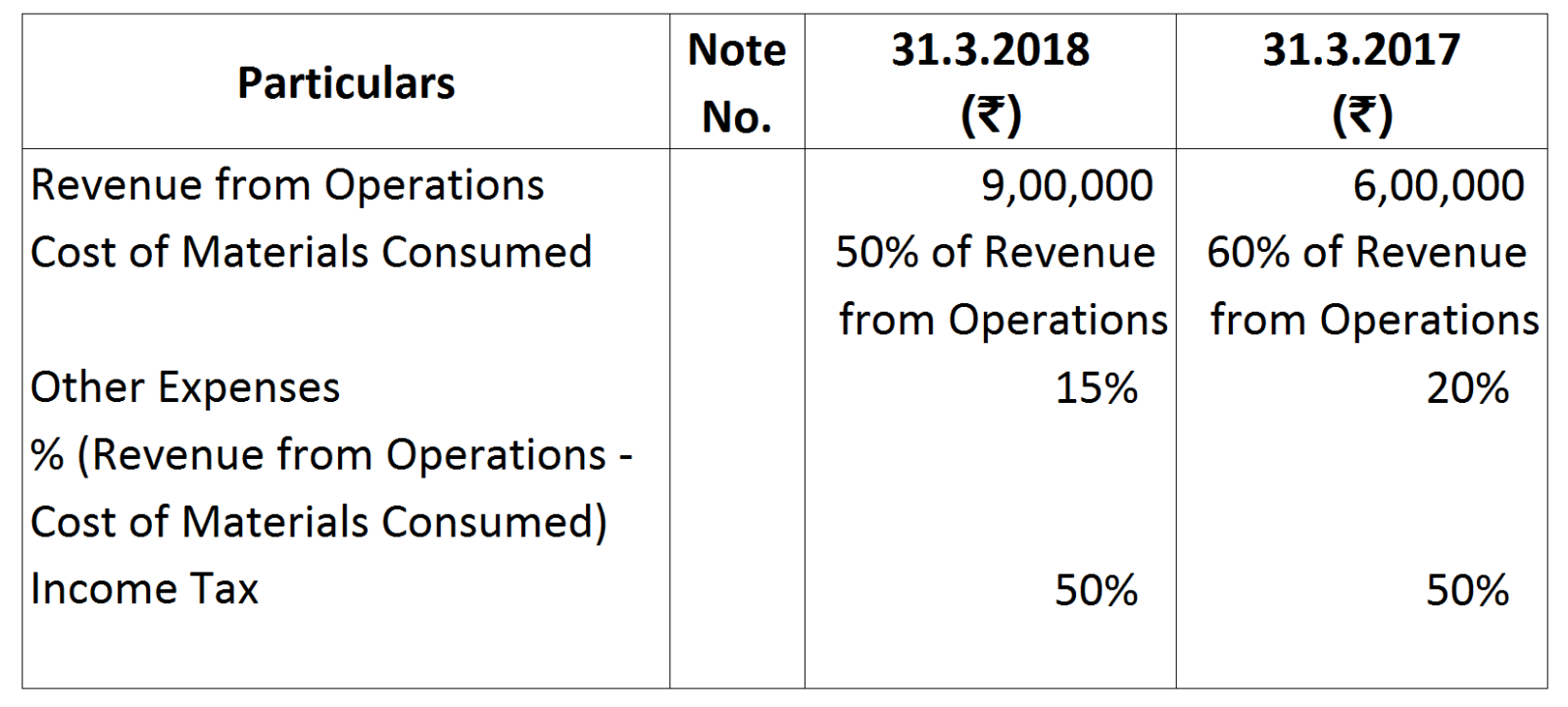
Form the following information provided, prepare Comparative Statement of Profit and loss for the years ended 31st March 2018 and 2017:
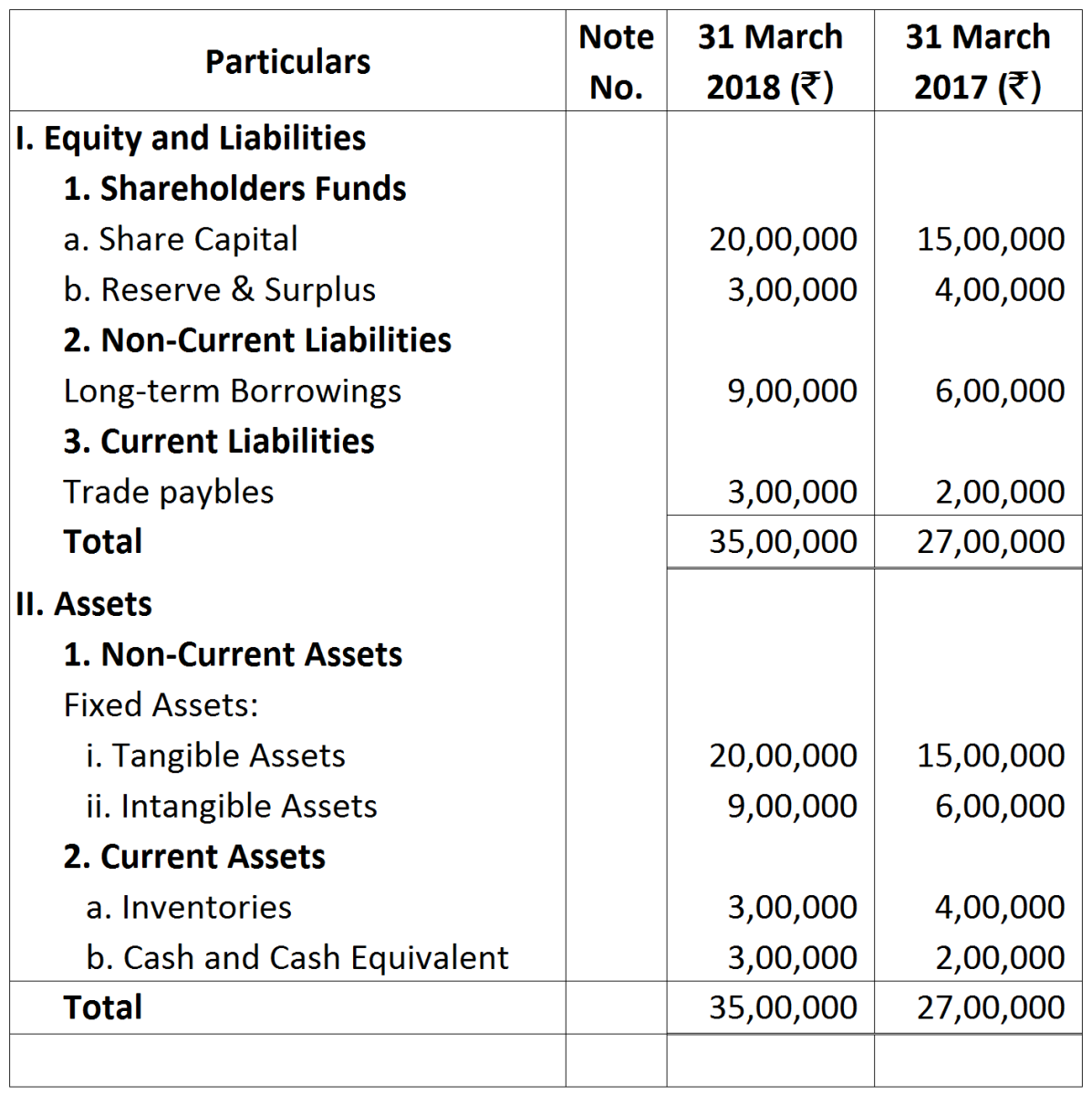
From the following Balance Sheet of CPT Ltd. as at 31st March, 2018, Prepare a Comparative Balance Sheet and also compute debt to Equity Ratio:
Give a format of Common Size Balance Sheet of a company for two years.
DF Ltd. invited applications for issuing 50,000 shares of ₹ 10 each at a premium of ₹ 2 per share. The amount was payable as follows:
On Application: ₹ 3 per share (including premium ₹ 1)
On Allotment: ₹ 3 per share (including premium ₹ 1)
On First call: ₹ 3 per share
On Second and Final Call: Balance amount
Application for 70,000 shares were received. Allotment was made on the following basis.
Applications for 5,000 shares – Full
Applications for 50,000 shares – 90%
Balance of the applications were rejected. ₹ 1,11,000 were received on account of allotment. The amount of allotment due from the shareholders to whom shares were allotted on prorata basis was fully received. A few shareholders to whom shares were allotted in full, failed to pay the allotment money. ₹ 1,20,000 were received on first call. Directors decided to forfeit those shares on which allotment and call money was due. Half of the forfeited shares were re-issued @ ₹ 8 per share fully paid up. Final call was not made.
Pass the necessary journal entries for the above transactions in the book of DF Ltd.