Question
State any two objectives of analysis of financial statements.

Answer

  1. To Measure the Earning Capacity or Profitability: According to Robert Anthony, "The overall objective of a business is to earn a satisfactory return on the
    funds invested in it, consistent with maintaining a sound financial position." Financial analysis helps in ascertaining whether adequate profits are being earned on the capital invested in the business. It is also disclosed by analysis of financial statements whether these profits are increasing or decreasing over the years. For this purpose, the financial statements of a few years are taken into account to compute the change in profits over the years. Such analysis helps in ascertaining the future profit ability or earning capacity of the business.
  2. To Measure the Solvency: It can be ascertained from financial analysis whether the business is in a position to pay its short-term and long-term liabilities in time. For example, the liquidity ratios ( current ratio and quick ratio) are calculated to ascertain whether the business enterprise has sufficient liquid funds to meet its short term liabilities and Debt Equity. Ratio is calculated ascertain wether the business enterprise has got the ability repay the long term liabillties.

Need a full question paper?

Generate a complete, print-ready paper with questions like this in minutes — across 16+ boards, with answer keys.

Start Generating Free

Similar questions

Dogra Ltd. had an authorised capital of ₹ 1,00,00,000 divided into Equity Shares of ₹ 100 each. The company offered 84,000 shares to the public at premium.
The amount was payable as follow:
On Application - ₹ 30 per share,
On Allotment - ₹ 40 per share(including premium),
On First and Final call - ₹ 50 per share.
Applications were received for 80,000 shares.
All sums were duly received except the following:
Lakhan, a holder of 200 shares did not pay allotment and call money.

Paras, a holder of 400 shares did not pay call money.
The company, forfeited the shares of Lakhan and Paras. Subsequently the forfeited shares were reissued for ₹ 80 per share as fully paid-up. Show the entries for the above transactions in the Cash Book and journal of the company.

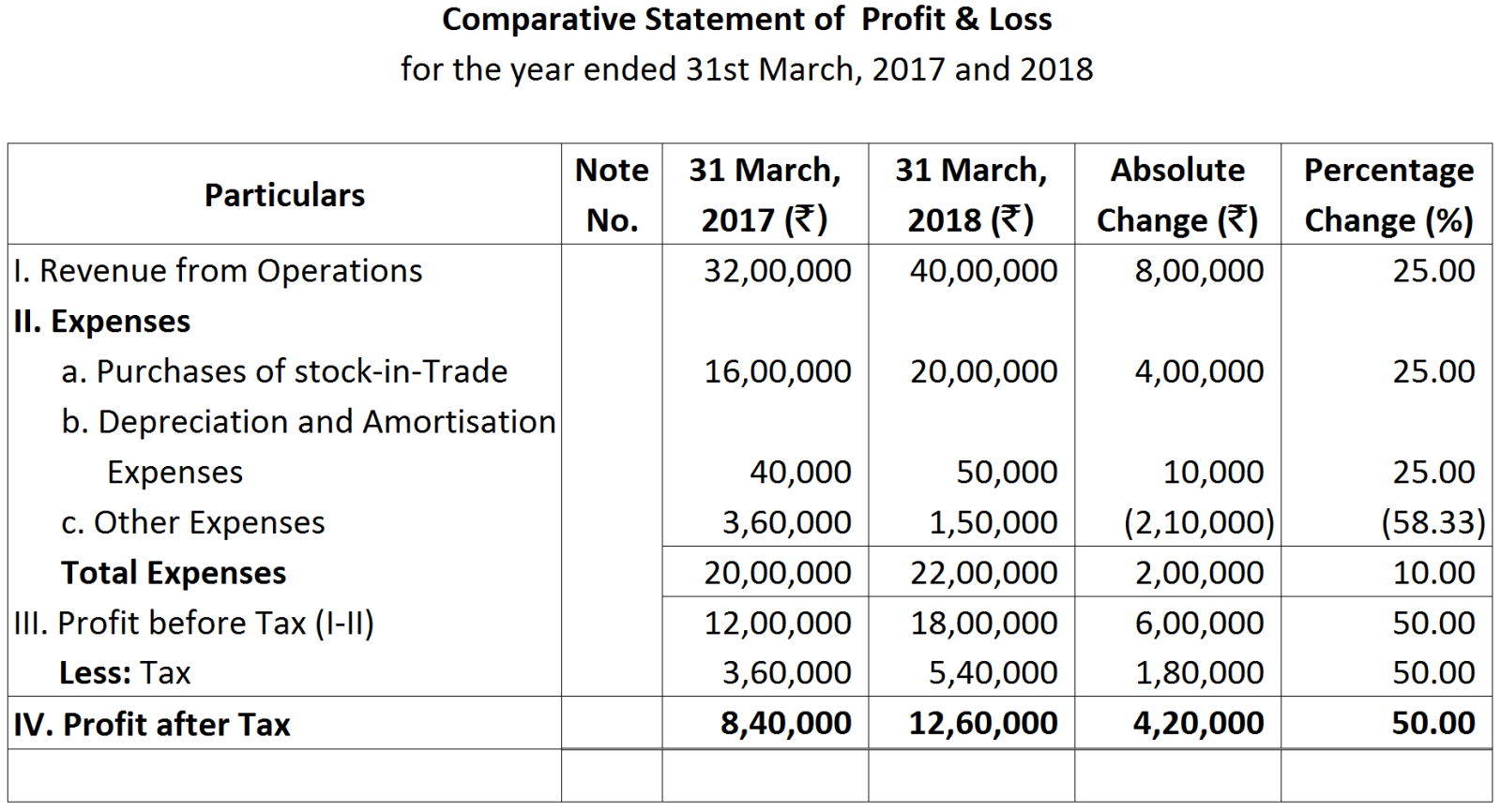
From the above Comparative Statment of Profit and loss for the year ended 31st March, 2017 and 31st March, 2018, compute Operating ratio.
Prince Limited issued a prospectus inviting applications for 20,000 equity shares of ₹ 10 each at a premium of ₹ 3 per share payable as follows:
On Application - ₹ 2,
On Allotment (including premium) - ₹ 5,
On First Call - ₹ 3,
On Second call - ₹ 3,
Applications were received for 30,000 shares and allotment was made on pro rata basis. Money overpaid on application s was adjusted to the amount due on allotment.
Mr. Mohit whom 400 shares were allotted, failed to pay the allotment money and the first call, and his shares were forfeited after the first call. Mr. Joly, whom 600 shares were allotted, failed to pay for the two calls and hence, his shares were forfeited.
Of the shares forfeited, 800 shares were reissued to Supriya as fully paid for ₹ 9 per share, the whole of Mr Mohit's shares being included.
The Current Ratio of a Company is 3 : 1. State giving reasons which of the following suggestions would (i) Improve; (ii) Reduce; (iii) Not change; the Current Ratio:-
  1. Payment of Trade Payables.
  2. Sale of goods costing ₹ 20,000 for ₹ 20,000 for Cash.
  3. Sale of goods costing ₹ 20,000 for ₹ 18,000 on Credit.
  4. Sale of goods costing ₹ 20,000 at a profit of ₹ 1,000.
  5. Purchase of goods on Credit.
  6. Purchase of goods for Cash.
  7. Purchase of machinery against long-term loan.
Alfa Ltd. invited applications for issuing 75,000 equity shares of ₹ 10 each. The amount was payable as follows:
On application and allotment - ₹ 4 per share,
On first Call - ₹ 3 per share,
On second and final Call - balance.
Applications for 1,00,000 shares were received. Shares were allotted to all the applicants on pro rata basis and excess money received with applications was transferred towards sums due on first call. Vibha who was allotted 750 shares failed to pay the first call. Her shares were immediately forfeited. Afterwards the second call was made. The amount due on second call was also received except on 1,000 shares applied by Monika. Her shares were also forfeited. All the forefited shares were reissued to Mohit for ₹ 9,000 as fully paid-up.
Pass necessary journal entries in the Books of Alfa Ltd. for the above transactions.
On 1.4.2013 JMR Ltd. had 20,000, 9% debentures of ₹ 100 each outstanding.
  1. On 1.4.2014 the company purchased in the open market 6,000 of its own debentures for ₹ 98 each and cancelled the same immediately.
  2. On 28.2.2015 the company redeemed at par debentures of ₹ 10,00,000 by draw of a lot.
  3. On 1.3.2016 the remaining debentures were purchased for immediate cancellation for ₹ 3,99,000.
Ignoring interest on debentures and debenture redemption reserve, pass necessary journal entries for the above transactions in the books of JMR Ltd.
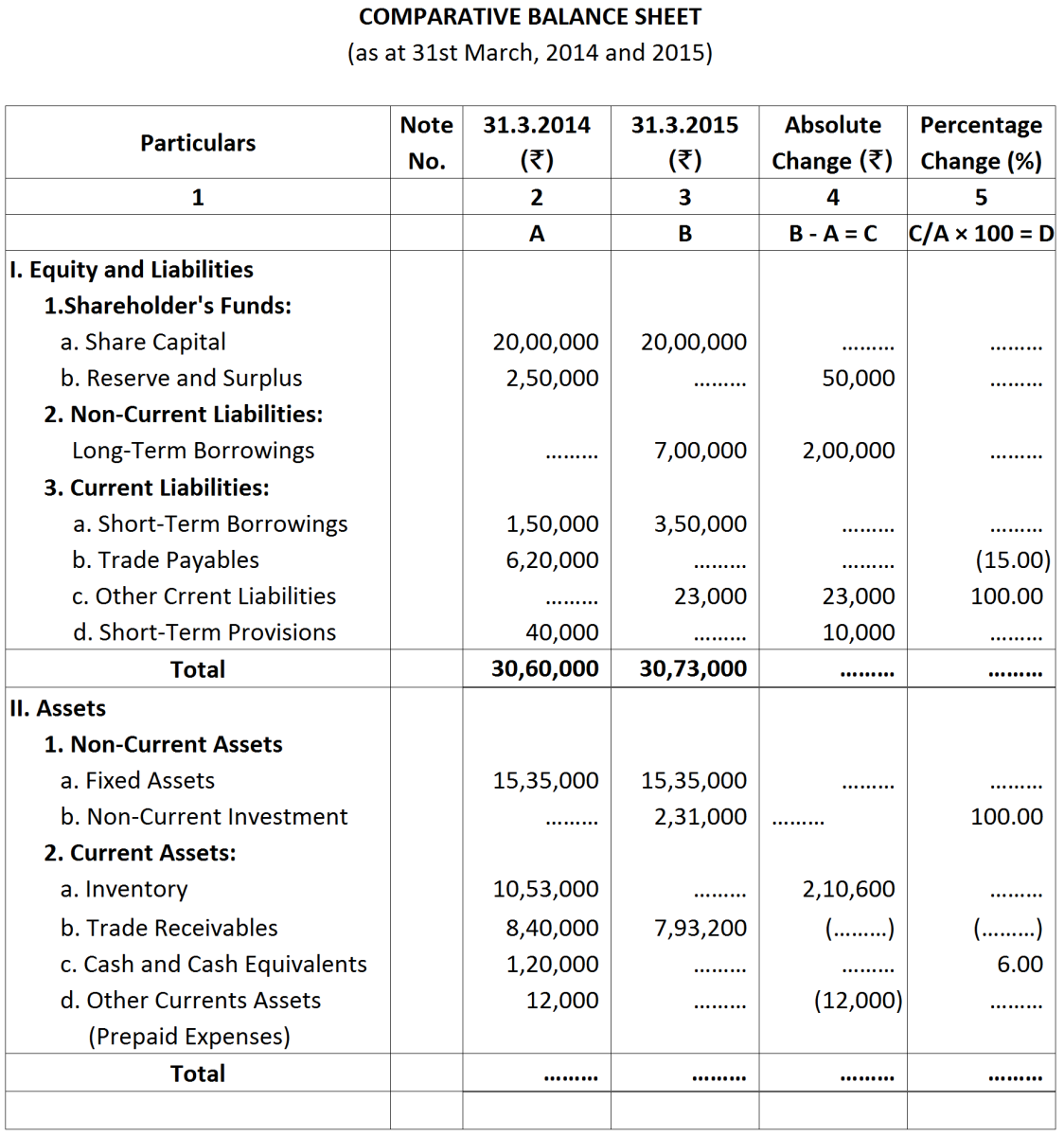
Following is the Comparative Balance Sheet of India Paper Ltd.
Additional Information: Revenue from Operations for the years ended 31st March, 2014 and 31st March, 2015 was ₹ 72,90,000 and ₹ 92,55,000 respectively. You are required to:
  1. Fill in the missing figures in the Comparative Balance Sheet.
  2. Calculate the following ratios:
  1. Working Capital Turnover Ratio.
  2. Quick Ratio.
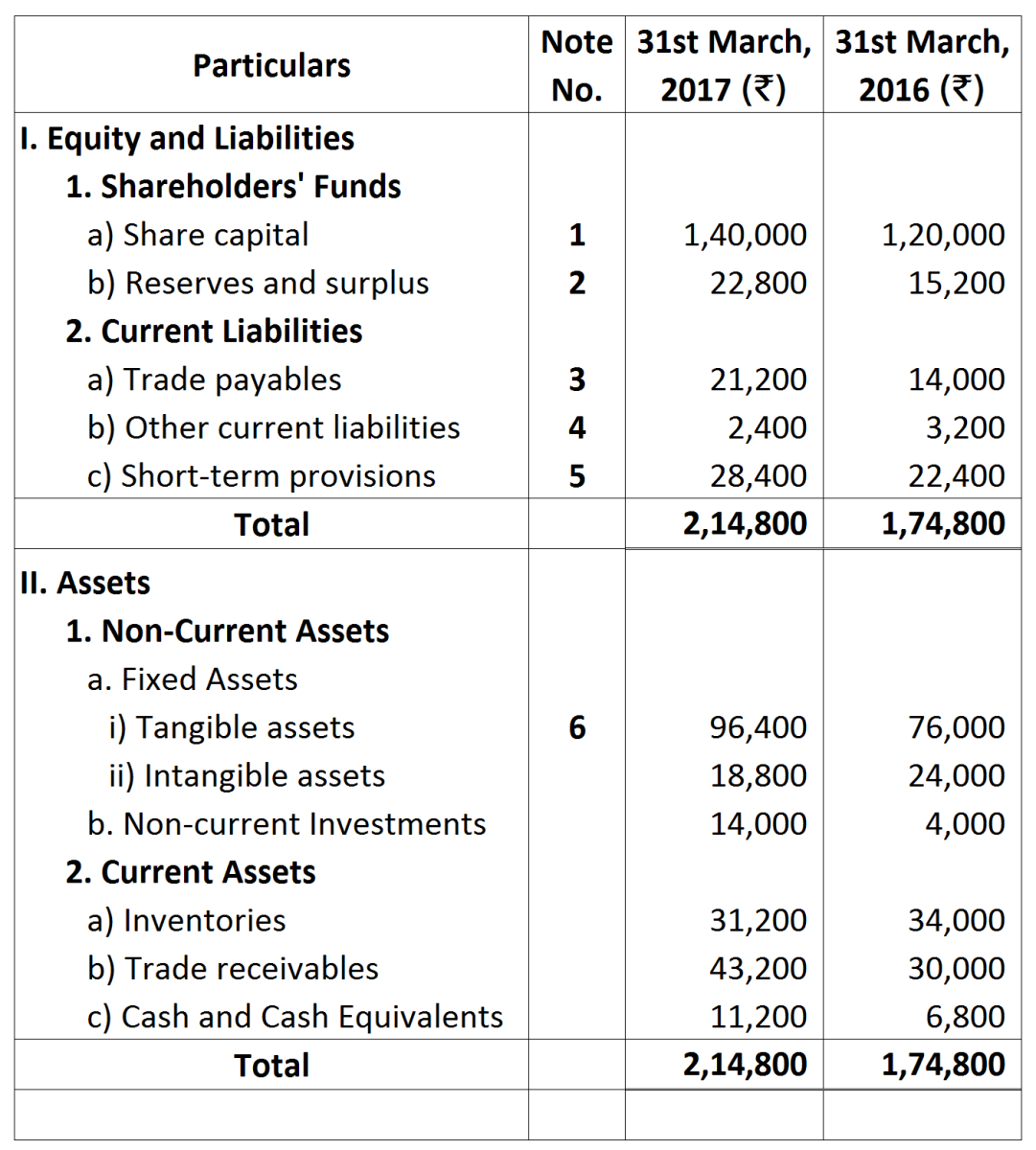
From the foltowingBatance Sheet of Tiger Super Steel Ltd, prepare Cash flow statement.

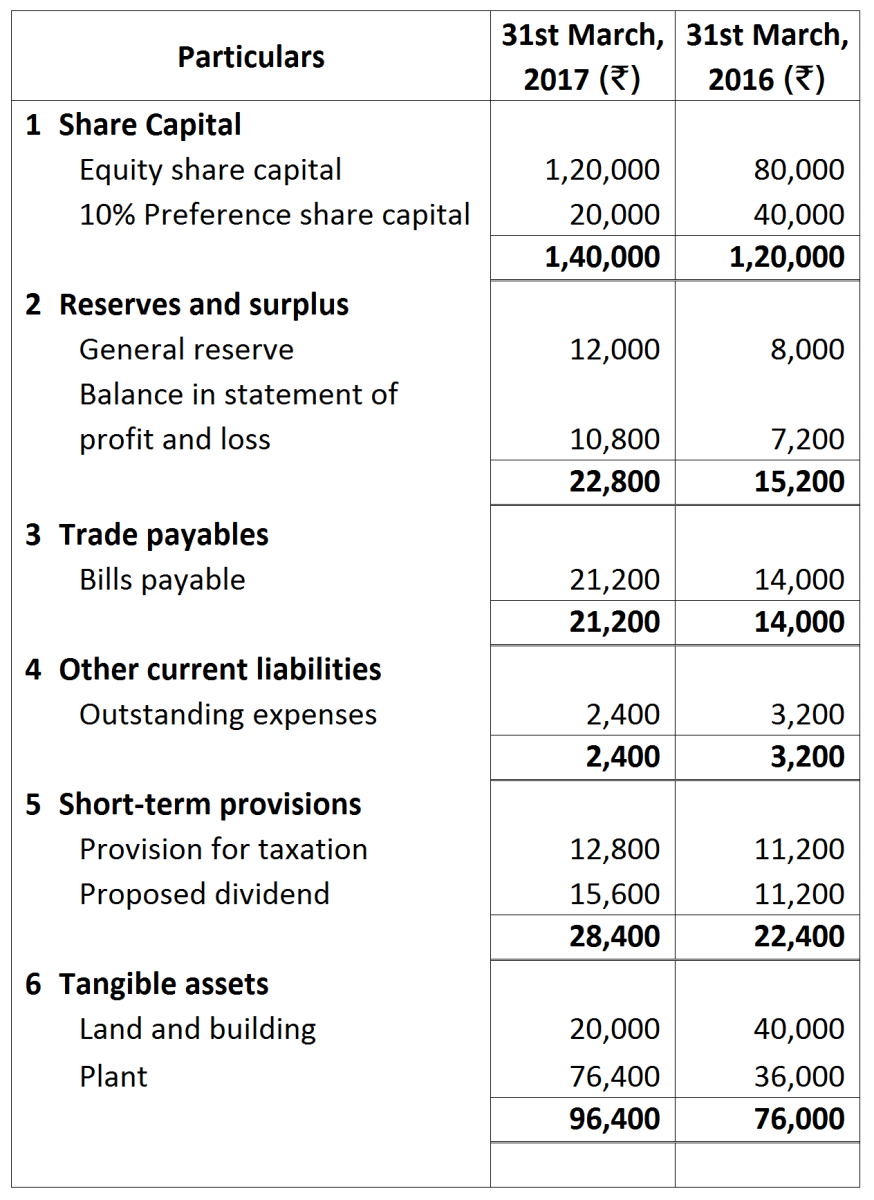
Notes to accounts:

Additional Information.
Depreciation Charged on Land and building ₹ 20,000 and plant ₹ 10,000 during the year.
Calculate Operating Profit Ratio and Operating Ratio from the following:
Net Revenue from Operations ₹ 3,00,000; Gross Profit ₹ 1,20,000; Operating Expenses ₹ 45,000.
XYZ Ltd. issued 8,000 Equity Shares of ₹ 10 each. ₹ 5 per share was called, payable ₹ 2 on application, ₹ 1 on allotment, ₹ 1 on first call and ₹ 1 on second call. All the money was duly received with the following exceptions:
A who holds 250 shares paid nothing after application.
B who holds 500 shares paid nothing after allotment.
C who holds 1,250 shares paid nothing after first call.
Prepare journal and the Balance Sheet.