Question
State any two objectives of preparing 'Cash Flow Statement'.

Answer

The objectives of Cash Flow Statement are:
  • To determine the sources (receipts) of Cash and Cash Equivalents under operating, investing and financing activities of the enterprise.
  • To determine applications (payments) of Cash and Cash Equivalents under operating, investing and financing activities of the enterprise.
  • To determine net change in Cash and Cash Equivalents being the difference between sources (receipts) and applications (payments) under operating, investing and financing activities between the dates of two Balance Sheets.

Need a full question paper?

Generate a complete, print-ready paper with questions like this in minutes — across 16+ boards, with answer keys.
Start Generating Free

Similar questions

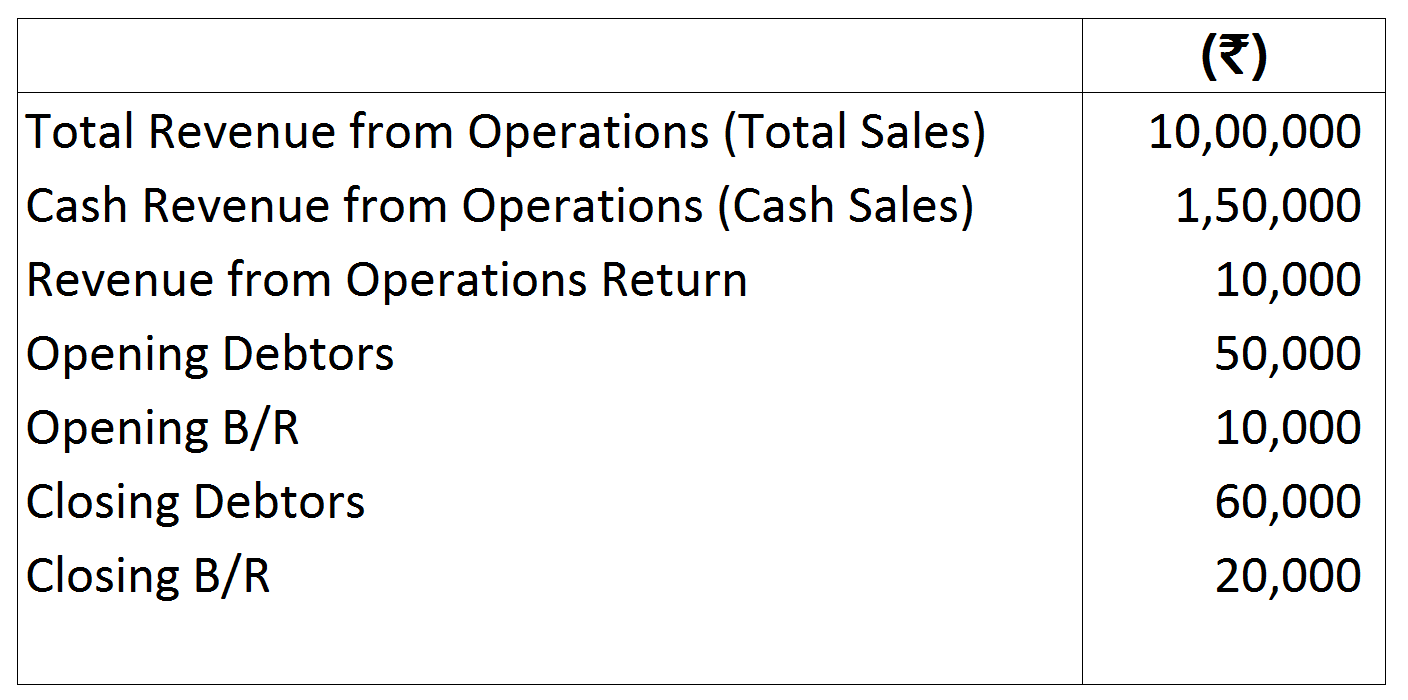
Calculate Trade Receivables Turnover Ratio and Average Collection Period from the following figures:
A Company has a loan of ₹ 30,00,000 as part of its capital employed. Interest payable on the loan is 12% and the R.O.I. of the company is 25%. The rate of income tax is 40%. What is the gain to shareholders due to the loan raised by the company?
From the following details, calculate Inventory Turnover Ratio:
 
Cost of Revenue from Operations (Cost of Goods Sold).
4,50,000
Inventory in the beginning of the year.
1,25,000
Inventory at the close of the year.
1,75,000
X Ltd. issued 10% Debentures of nominal value of ₹ 10,00,000 as follows:
  1. To sundry persons for cash at par - ₹ 5,00,000 nominal.
  2. To a vendor for ₹ 5,50,000 for purchase of fixed assets - ₹ 5,00,000 nominal.
Pass journal entries in the books of X Ltd.
Nikhil and Ashwin Limited bought business of Agarwal Limited consisting sundry assets of ₹ 3,60,000, sundry creditors ₹ 1,00,000 for a consideration of ₹ 3,07,200. It issued 14% debentures of ₹ 100 each fully paid at a discount of 4% in satisfaction of purchase consideration. Record necessary journal entries.
Newton Ltd. purchased a Machinery from B for ​₹ 5,76,000 to be paid by the issue of 9% Debentures of ​₹ 100 each at 4% discount. Journalise the trasactions.
Deepak Ltd purchased furniture of ₹ 2,20,000 from M/s. Furniture Mart. 50% of the amount was paid to M/s. Furniture Mart by accepting a Bill of Exchanged and for the balance the company issued 9% Debenture of ​₹ 100 each at a premium of 10% in favour of M/s. Furniture Mart.
Pass Journal entries in the books of Deepak Ltd.
Pass journal entries in the following cases:
A Co.Ltd. issued ₹ 40,000; 12% Debentures at a discount of 5% and redeemable at 5% premium.
From the following information, calculate Change in inventory of Stock-in-Trade:
Opening and Closing Stock-in-Trade ₹ 5,00,000 and ₹ 4,50,000 respectively.
Footfall Ltd. issues 10,000 Debentures of ₹ 100 each at a discout of 10% redeemable at a premium of 5% after the explry of three yeras.
Pass journal entries for the issue of these debentures.