Question
  1. State Bohr’s quantization condition for defining stationary orbits. How does de Broglie hypothesis explain the stationary orbits?
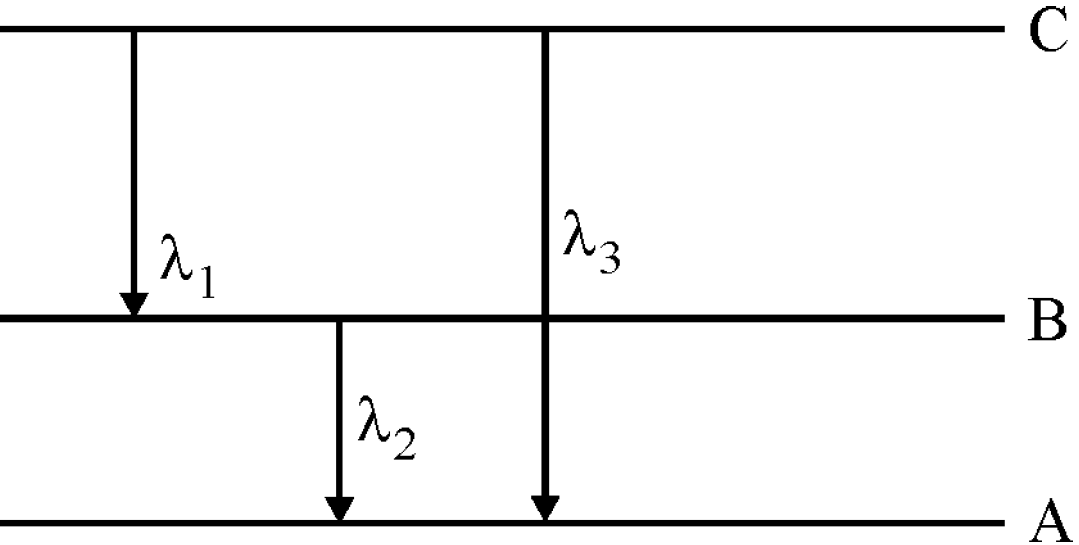
  2. Find the relation between the three wavelengths$\lambda_{1} , \lambda_{2}$ and$\lambda_{3}$ from the energy level diagram shown below.
Answer

Only those orbits are stable for which the angular momentum, of revolving electron, is an integral multiple of $\frac{\text{h}}{2\pi}.$Alternate Answer
$[\text{L} = \frac{\text{nh}}{2\pi}$ i.e. angular momentum of orbiting electron is quantised.] According to de Broglie hypothesis Linear momentum $(\text{P}) = \frac{\text{h}}{\lambda}$  And for circular orbit $\text{L} =\text{r}_{n}\text{p}$ where $' \text{r}_{n} '$ is the radius of quantized orbits. $ = \frac{\text{rh}}{\lambda}$ Also $\text{L} = \frac{\text{nh}}{2\pi}$ $\therefore\frac{\text{rh}}{\lambda} = \frac{\text{nh}}{2\pi}$ $\Rightarrow2\pi\text{r}_{n} = \text{n}\lambda$ $\therefore$ Circumference of permitted orbits are integral multiples of the wavelength $\lambda$ $\text{E}_{c} - \text{E}_{B} = \frac{\text{hc}}{\lambda}_{1}$ . . . . (i) $\text{E}_{B} - \text{E}_{A} =\frac{\text{hc}}{\lambda}_{2}$ . . . . (ii) $\text{E}_{c} - \text{E}_{A} = \frac{\text{hc}}{\lambda}_{a}$ . . . . . (iii) Adding (i) & (ii) $\text{E}_{c} - \text{E}_{A} = \frac{\text{hc}}{\lambda}_{1} + \frac{\text{hc}}{\lambda}_{2}$ . . . . . (vi) Using equation (iii) and (iv) $\frac{\text{hc}}{\lambda}_{3} = \frac{\text{hc}}{\lambda}_{1} + \frac{\text{hc}}{\lambda}_{2} = > \frac{1}{\lambda}_{3} = \frac{1}{\lambda}_{1} + \frac{1}{\lambda}_{2}$

Need a full question paper?

Generate a complete, print-ready paper with questions like this in minutes — across 16+ boards, with answer keys.

Start Generating Free

Similar questions

Can two particles be in equilibrium under the action of their mutual gravitational force? Can three particles be? Can one of the three particles be?
A point object is placed on the principal axis of a convex lens (f = 15cm) at a distance of 30cm from it. A glass plate $(\mu=1.50)$ of thickness 1cm is placed on the other side of the lens perpendicular to the axis. Locate the image of the point object.
(a) Which of the following can be a source for origin of electromagnetic waves? Give reason.
(i) A charge moving with constant speed
(ii) Charge undergoing circular motion
(iii) Fixed charge.
(b) Name that part of electromagnetic spectrum with which waves of frequency
(i) $10^{20} Hz$,
(ii) $10^9 Hz$ associated.
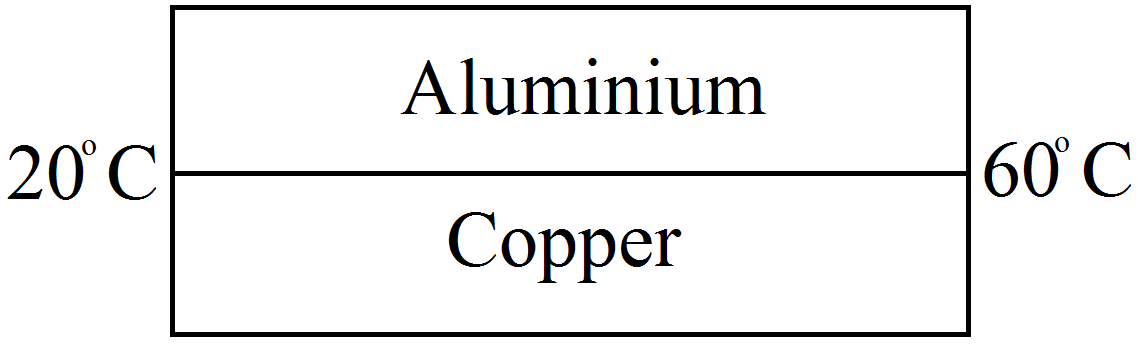
An aluminium rod and a copper rod of equal length $1.0m$ and cross$-$sectional area $1\ cm^2$ are welded together as shown in figure. One end is kept at a temperature of $20^\circ C$ and the other at $60^\circ C.$ Calculate the amount of heat taken out per second from the hot end. Thermal conductivity of aluminium $= 200\ Wm^{-1^\circ }C^{-1}$ and of copper $= 390\ Wm^{-1^\circ }C^{-1}.$
The energy flux of sunlight reaching the surface of the earth is $1.388 \times 10^3 W / m ^2$. How many photons $($nearly$)$ per square metre are incident on the Earth per second? Assume that the photons in the sunlight have an average wavelength of $550\ nm$ .
According to the station clocks, two babies are born at the same instant, one in Howrah and other in Delhi.
  1. Who is elder in the frame of 2301 Up Rajdhani Express going from Howrah to Delhi?
  2. Who is elder in the frame of 2302 Dn Rajdhani Express going from Delhi to Howrah.
Find the moment of inertia of a uniform square plate of mass m and edge a about one of its diagonals.
An ideal gas is taken through a process in which the pressure and the volume are changed according to the equation p = kV. Show that the molar heat capacity of R the gas for the process is given by $\text{C}=\text{C}_\text{v}+\frac{\text{R}}{2}.$
Establish an expression for mobility by giving definition of mobility. Establish relation between mobility of free electrons and electric current.
Rate of change of electric field in the region between the plates of capacitor is $1.5 \times 10^{12} Vm ^{-1} s^{ 1 }$. If circular plate of capacitor has a radius of 55 mm , then find the magnitude of displacement current.