Question
  1. State Bohr’s quantization condition for defining stationary orbits. How does de Broglie hypothesis explain the stationary orbits?
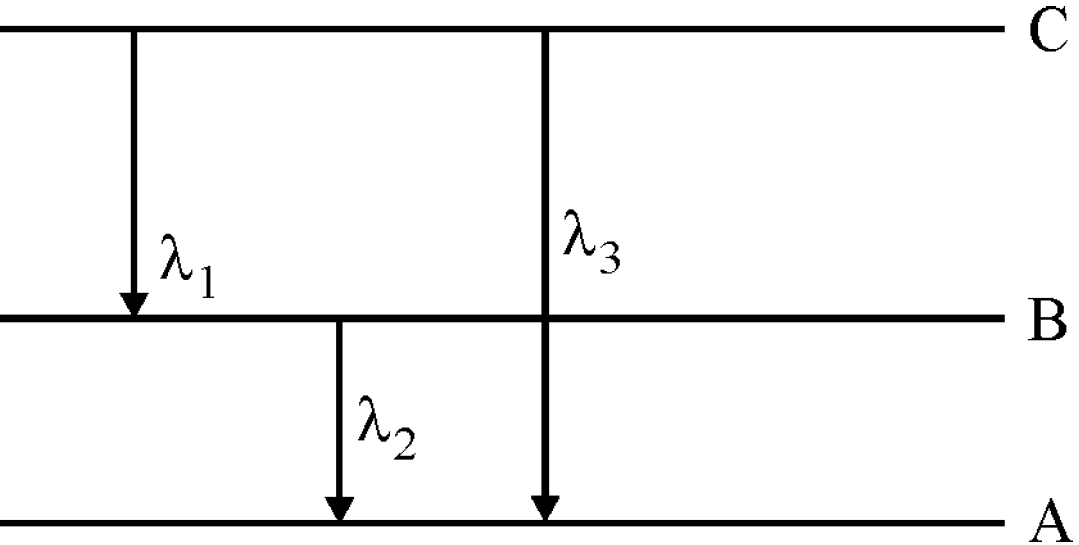
  2. Find the relation between the three wavelengths$\lambda_{1} , \lambda_{2}$ and$\lambda_{3}$ from the energy level diagram shown below.
Answer

Only those orbits are stable for which the angular momentum, of revolving electron, is an integral multiple of $\frac{\text{h}}{2\pi}.$

Alternate Answer

$[\text{L} = \frac{\text{nh}}{2\pi}$ i.e. angular momentum of orbiting electron is quantised.]

According to de Broglie hypothesis

Linear momentum $(\text{P}) = \frac{\text{h}}{\lambda}$ 

And for circular orbit $\text{L} =\text{r}_{n}\text{p}$ where $' \text{r}_{n} '$ is the radius of quantized orbits.

$ = \frac{\text{rh}}{\lambda}$

Also $\text{L} = \frac{\text{nh}}{2\pi}$

$\therefore\frac{\text{rh}}{\lambda} = \frac{\text{nh}}{2\pi}$

$\Rightarrow2\pi\text{r}_{n} = \text{n}\lambda$

$\therefore$ Circumference of permitted orbits are integral multiples of the wavelength $\lambda$

$\text{E}_{c} - \text{E}_{B} = \frac{\text{hc}}{\lambda}_{1}$ . . . . (i)

$\text{E}_{B} - \text{E}_{A} =\frac{\text{hc}}{\lambda}_{2}$ . . . . (ii)

$\text{E}_{c} - \text{E}_{A} = \frac{\text{hc}}{\lambda}_{a}$ . . . . . (iii)

Adding (i) & (ii)

$\text{E}_{c} - \text{E}_{A} = \frac{\text{hc}}{\lambda}_{1} + \frac{\text{hc}}{\lambda}_{2}$ . . . . . (vi)

Using equation (iii) and (iv)

$\frac{\text{hc}}{\lambda}_{3} = \frac{\text{hc}}{\lambda}_{1} + \frac{\text{hc}}{\lambda}_{2} = > \frac{1}{\lambda}_{3} = \frac{1}{\lambda}_{1} + \frac{1}{\lambda}_{2}$

Need a full question paper?

Generate a complete, print-ready paper with questions like this in minutes — across 16+ boards, with answer keys.

Start Generating Free

Similar questions

Does the force on a charge due to another charge depend on the charges present nearby?
When a charged comb is brought near a small piece of paper, it attracts the piece. Does the paper become charged when the comb is brought near it?
A rod of length L is placed along the X-axis between x = 0 and x = L. The linear density (mass/ length) $\rho$ of the rod varies with the distance x from the origin as $\rho=\text{a + bx.}$
  1. Find the SI units of a and b.
  2. Find the mass of the rod in terms of a, b and L.
Two charged particles, having equal charges of 2.0 × 10-5C each, are brought from infinity to within a separation of 10cm. Find the increase in the electric potential energy during the process.
An electric field of 20NC-1 exists along the x-axis in space. Calculate the potential difference VB - VA where the points A and B are given by,
  1. A = (0, 0); B = (4m, 2m)
  2. A = (4m, 2m); B = (6m, 5m)
  3. A = (0, 0); B = (6m, 5m)
Do you find any relation between the answers of parts (a), (b) and (c)?
Draw a circuit diagram of a transistor amplifier in CE configuration.
Define the terms: (i) Input resistance and (ii) Current amplification factor. How are these determined using typical input and output characteristics?
What is reverse bias? Explain the change occuring in the junction under the effect of reverse bias.
Whenever a photon is emitted by hydrogen in Balmer series, it is followed by another photon in Lyman series. What wavelength does this latter photon correspond to?
A charge q is placed at the centre of the line joining two equal charges Q.
Show that the system of three charges will be in equilibrium if $\text{q}=-\frac{\text{Q}}{4}.$
Double - convex lenses are to be manufactured from a glass of refractive index 1.55, with both faces of the same radius of curvature. What is the radius of curvature required if the focal length is to be 20cm?