Question
State de-Broglie hypothesis.

Answer

De-Broglie hypothesis states that atomic particles of matter moving with a given velocity, (or momentum) can display wave like properties.

Need a full question paper?

Generate a complete, print-ready paper with questions like this in minutes — across 16+ boards, with answer keys.
Start Generating Free

Similar questions

Write the following in descending order of wavelength:
Gamma rays, Hertzian waves, yellow light, blue light, infrared radiation, ultraviolet radiation, X-rays, γ-rays.
Choose the correct alternative from the clues given at the end of the each statement:
In the ground state of .......... electrons are in stable equilibrium, while in .......... electrons always experience a net force. (Thomson’s model/ Rutherford’s model.)
The radius of curvature of a concave mirror is 28 cm . Its focal length will be :
What is the value of dielectric constant of metals?
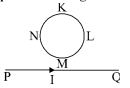
What will be the magnitude of induced current in circular loop KLMN of radius $r$ if constant current of $1 A$ is passed in straight wire $P Q$ ?
Image
Show graphically, the variation of the de-Broglie wavelength (λ) with the potential (V) through which an electron is accelerated from rest.
What is the direction of magnetic field at a point due to a long and straight current carrying conductor?
What will be the change in the force acting on a point charge placed on its axis if its distance is doubled?
Magnetic scalar potential is defined as$\text{U}(\overrightarrow{\text{r}_2})-\text{U}(\overrightarrow{\text{r}_1})=-\int\limits^{\vec{\text{r}}_2}_{\vec{\text{r}_1}} \vec{\text{B}}.\text{d}\vec{\text{l}}.$
Apply this equation to a closed curve enclosing a long atraicht wire. The RHS of the above equation is then $-{\mu}_\text{o} \text{ i}$ by Ampere's law. We see that $\text{U}(\vec{\text{r}_2})\neq\text{U}(\vec{\text{r}_1})$ even when $\vec{\text{r}_2}=\vec{\text{r}_1}.$Can we have a magnetic acalar potential in this case?
Consider a small surface area of $1mm^2$ at the top of a mercury drop of radius 4.0mm. Find the force exerted on this area:
  1. By the air above it.
  2. By the mercury below it and.
  3. By the mercury surface in contact with it. Atmospheric pressure $= 1.0 × 10^5$Pa and surface tension of mercury = 0.465N/m. Neglect the effect of gravity. Assume all numbers to be exact.